8 Best Index Funds In India For 2026: Low-Cost Direct Plans
Shlok Sobti
8 Best Index Funds In India For 2026: Low-Cost Direct Plans
Index funds have quietly become the go-to choice for Indian investors who want market returns without the headache of stock picking. With expense ratios as low as 0.1%, these passive funds let your money work harder by cutting out unnecessary costs. If you're searching for the best index funds in India, you're already thinking like a smart investor, one who values simplicity and long-term wealth building over chasing hot tips.
But here's the challenge: not all index funds are created equal. Some track the Nifty 50, others follow the Sensex, and a few target mid-cap or sector-specific indices. The differences in tracking error, expense ratios, and fund house reputation can significantly impact your returns over time. Choosing the right one requires clear, unbiased information, exactly what we provide at Invsify through our AI-powered advisory platform as a SEBI Registered Investment Advisor.
This guide breaks down 8 top-performing index funds for 2026, comparing their costs, historical performance, and the indices they track. Whether you're just starting out or rebalancing an existing portfolio, you'll find actionable picks backed by data, not sales commissions.
1. Invsify
Invsify operates as a SEBI Registered Investment Advisor that combines AI technology with human expertise to help you navigate India's investment landscape. Unlike traditional brokers or distributors who earn commissions from fund houses, we charge transparent fees and recommend only direct plans that save you thousands in hidden costs over time. Our platform analyzes your financial goals, risk profile, and current portfolio to suggest the best index funds in India tailored to your specific situation.
What it is
Invsify is an AI-powered wealth advisory platform designed for Indian salaried professionals who want conflict-free investment advice. You get access to a conversational AI assistant that answers your questions in multiple languages, tracks your portfolio in real-time, and sends daily audio snippets on market developments. The platform calculates your personalized Wealth Wellness Score based on dozens of financial parameters, giving you a clear picture of where you stand and where you need to improve.
What it helps you do for index fund selection
The platform simplifies index fund selection by analyzing expense ratios, tracking errors, and historical returns across hundreds of schemes. You receive AI-driven recommendations that match your investment horizon, whether you're building a core Nifty 50 allocation or adding mid-cap exposure through specialized index funds. Our system filters out underperforming funds and highlights direct plans that maximize your net returns, eliminating the guesswork that often leads to suboptimal choices.
"Traditional distributors pocket up to 1.5% annually through commissions, money that should compound in your portfolio instead."
Costs to expect and how fees work
Invsify charges a transparent advisory fee starting at ₹999 per month for comprehensive wealth management services. This includes unlimited access to our AI chatbot, weekly personalized insights, portfolio rebalancing alerts, and 30-second callback support when you need human intervention. You pay no commissions on investments, no hidden charges, and no transaction fees beyond what your fund house or broker charges directly.
Who should use it
You'll benefit most from Invsify if you're a salaried professional tired of relying on Reddit threads or commission-driven advisors for investment decisions. The platform suits both beginners building their first index fund portfolio and experienced investors managing multiple crores who want unbiased advice backed by data. If you value transparency, hate paying unnecessary fees, and want 24/7 access to reliable financial guidance, this service aligns with your priorities.
How to use it to build an index fund shortlist
Start by completing the digital KYC process and risk profiling questionnaire on our platform. Share your existing portfolio details, investment goals, and time horizon with the AI assistant through the conversational interface. Within minutes, you receive a customized shortlist of index funds ranked by their suitability to your profile, complete with expense ratio comparisons and expected return projections. You can then drill down into each fund's details, compare tracking errors, and execute investments through our partner platforms with one-click simplicity.

2. UTI Nifty 50 Index Fund Direct and SBI Nifty Index Fund Direct
These two funds represent the oldest and most established Nifty 50 index offerings in India, with UTI launching its scheme in 2000 and SBI following shortly after. Both funds track the same benchmark, meaning they hold identical stocks in identical proportions, yet subtle differences in execution and fund house efficiency create performance variations you need to understand before investing.
What these funds are
UTI Nifty 50 Index Fund Direct and SBI Nifty Index Fund Direct are passive equity schemes that replicate the Nifty 50 index by investing in all 50 constituent stocks. You get exposure to India's largest companies across sectors like IT, banking, energy, and pharmaceuticals through a single investment. The direct plans eliminate distributor commissions, putting extra returns directly into your pocket compared to regular plans offered through brokers.
Index exposure and diversification
Both funds provide identical exposure to India's top 50 companies by market capitalization, including giants like Reliance Industries, HDFC Bank, Infosys, and TCS. Your investment spreads across multiple sectors with financial services typically forming the largest allocation at around 35-40%. This concentration in large-cap stocks reduces volatility compared to mid-cap or small-cap investments but limits growth potential during bull markets when smaller companies outperform.
Costs and tracking quality
UTI charges an expense ratio of 0.10% on its direct plan, while SBI's direct plan comes in at approximately 0.12%. These minimal costs translate to more money compounding in your favor over decades. Tracking error, which measures how closely the fund mirrors the index, typically stays below 0.5% for both schemes, though UTI historically shows marginally tighter tracking based on five-year data.
"A 0.02% difference in expense ratio might seem trivial, but it compounds to lakhs saved over a 20-year investment horizon."
Who should choose one of these
You should consider these funds if you want proven track records from established fund houses managing Nifty 50 exposure. First-time investors building core portfolio allocations benefit from their reliability, while experienced investors use them as foundational holdings before adding mid-cap or sector-specific index funds. Choose UTI if tracking precision matters most to you, or SBI if you prefer their broader banking relationship and digital ecosystem.
How to invest in the direct plan
You can invest through the fund houses' websites directly or use platforms like Zerodha Coin, Groww, or Kuvera that offer zero-commission access to direct plans. Complete your KYC verification through any SEBI-registered intermediary, then set up a monthly SIP starting from ₹500 or make lump-sum investments based on your cash flow. Link your bank account for auto-debit convenience and enable dividend reinvestment to maximize compounding benefits.
3. Navi Nifty 50 Index Fund Direct and ICICI Prudential Nifty 50 Index Fund Direct
Navi Mutual Fund entered the index fund space as a digital-first player focused on ultra-low costs, while ICICI Prudential brings decades of fund management experience to its Nifty 50 offering. Both schemes track the same benchmark but differ significantly in their operational approaches and cost structures, giving you distinct options based on your priorities.
What these funds are
Navi Nifty 50 Index Fund Direct represents a newer entry launched by Navi Mutual Fund with aggressive pricing designed to undercut competitors. ICICI Prudential Nifty 50 Index Fund Direct comes from one of India's largest fund houses with extensive infrastructure and investor servicing capabilities. Both funds passively replicate the Nifty 50 index by holding all constituent stocks in proportion to their market capitalization weights.
Index exposure and diversification
Your investment in either fund spreads across the same 50 blue-chip companies that dominate Indian markets. The portfolio automatically adjusts when index constituents change during quarterly rebalancing, maintaining exposure to sectors like financial services, IT, energy, and consumer goods. This identical underlying allocation means performance differences arise purely from execution efficiency rather than stock selection.
Costs and tracking quality
Navi charges an expense ratio of 0.06% on its direct plan, making it among the cheapest index funds available in India. ICICI Prudential's direct plan costs approximately 0.19%, reflecting higher operational expenses from its established infrastructure. Tracking errors hover around 0.3% for Navi and 0.5% for ICICI, both acceptable ranges that preserve most index returns.
"The 0.13% expense ratio difference between these funds compounds to significant savings over multi-decade investment periods."
Who should choose one of these
You should pick Navi if absolute minimum costs drive your selection criteria and you're comfortable with a relatively newer fund house. ICICI Prudential suits investors who value brand reputation and extensive customer support networks, especially if you already maintain other relationships with the ICICI group. First-time investors often prefer ICICI's proven track record despite the higher expense ratio.
How to invest in the direct plan
Both funds accept investments through their respective websites, mobile apps, and third-party platforms like Zerodha or Groww. Complete your one-time KYC through any registered intermediary, then start SIPs from ₹100 for Navi or ₹500 for ICICI. Link your bank account for automated monthly debits and choose growth options to maximize compounding benefits without tax inefficiencies from dividend distributions.
4. HDFC Nifty Next 50 Index Fund Direct
HDFC Mutual Fund's Nifty Next 50 offering targets the 51st to 100th largest companies by market capitalization, providing exposure to businesses positioned just below the mega-cap tier. This fund captures companies on their growth trajectory before they potentially enter the Nifty 50, giving you access to India's emerging blue-chip stocks at an earlier stage than traditional large-cap index funds.
What this fund is
HDFC Nifty Next 50 Index Fund Direct is a passive equity scheme that replicates the Nifty Next 50 index by investing in 50 companies ranked immediately after the Nifty 50 constituents. You gain exposure to established mid-to-large cap businesses that demonstrate strong fundamentals but haven't yet reached the top tier. The direct plan eliminates distributor commissions, putting those savings directly into your investment returns.
Index exposure and diversification
Your investment spreads across 50 companies spanning sectors like consumer goods, pharmaceuticals, cement, metals, and diversified financials. Unlike Nifty 50 funds that concentrate heavily in financial services and IT, this index offers better sector balance with no single industry dominating more than 20% of the portfolio. Companies like Adani Enterprises, Grasim Industries, and Avenue Supermarts typically appear in this index, representing future market leaders rather than current ones.
Costs and tracking quality
HDFC charges an expense ratio of 0.40% on the direct plan, higher than Nifty 50 funds but justified by the additional complexity of managing less liquid stocks. Tracking error typically stays around 0.6-0.8%, slightly elevated compared to large-cap index funds due to occasional liquidity challenges when rebalancing holdings.
"The Nifty Next 50 historically delivers higher volatility but stronger long-term returns compared to the Nifty 50 during bull market phases."
Who should choose it
You should consider this fund if you already hold core Nifty 50 exposure and want to add a growth component without venturing into pure mid-cap territory. Investors with 10+ year horizons benefit most from the higher growth potential these emerging leaders offer. This fund works well as 20-30% of your equity allocation alongside large-cap index holdings.
How to invest in the direct plan
You can invest through HDFC Mutual Fund's website, mobile app, or platforms like Zerodha and Groww that provide commission-free access to direct plans. Start SIPs from ₹500 monthly or make lump-sum investments based on your available capital. Complete digital KYC through any registered intermediary and link your bank account for automated monthly debits.
5. Motilal Oswal Nifty Midcap 150 Index Fund Direct
Motilal Oswal's Nifty Midcap 150 offering gives you access to India's fastest-growing companies in the mid-cap segment through a single passive investment. This fund tracks businesses that have moved beyond small-cap unpredictability but haven't yet reached the stability and lower growth rates of large-cap stocks, making it a strategic addition when you're searching for the best index funds in India beyond traditional large-cap options.
What this fund is
Motilal Oswal Nifty Midcap 150 Index Fund Direct is a passive equity scheme that replicates the Nifty Midcap 150 index by investing in 150 mid-cap companies ranked by market capitalization. You capture exposure to established businesses with proven business models and strong market positions in their respective sectors.
Index exposure and diversification
Your investment spreads across 150 companies covering diverse sectors like industrials, consumer goods, chemicals, pharmaceuticals, and capital goods. This broader diversification compared to large-cap indices reduces single-stock risk while maintaining the higher growth potential characteristic of mid-cap businesses. No single company dominates more than 3-4% of the portfolio, creating balanced sector exposure.
Costs and tracking quality
The direct plan charges an expense ratio of 0.25%, reasonable for a mid-cap index fund given the additional complexity of managing less liquid stocks. Tracking error typically ranges from 0.8-1.0%, reflecting occasional challenges in rebalancing holdings when constituent stocks experience sharp price movements.
"Mid-cap index funds historically deliver higher returns than large-cap indices over 10+ year periods, compensating for their increased volatility."
Who should choose it
You should consider this fund if you already maintain core large-cap exposure through Nifty 50 or Sensex index funds and want to add growth potential. Investors with 15+ year horizons benefit most from mid-cap volatility, which smooths out over extended periods while capturing superior returns during economic expansion phases.
How to invest in the direct plan
You can invest through Motilal Oswal's website, mobile app, or platforms like Zerodha and Groww offering zero-commission access. Start SIPs from ₹500 monthly after completing digital KYC verification.
6. ICICI Prudential Nifty 500 Index Fund Direct
ICICI Prudential's Nifty 500 offering provides the broadest market exposure among all index funds covered in this guide, capturing large-cap, mid-cap, and small-cap stocks through a single investment. This fund replicates the entire investable universe of Indian equities, making it one of the best index funds in India for investors seeking complete market participation without the need to allocate separately across market capitalizations.
What this fund is
ICICI Prudential Nifty 500 Index Fund Direct is a passive equity scheme that tracks the Nifty 500 index by investing in 500 companies spanning the entire market capitalization spectrum. You get exposure to approximately 95% of India's free-float market capitalization through this single fund, eliminating the need to manage multiple index holdings.
Index exposure and diversification
Your investment spreads across 500 companies covering every major sector and market cap category, with large-caps forming roughly 60-65%, mid-caps 25-30%, and small-caps 5-10% of the portfolio. This automatic rebalancing across market segments ensures you capture growth wherever it emerges without making tactical allocation decisions yourself.
Costs and tracking quality
The direct plan charges an expense ratio of 0.18%, remarkably low given the complexity of managing 500 stocks across different liquidity profiles. Tracking error typically ranges from 0.5-0.7%, reflecting the challenges of rebalancing such a broad portfolio while maintaining tight alignment with the benchmark.
"A Nifty 500 index fund essentially replaces the need for separate large-cap, mid-cap, and small-cap allocations through one streamlined holding."
Who should choose it
You should consider this fund if you want maximum diversification without managing multiple index holdings. Investors with 15+ year horizons benefit from capturing growth across all market segments while accepting the higher volatility that comes from small-cap exposure.
How to invest in the direct plan
You can invest through ICICI Prudential's website, mobile app, or platforms like Zerodha offering commission-free access. Start SIPs from ₹500 monthly after completing your digital KYC verification.
7. ICICI Prudential BSE Sensex Index Fund Direct
ICICI Prudential's Sensex offering tracks India's oldest and most recognized equity benchmark, the BSE Sensex, which consists of 30 blue-chip companies listed on the Bombay Stock Exchange. This fund provides concentrated exposure to India's most established businesses across sectors, making it a popular choice among investors seeking stability and name recognition in their portfolio. The Sensex's smaller constituent count compared to the Nifty 50 creates a more focused portfolio that some investors prefer for core holdings.
What this fund is
ICICI Prudential BSE Sensex Index Fund Direct is a passive equity scheme that replicates the BSE Sensex by investing in all 30 constituent stocks. You gain exposure to companies like Reliance Industries, TCS, HDFC Bank, and Infosys through a single investment vehicle that automatically rebalances as the index composition changes.
Index exposure and diversification
Your investment concentrates in just 30 of India's largest companies, creating less diversification than Nifty 50 or broader index funds. Financial services typically form 35-40% of the portfolio, followed by IT, energy, and consumer goods sectors. This concentrated approach amplifies both positive and negative performance from individual stock movements compared to broader indices.
Costs and tracking quality
The direct plan charges an expense ratio of 0.18%, competitive within the large-cap index fund category. Tracking error typically stays below 0.5%, reflecting ICICI Prudential's execution efficiency despite the fund's relatively smaller asset base compared to their Nifty 50 offering.
"The Sensex's 30-stock composition makes it easier to understand and track compared to broader indices with hundreds of constituents."
Who should choose it
You should consider this fund if you prefer the historical prestige of the Sensex benchmark over the Nifty 50, or if you want more concentrated exposure to India's absolute blue-chip tier. Investors who already hold mid-cap or small-cap allocations benefit from the stability this fund provides as a core holding.
How to invest in the direct plan
You can invest through ICICI Prudential's website, mobile app, or platforms like Zerodha and Groww offering zero-commission access. Start SIPs from ₹500 monthly after completing your digital KYC verification and linking your bank account for automated debits.
Your shortlist in 10 minutes
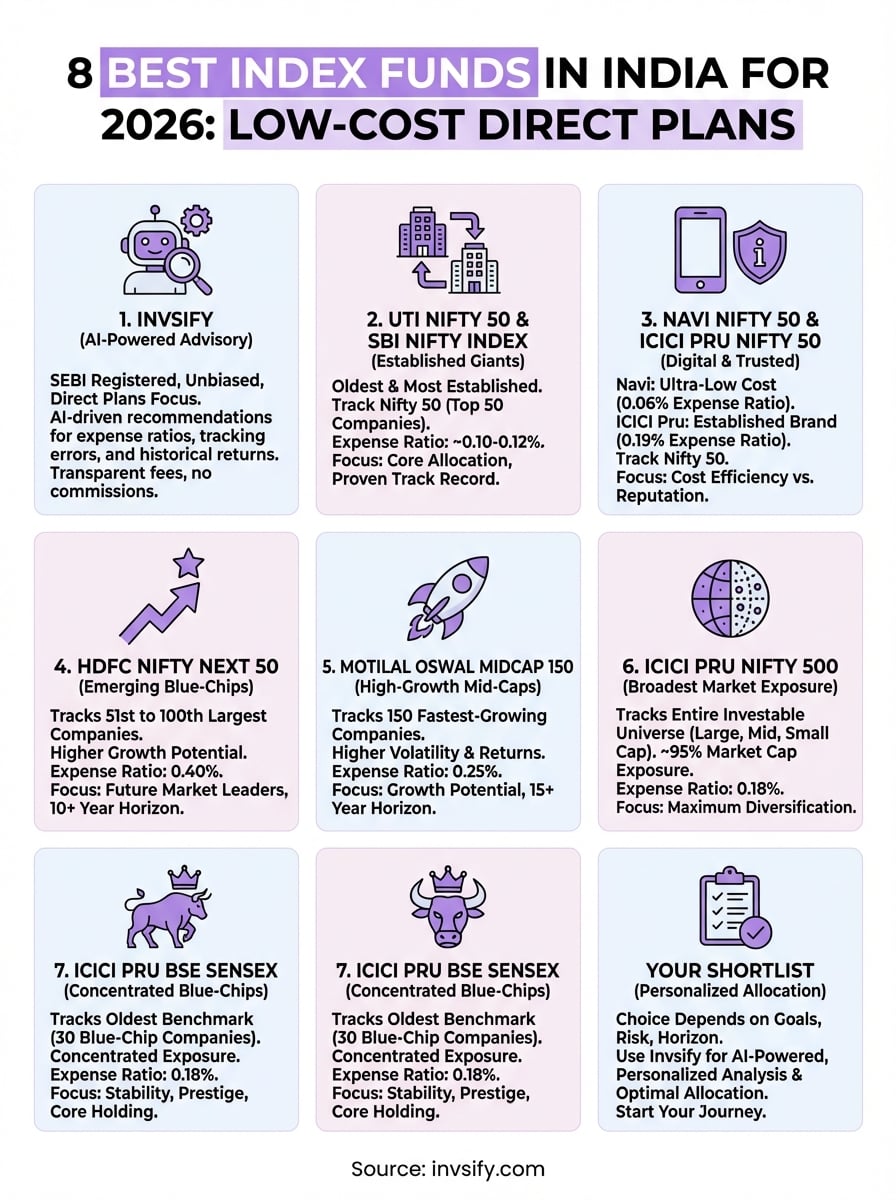
You now have eight solid options covering Nifty 50, Next 50, Midcap 150, Nifty 500, and Sensex exposure through direct plans that eliminate distributor commissions. Each fund serves a specific role, from UTI and SBI's proven large-cap stability to Motilal Oswal's mid-cap growth potential. The best index funds in India for your portfolio depend on your age, risk capacity, and existing holdings rather than any universal ranking.
Building your actual shortlist requires matching these options against your financial situation. You need to know whether you should prioritize ultra-low costs like Navi's 0.06% expense ratio or broader diversification through ICICI's Nifty 500 offering. Start your personalized portfolio analysis at Invsify to get AI-powered recommendations that consider your complete financial picture, not just generic fund rankings. Our platform analyzes your goals, risk profile, and current investments to suggest the optimal index fund allocation in under 10 minutes, saving you hours of research and thousands in hidden fees over your investment journey.