Financial Literacy For Women In India: Stats And Steps 2026
Shlok Sobti

Financial Literacy For Women In India: Stats And Steps 2026
Women in India control a growing share of household savings, yet most are locked out of the decisions about where that money goes. Financial literacy for women in India remains alarmingly low, and the gap isn't closing fast enough. According to recent data, fewer than 25% of Indian women are financially literate, compared to roughly 27% of men. That gap might look small on paper, but its real-world consequences are enormous: lower investment participation, higher dependence on others for money decisions, and missed opportunities for wealth creation.
This article breaks down the current state of women's financial awareness in India with updated 2026 statistics, explains why it matters beyond just personal finance, and outlines practical steps women can take to build real financial independence, from understanding mutual funds to using AI-driven advisory tools.
At Invsify, we see this gap up close. As a SEBI Registered Investment Advisor, we built our AI-powered platform specifically to make smart, conflict-free financial advice accessible to everyone, including the millions of women who've been underserved by traditional financial advisory models. What follows is a data-backed, honest look at where things stand and what can actually move the needle.
Why financial literacy matters for women in India
Financial literacy for women in India isn't just about knowing how to read a bank statement. It determines whether you control your own financial future or depend on someone else to make those calls for you. When women lack basic money skills, the consequences reach beyond personal savings: they affect family resilience, children's education outcomes, and community-level economic stability. The stakes are high, and the benefits of getting this right compound over time, just like a well-managed investment portfolio.
The link between financial knowledge and personal independence
When you understand how money works, you make better decisions under pressure. A woman who knows the difference between a fixed deposit and a mutual fund, or who understands how inflation erodes idle cash, isn't just financially smarter. She is harder to exploit. Research consistently shows that financially literate women are more likely to save independently, negotiate their salaries, and plan for retirement without relying on a spouse or a family member.
Financial knowledge is one of the few assets that no one can take from you once you have it.
That independence isn't selfish; it's protective. It shields you from financial abuse, sudden job loss, divorce, or the loss of a breadwinner. When you control your own finances, you also model that behavior for your children, which breaks cycles of financial exclusion across generations.
Why women face unique financial barriers in India
India's social structure creates specific challenges for women that men simply don't face at the same scale. Career breaks for caregiving are common, and they directly interrupt income, provident fund contributions, and retirement savings. Many women also enter marriage with limited visibility into household finances, even when they earn. Cultural norms in many parts of the country still treat money decisions as a male domain, which means women are often excluded from conversations about mutual funds, insurance, and property investments until it's too late.
Add to that the lower average income and you get a compounding disadvantage: less money coming in, less of it invested wisely, and less buffer when something goes wrong. These barriers aren't insurmountable, but understanding them is the starting point for changing your own situation and for demanding that financial institutions design products that actually work for Indian women.
Where India stands in 2026: key stats and gaps
The numbers behind financial literacy for women in India are sobering. India ranked 7th from the bottom in the S&P Global Financial Literacy Survey, with overall financial literacy sitting at just 24%. Women consistently score lower than men across every region, income group, and age bracket surveyed. These aren't abstract statistics: they reflect real gaps in how millions of women manage debt, plan for retirement, and respond to financial emergencies.
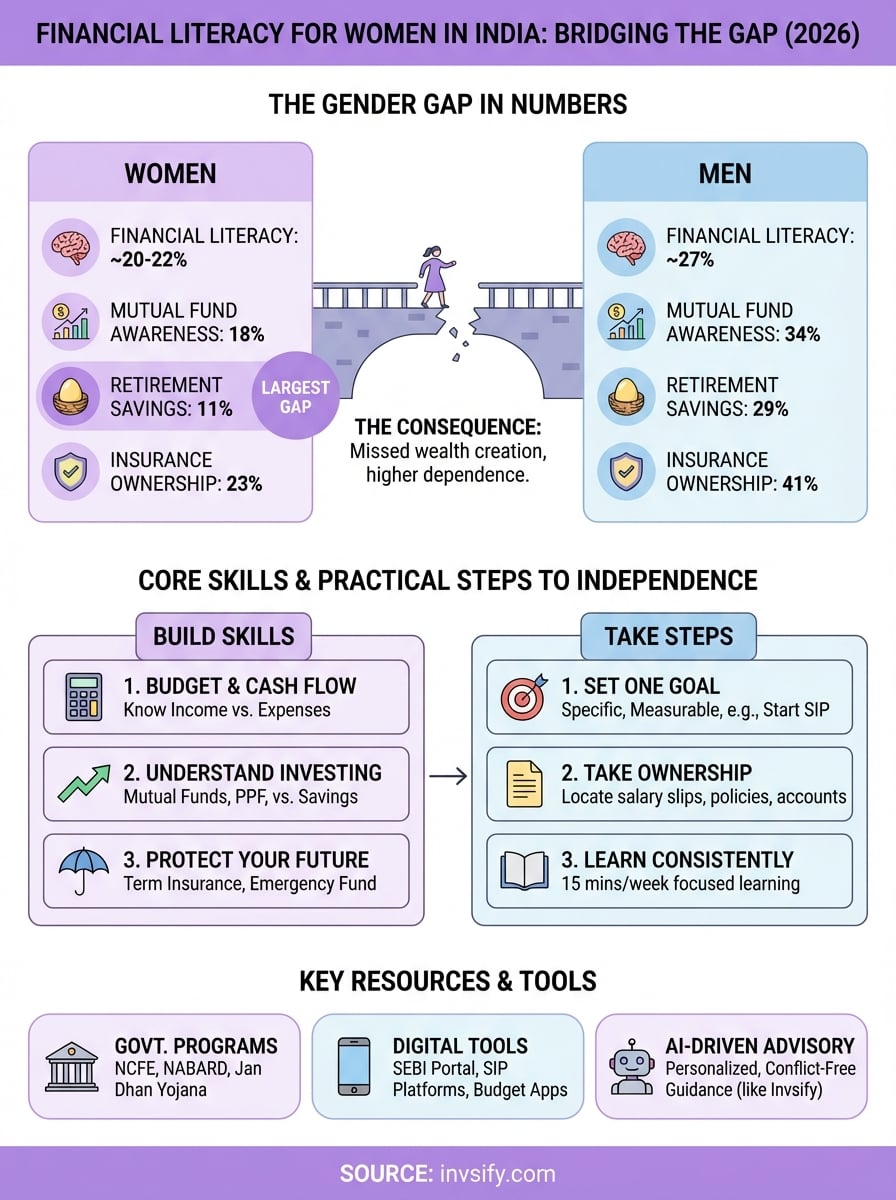
The financial literacy gender gap in numbers
The data points below show where the gaps are measurable and why they matter for your financial planning decisions:
Metric | Women | Men |
|---|---|---|
Financial literacy rate (India) | ~20-22% | ~27% |
Awareness of mutual funds | 18% | 34% |
Retirement savings participation | 11% | 29% |
Insurance ownership | 23% | 41% |
The retirement savings gap is the most dangerous of these, because it compounds silently over decades until it becomes a crisis with no easy fix.
Where the gaps are sharpest
Rural women face the steepest disadvantage. Access to banks, smartphones, and formal credit remains limited in tier-3 cities and villages, which means financial products that work fine in Mumbai simply don't reach a large portion of Indian women. Even digital financial tools struggle to close this gap when basic internet access isn't consistent.
Urban women face a different set of gaps: higher income but lower investment participation. Many salaried women in metro cities keep money in savings accounts or fixed deposits, unaware of the long-term wealth cost of avoiding equity investments entirely.
What women need to know: core money skills
Financial literacy for women in India starts with a manageable set of skills, not an economics degree. Most women who feel overwhelmed by money decisions are missing a few foundational concepts that, once understood, make everything else click into place. You don't need to master every financial product on the market; you need to understand the ones that directly affect your savings, your protection, and your long-term wealth.
Budgeting and understanding cash flow
Knowing where your money goes each month is the foundation everything else builds on. You need to track your income against your expenses and identify where money leaks out without intention. A simple system, whether a spreadsheet or an app, can reveal patterns that are invisible when you pay bills on autopilot. Most women who start this process discover three to five spending categories they can immediately reduce without affecting their quality of life.

Here are the three numbers every woman should know at all times:
Net monthly income after tax and deductions
Fixed expenses like rent, EMIs, and insurance premiums
Discretionary spending that can flex based on your goals
Investing basics: beyond the savings account
Keeping all your money in a savings account feels safe, but inflation silently erodes its real value every year. You need to understand at least three investment vehicles: mutual funds for long-term wealth building, Public Provident Fund (PPF) for tax-efficient savings, and term insurance to protect your income. Index funds, in particular, give you broad market exposure without requiring you to pick individual stocks or time the market.
The gap between earning money and growing money comes down to knowledge, and that knowledge is genuinely learnable by anyone willing to start.
Steps to build financial confidence and independence
Building financial confidence isn't a single event; it's a sequence of deliberate actions that compound over time. Financial literacy for women in India improves fastest when you move from passive awareness to active decisions, even small ones. The steps below give you a concrete path forward, regardless of where you're starting from.
Start with one financial goal
The biggest mistake most people make is trying to fix everything at once. Pick one clear financial goal for the next 12 months, whether that's building an emergency fund of three months' expenses or starting a monthly SIP of ₹500. Specificity matters: a goal with a number and a deadline is far more likely to happen than a vague intention to "save more." Once you hit that first goal, the next one becomes significantly easier to commit to.
Take ownership of your documents
Most women don't know where their key financial documents are stored or what they contain. Locate and review your salary slips, bank statements, insurance policies, and any investment account records you have access to. Knowing what you own and what you owe is the foundation for every serious financial decision you'll make going forward.
Awareness precedes action: you cannot optimize what you haven't yet examined.
Build your knowledge in small, consistent steps
You don't need dense financial textbooks to make progress. Commit to 15 minutes per week of focused financial learning using credible sources. Track what you learn and apply at least one insight per month to your actual financial behavior, whether that's adjusting a spending habit, increasing a SIP amount, or reviewing your insurance coverage.
Programs and tools that can help in India
Access to reliable programs and tools has expanded significantly in recent years, giving Indian women more entry points into financial education than ever before. The challenge isn't scarcity of resources anymore; it's knowing which ones are worth your time and which ones will actually shift your behavior around money.
Government-backed programs worth knowing
The Indian government runs several initiatives directly relevant to financial literacy for women in India. The National Centre for Financial Education (NCFE), under SEBI, offers free learning resources designed for first-time investors. NABARD runs financial literacy camps specifically targeting rural women, covering basics like bank account management, insurance, and savings habits. The Jan Dhan Yojana gave millions of women access to formal banking for the first time, which remains the foundation for every other financial step.
The most impactful government programs focus on access first, because you cannot build financial habits around tools you've never used.
These programs are freely available, but they require you to actively seek them out rather than wait for them to come to you.
Digital tools for everyday money management
Several easy-to-use platforms make tracking and investing straightforward, even if you're starting from zero. SEBI's investor education portal offers free modules in multiple languages. For investing, registered platforms allow you to start a systematic investment plan (SIP) with as little as ₹100 per month, removing the barrier of needing a large lump sum. Pairing a basic budgeting app with a SEBI-registered advisor gives you both the visibility and the guidance needed to make consistent progress without guesswork.
A practical way forward
Financial literacy for women in India improves one decision at a time, not through overnight transformation. You now have the statistics, the core skills, and the specific steps to start building real financial confidence. The gap is real, but so is your ability to close it on your own terms.
Start with the actions that are immediately within your control: know your net income, open an investment account, and pick one financial goal with a clear deadline. Every week you delay costs you compounding returns you cannot recover later. Consistency beats perfection every single time, and the best financial plan is the one you actually follow through on.
If you want personalized, conflict-free investment guidance backed by AI and SEBI-registered expertise, Invsify is built for exactly this. Start your financial journey with Invsify and get advice that works for your goals, not someone else's commission.