Groww Mutual Fund Calculator: Guide to Estimating Returns
Shlok Sobti

Groww Mutual Fund Calculator: Guide to Estimating Returns
You want to invest in mutual funds but need to know what your money might grow into. Whether you plan to invest ₹5,000 monthly through a SIP or put in a lumpsum amount, seeing potential returns helps you make smarter decisions. The Groww mutual fund calculator gives you these numbers quickly, showing exactly how your investments might perform over time.
This free online tool does the math for you. You enter your investment amount, choose your time horizon, and set an expected return rate. Within seconds, you get an estimate of your total corpus and the returns you might earn. No complex formulas or spreadsheets needed.
This guide walks you through using Groww's calculator step by step. You'll learn how to select between SIP and lumpsum options, input the right numbers, set realistic return expectations, and interpret your results. By the end, you'll know exactly how to use this tool to plan your mutual fund investments with confidence.
Why estimate returns before investing
You need clear numbers before putting your money into any mutual fund. Estimating returns helps you understand whether a ₹5,000 monthly SIP or a ₹1 lakh lumpsum makes more sense for your goals. When you use the groww mutual fund calculator, you get exact figures that show how much your investment might grow in 5, 10, or 15 years. This removes guesswork and lets you plan your financial future with actual data.
Compare different investment scenarios
Running multiple calculations shows you which approach works best for your situation. You can compare a SIP of ₹3,000 for 20 years against a lumpsum of ₹5 lakhs for 10 years to see which generates more wealth. The calculator displays both scenarios side by side, making it easy to spot the better option.

Testing different return rates also reveals what happens in various market conditions. Your 12% annual return gives different results than an 8% conservative estimate or a 15% aggressive projection. You see the best-case and worst-case outcomes before investing a single rupee.
Comparing multiple scenarios helps you choose the investment strategy that matches both your risk appetite and timeline.
Set realistic financial goals
Calculating estimated returns connects your investments to specific life goals. If you need ₹50 lakhs for your child's education in 15 years, the calculator tells you exactly how much to invest monthly. You might find that a ₹10,000 monthly SIP at 12% returns reaches your target, while ₹7,000 monthly falls short. This clarity helps you plan the right investment amount from day one.
You can also adjust your strategy when goals change. Perhaps you initially planned for ₹30 lakhs but realize you need ₹40 lakhs instead. The calculator shows whether you should increase your monthly SIP amount or extend your investment horizon to bridge that gap.
Avoid emotional investment decisions
Numbers prevent you from making impulsive choices based on market noise. When markets crash and everyone panics, your pre-calculated projections remind you why you started investing. You know that your ₹5,000 monthly SIP over 20 years should still reach your target, even with temporary dips.
Estimated returns also stop you from chasing unrealistic gains. If someone promises 25% annual returns, you can check whether similar funds historically delivered such results. The calculator grounds your expectations in reality, protecting you from schemes that sound too good to be true. You make decisions based on realistic return rates rather than emotional reactions or peer pressure.
Step 1. Select the investment type
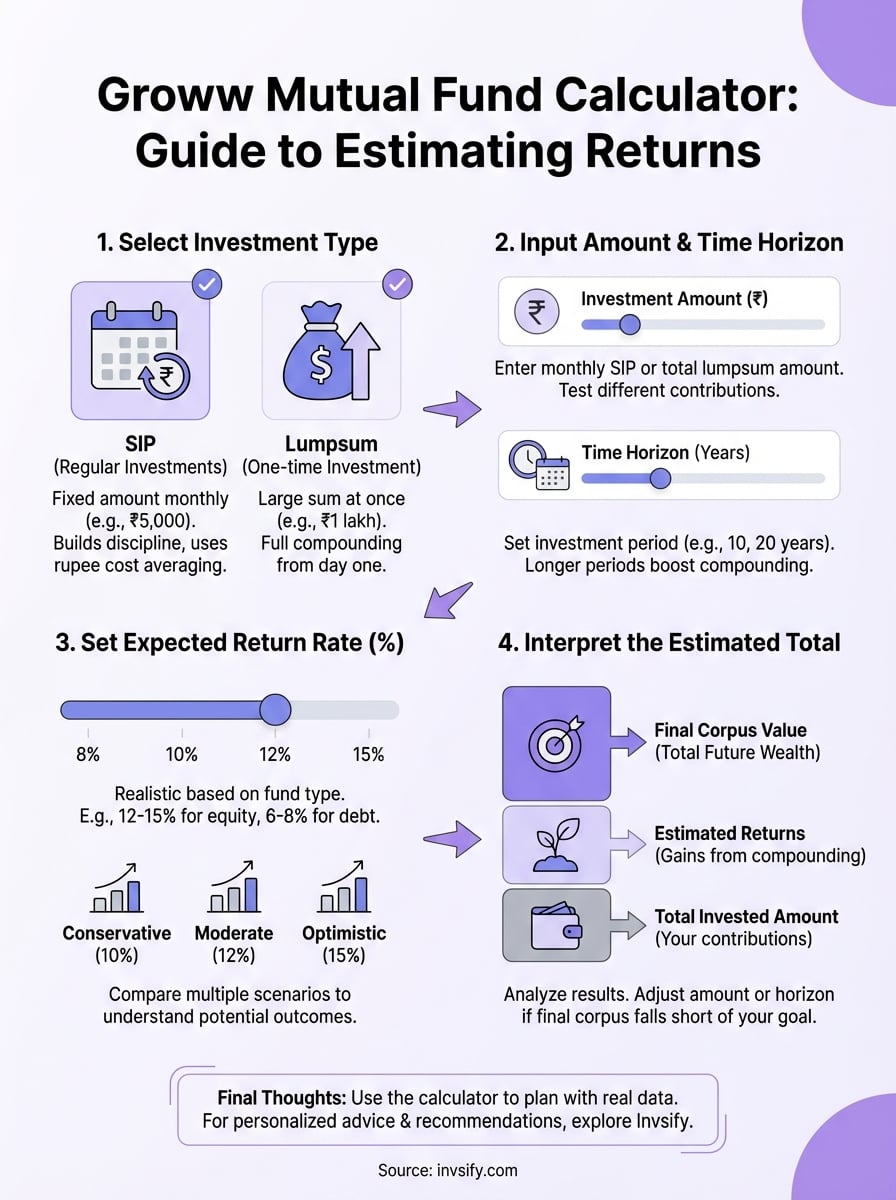
The first thing you see when opening the groww mutual fund calculator is the choice between SIP and Lumpsum. This selection determines how the calculator processes your numbers and shows your projected returns. You need to pick the option that matches your actual investment plan. If you invest a fixed amount every month, select SIP. If you have a large sum ready to invest at once, choose lumpsum. Your selection changes the entire calculation structure, so getting this right matters from the start.
Choose SIP for regular investments
Select the SIP option when you plan to invest a fixed amount at regular intervals. This works perfectly if you get a monthly salary and want to set aside ₹2,000, ₹5,000, or any other amount each month. The calculator then shows how these regular contributions grow over time with the power of compounding.
Your SIP investment builds discipline because you invest regardless of market conditions. When you select this option, you commit to contributing the same amount monthly. For example, if you choose ₹3,000 monthly for 15 years at 12% returns, the calculator shows your total investment of ₹5.4 lakhs growing to approximately ₹15 lakhs. The SIP mode also factors in rupee cost averaging, which means you buy more units when prices are low and fewer when prices are high.
SIP works best when you have steady income and want to invest without timing the market.
Choose lumpsum for one-time investments
Pick the lumpsum option when you have a large amount available right now. This applies when you receive a bonus, inheritance, sale proceeds from property, or any windfall. The calculator treats this as a single investment that grows at your expected return rate for the chosen period.
Lumpsum investments suit you when market conditions look favorable or when you have idle cash that needs to work harder. If you invest ₹10 lakhs today at 12% annual returns for 10 years, the calculator shows this growing to approximately ₹31 lakhs. The entire principal amount starts earning returns immediately, unlike SIP where your money enters the market gradually. You get the full benefit of compounding from day one, making lumpsum powerful during market corrections when prices are low.
Step 2. Input amount and time horizon
After selecting your investment type, you enter two critical numbers that determine your projected returns. The investment amount tells the calculator how much money you plan to invest, while the time horizon sets how long your money stays invested. These inputs work together to show your potential wealth accumulation. Getting accurate numbers here ensures your calculations match your actual investment capacity and goals.
Enter your investment amount
Type the exact monthly contribution you plan to make if you selected SIP. Start with an amount that fits your budget without straining your finances. If you earn ₹50,000 monthly, you might input ₹5,000 or ₹10,000 depending on your expenses and other commitments. The groww mutual fund calculator accepts any amount, so you can test different scenarios like ₹2,000, ₹7,500, or ₹15,000 to see what works best for your target corpus.
For lumpsum investments, enter the total amount you have available right now. This could be ₹1 lakh, ₹5 lakhs, or ₹25 lakhs depending on your savings or windfall. The calculator processes this single amount and shows how it compounds over your chosen period. You can experiment with different lumpsum amounts to understand how much you need to invest today to reach specific goals in the future.
Testing multiple investment amounts helps you find the right balance between your current financial capacity and future wealth goals.
Define your investment period
Select how many years you plan to stay invested. Your time horizon depends on when you need the money. If you save for retirement in 25 years, input 25. For your child's college education in 12 years, enter 12. The calculator typically offers a slider or input field where you can set anywhere from 1 year to 40 years or more.
Longer periods generate significantly higher returns because compounding works better over time. An ₹8,000 monthly SIP at 12% returns for 10 years gives you approximately ₹18.4 lakhs, but extend it to 20 years and you get around ₹79.6 lakhs. The extra decade more than quadruples your wealth. Choose a realistic timeline that aligns with your actual goal date, not an arbitrary number that looks good on paper.
Step 3. Set your expected return rate
You now set the annual return percentage you expect your investment to generate. This rate directly impacts your final corpus calculation in the groww mutual fund calculator. The slider typically ranges from 1% to 30%, but you need to pick a realistic number based on historical fund performance and your risk tolerance. Your choice here determines whether your projections match reality or create false expectations.
Understanding realistic return expectations
Most equity mutual funds have historically delivered 12% to 15% annual returns over long periods of 10 years or more. You can set 12% as a reasonable baseline for diversified equity funds, though actual returns fluctuate year to year. Conservative investors often use 10% to 11% to account for market downturns and build a safety margin into their calculations.

Debt funds deliver lower returns, typically 6% to 8% annually, because they invest in bonds and fixed-income securities rather than stocks. If you choose hybrid funds that mix equity and debt, expect returns somewhere between these ranges, usually 9% to 11%. You can check the historical returns of specific fund categories on the Groww platform before setting your rate. Past performance never guarantees future results, but it gives you a data-backed starting point for your estimates.
Setting conservative return rates protects you from disappointment and helps you plan more realistic investment amounts.
Adjusting rates for different market conditions
You should test multiple return scenarios to see how your corpus changes. Start with a conservative 10% estimate to see your minimum potential wealth. Then try a moderate 12% for average market conditions and an optimistic 15% for strong bull markets. This three-scenario approach shows your investment outcome range. For example, your ₹10,000 monthly SIP for 15 years generates approximately ₹41.7 lakhs at 10%, ₹50 lakhs at 12%, and ₹61.4 lakhs at 15%. The difference between conservative and optimistic scenarios helps you plan for uncertainties. You understand the best-case and worst-case outcomes before committing your money, making your investment decision more informed and confident.
Step 4. Interpret the estimated total
The groww mutual fund calculator displays your results immediately after you click calculate. You see three key numbers on your screen: your total invested amount, the estimated returns, and the final corpus value. Understanding what each number means helps you decide whether this investment strategy meets your financial goals. The calculator breaks down exactly how much money comes from your contributions versus how much comes from compounding returns.
Separate your investment from your gains
The calculator shows your total investment as the sum of all your contributions over the investment period. For a ₹5,000 monthly SIP over 15 years, this number reaches ₹9 lakhs because you contributed 5,000 × 12 months × 15 years. Your actual money goes into this bucket, representing every rupee you transferred from your bank account.
Next comes the estimated returns figure, which shows the wealth generated purely through compounding. Using the same example at 12% annual returns, your ₹9 lakhs investment generates approximately ₹13.5 lakhs in returns, bringing your total corpus to ₹22.5 lakhs. This return amount represents the profit your investment earned, separate from your original contributions. You can see exactly how much your money worked for you over the years.
The difference between total corpus and invested amount reveals the real power of compounding over long periods.
Make informed adjustments
Check whether your final corpus matches your target goal. If you need ₹30 lakhs but the calculator shows only ₹22.5 lakhs, you know immediately that your current strategy falls short. You then have three options: increase your monthly investment amount, extend your investment period, or target funds with potentially higher return rates. Try increasing your SIP to ₹7,000 monthly and recalculate to see if this closes the gap.
Compare the returns percentage against your total investment to gauge efficiency. In the example above, your ₹9 lakhs grew by 150% to reach ₹22.5 lakhs. This context helps you evaluate whether the effort and discipline required for regular investing justifies the outcome. You make smarter decisions when you understand both the absolute numbers and the relative growth of your wealth.
Final thoughts
You now know exactly how to use the groww mutual fund calculator to estimate your investment returns. You can select between SIP and lumpsum options, input your amounts and timelines, set realistic return rates, and interpret the results accurately. This tool removes guesswork from your investment planning and shows clear projections based on your specific numbers.
Running calculations before investing gives you the confidence to commit your money. You understand whether your monthly contributions or one-time investments will reach your financial goals. The calculator reveals gaps in your strategy early, letting you adjust amounts or timelines before starting your investment journey.
While calculators provide valuable estimates, getting personalized advice takes your planning further. Sign up with Invsify to receive AI-powered recommendations tailored to your financial situation, risk profile, and goals. You get conflict-free guidance that helps you choose the right funds and investment strategy for your wealth creation journey.