12 Best ICICI Prudential Mutual Fund Direct Plan Schemes
Shlok Sobti

12 Best ICICI Prudential Mutual Fund Direct Plan Schemes
ICICI Prudential is one of India's largest asset management companies, managing over ₹8 lakh crore in assets. If you're considering an ICICI Prudential mutual fund direct plan, you're already making a smart move, direct plans cut out distributor commissions, which means more of your money stays invested and compounds over time.
But here's where most investors get stuck: ICICI Prudential offers dozens of direct plan schemes across equity, debt, and hybrid categories. Picking the right ones based on your risk profile, investment horizon, and financial goals isn't straightforward. Performance data like NAV, trailing returns, and expense ratios all matter, and they need to be looked at together, not in isolation. That's exactly why we built Invsify, to give you AI-powered, conflict-free investment advice as a SEBI Registered Investment Advisor, so you can make decisions backed by data instead of guesswork.
In this article, we've shortlisted 12 of the best ICICI Prudential direct plan schemes across categories, broken down their performance metrics, and explained what makes each one worth considering. Whether you're a first-time investor exploring mutual funds or someone looking to optimize an existing portfolio, this list will help you narrow down your options and invest with more clarity.
1. ICICI Pru Balanced Advantage Fund direct plan
The ICICI Pru Balanced Advantage Fund is one of the most widely held funds in the balanced advantage (dynamic asset allocation) category in India. By choosing the direct plan, you cut out distributor commissions entirely, which can add up to meaningful gains in net returns over a 5-10 year horizon.
What the fund aims to do
This fund dynamically manages its equity and debt allocation based on prevailing market valuations. When equity markets look expensive on a price-to-book or price-to-earnings basis, the fund reduces equity exposure and shifts into debt or arbitrage. When valuations turn attractive, it moves back toward equities.
The fund's ability to self-adjust its equity-debt mix gives you built-in downside protection without requiring you to time the market yourself.
Portfolio mix and strategy
The fund uses an in-house valuation model to determine equity allocation at any point, with net equity exposure typically ranging between 30% and 80%. The remaining portion goes into debt instruments and arbitrage positions. Because gross equity exposure stays above 65%, the fund remains equity-taxed for tax purposes, which is a material advantage for most Indian investors.

When it fits a salaried investor
If you're a salaried professional with a moderate risk appetite and a 3-5 year investment horizon, this fund fits well. You don't need to actively rebalance your portfolio since the fund handles allocation internally. It works particularly well as a core portfolio holding if you're not sure whether to pick a pure equity or pure debt fund at current market levels.
Key risks and watchouts
The fund's defensive positioning during high-valuation markets can cause it to underperform pure equity funds in a prolonged bull run. The model-driven allocation also doesn't guarantee you won't see losses; it only aims to reduce their depth. Reviewing the fund's drawdown history during past corrections like 2020 and 2022 is worth doing before committing capital.
Costs, minimums, and how to invest
The direct plan expense ratio sits at approximately 0.40-0.55% (verify the current figure on AMFI's website before investing). The minimum SIP amount is ₹100, and the minimum lump sum investment is ₹5,000. You can invest directly through ICICI Prudential's official website or through a SEBI Registered Investment Advisor who can help you evaluate whether this fund suits your broader financial plan.
2. ICICI Pru Equity and Debt Fund direct plan
The ICICI Pru Equity and Debt Fund is an aggressive hybrid fund that holds a fixed, higher allocation toward equity compared to balanced advantage funds. Choosing the ICICI Prudential mutual fund direct plan variant here means you avoid distributor trail commissions year after year.
What the fund invests in
This fund typically allocates 65-80% to equities and the remaining 20-35% to debt instruments like corporate bonds and government securities. The equity portion focuses on large and mid-cap stocks across sectors, while the debt portion aims to add stability and income.
How returns get generated
Returns come from two engines: capital appreciation from the equity portion and interest income from the debt holdings. Because equity dominates the portfolio, returns move broadly in line with markets, but the debt cushion reduces the severity of drawdowns during corrections.
The debt allocation isn't just a buffer; it gives the fund manager dry powder to rebalance into equities when prices fall sharply.
Who this can suit
This fund suits moderately aggressive investors with a 5+ year horizon who want meaningful equity exposure but aren't comfortable with a 100% equity portfolio. It also works well for salaried investors who prefer a single fund handling both growth and stability rather than managing separate equity and debt funds.
Key risks and watchouts
Both equity market volatility and interest rate movements can affect this fund simultaneously. In rising rate environments, the debt portion can drag on overall returns.
Costs, minimums, and how to invest
The direct plan expense ratio is approximately 0.80-1.00%. The minimum SIP starts at ₹100, with a lump sum minimum of ₹5,000, and you can invest through ICICI Prudential's website directly.
3. ICICI Pru Large Cap Fund direct plan
The ICICI Pru Large Cap Fund invests primarily in the top 100 companies by market capitalization listed on Indian exchanges. Opting for the ICICI Prudential mutual fund direct plan version of this fund removes distributor commissions from the equation, which directly improves your net compounded returns over time.
What the fund invests in
This fund allocates a minimum of 80% of its portfolio to large-cap stocks, as mandated by SEBI's categorization rules. These are well-established companies with strong balance sheets, stable cash flows, and dominant market positions across sectors like banking, IT, energy, and consumer goods. The remaining allocation can go toward mid-caps or debt instruments at the fund manager's discretion.
What to expect from performance cycles
Large-cap funds tend to move closely with benchmark indices like the Nifty 50 or Nifty 100. During strong bull markets, they rarely outperform flexi-cap or mid-cap funds by a wide margin. However, they typically hold up better during corrections because the underlying companies have stronger fundamentals.
If you're looking for steady, benchmark-linked growth over a long horizon, large-cap funds are a more predictable choice than mid or small-cap funds.
Who this can suit
This fund suits conservative equity investors with a 5+ year horizon who want exposure to Indian equities without taking on significant volatility. It works well as a foundational equity holding in a salaried investor's portfolio.
Key risks and watchouts
The biggest risk here is benchmark underperformance, since actively managed large-cap funds often struggle to beat index funds after costs. Comparing this fund against a Nifty 100 index fund before investing is worth your time.
Costs, minimums, and how to invest
The direct plan expense ratio is approximately 0.90-1.10%. The minimum SIP starts at ₹100, and the lump sum minimum is ₹5,000. You can invest directly through ICICI Prudential's official website or via a SEBI Registered Investment Advisor.
4. ICICI Pru Large and Mid Cap Fund direct plan
The ICICI Pru Large and Mid Cap Fund follows a mandatory SEBI-defined structure, requiring a minimum of 35% in large-cap stocks and 35% in mid-cap stocks at all times. Choosing the ICICI Prudential mutual fund direct plan version removes distributor commissions, keeping more of your returns compounding over time.
What the fund invests in
This fund splits its core allocation between the top 100 large-cap companies and the next 150 mid-cap companies by market capitalization. The remaining portion gives the fund manager flexibility to tilt toward whichever segment looks more attractive based on valuations. This structure means you always get meaningful exposure to both stability and growth within a single fund.
Why investors use this category
Large and mid-cap funds sit between large-cap and flexi-cap funds on the risk-return spectrum. Mid-caps historically deliver higher long-term returns than large-caps but with more volatility. By combining both, this category lets you capture mid-cap upside while the large-cap allocation acts as a stabilizer during market downturns.
The mandatory minimum allocations in this category prevent the fund manager from retreating entirely to large-caps during volatility, which keeps your mid-cap exposure intact.
Who this can suit
This fund fits moderately aggressive salaried investors with a 5-7 year horizon who want more growth potential than a pure large-cap fund without taking on full mid-cap risk.
Key risks and watchouts
Mid-cap stocks can drop sharply during broad market corrections, and this fund will feel that pressure given its mandatory 35% mid-cap floor.
Costs, minimums, and how to invest
The direct plan expense ratio is approximately 0.90-1.10%. The minimum SIP is ₹100, and the lump sum minimum is ₹5,000, invested directly through ICICI Prudential's official website.
5. ICICI Pru Flexicap Fund direct plan
The ICICI Pru Flexicap Fund gives the fund manager complete freedom to allocate capital across large, mid, and small-cap stocks without any fixed percentage constraints. Choosing the ICICI Prudential mutual fund direct plan version means you avoid distributor commissions year after year, which directly improves your net compounding over a long horizon.
What the fund invests in
This fund invests a minimum of 65% in equity and equity-related instruments across the full market cap spectrum. The fund manager can concentrate the portfolio in large-caps during uncertain periods or increase mid and small-cap exposure when valuations appear attractive. This unconstrained mandate is what separates flexi-cap funds from large-cap or large-and-mid-cap funds.
How flexicap funds shift across market caps
The fund manager actively monitors market valuations and earnings growth trends to decide where to position the portfolio at any given time. During bull markets, the allocation may tilt toward mid and small-caps to capture higher growth. During corrections, the portfolio typically shifts toward more defensively positioned large-cap stocks to limit drawdown.
This flexibility is the core advantage of a flexi-cap fund: you get one manager making calculated allocation calls across the entire market, rather than you having to hold multiple separate funds.
Who this can suit
This fund works well for moderately aggressive investors with a 5+ year horizon who want a single equity fund that adapts to market conditions without manual intervention on your part.
Key risks and watchouts
The fund's returns depend heavily on the fund manager's allocation decisions, which introduces a layer of manager risk not present in index funds.
Costs, minimums, and how to invest
The direct plan expense ratio sits at approximately 0.80-1.00%. The minimum SIP is ₹100, and the lump sum minimum is ₹5,000, invested directly through ICICI Prudential's official website.
6. ICICI Pru Value Fund direct plan
The ICICI Pru Value Fund follows a contrarian value investing approach, targeting stocks that trade below their estimated intrinsic worth. Choosing the ICICI Prudential mutual fund direct plan variant removes distributor trail commissions, letting your returns compound uninterrupted over a long horizon.
What the fund invests in
This fund allocates at least 65% of its portfolio to value-style stocks across market capitalizations. These are companies the fund manager believes the market has mispriced, often due to short-term headwinds, sector unpopularity, or temporary earnings pressure, rather than any structural breakdown in the business.
How value investing works in practice
Value investing demands patience and a long holding period because mispriced stocks do not re-rate quickly. The fund manager identifies companies with strong underlying fundamentals but depressed valuations, then waits for the broader market to close that pricing gap.
Value funds can lag growth-oriented funds for extended stretches, but their recoveries tend to be sharper once the re-rating cycle begins.
Who this can suit
This fund suits contrarian investors with a 7+ year horizon who accept short-term underperformance as part of the process. It works well as a satellite allocation within a diversified equity portfolio for a salaried investor already holding a core large-cap or flexi-cap fund.
Key risks and watchouts
Value traps are the primary risk: stocks can appear cheap for legitimate reasons like deteriorating business quality. Prolonged sector unpopularity can also keep returns suppressed for years before any recovery materializes.
Costs, minimums, and how to invest
The direct plan expense ratio is approximately 0.90-1.10%. The minimum SIP is ₹100, and the lump sum minimum is ₹5,000, invested directly through ICICI Prudential's official website.
7. ICICI Pru Multicap Fund direct plan
The ICICI Pru Multicap Fund operates under a SEBI-mandated structure that requires equal minimum allocations across large, mid, and small-cap segments. Selecting the ICICI Prudential mutual fund direct plan version eliminates distributor commissions, letting your full investment work toward long-term compounding.
What the fund invests in
This fund allocates a minimum of 25% each to large-cap, mid-cap, and small-cap stocks, with the remaining 25% giving the fund manager some tactical flexibility. Unlike flexi-cap funds, the manager cannot abandon any segment entirely, which means your portfolio always carries meaningful exposure across the full market cap spectrum.
What makes multicap funds different
The mandatory multi-segment exposure forces true diversification across company sizes, which no other equity category replicates exactly. Because small-caps must stay above 25%, this fund carries more volatility than large-cap or large-and-mid-cap funds, but it also captures growth opportunities across smaller, faster-growing businesses that pure large-cap funds miss entirely.

The fixed floor on small-cap allocation is what separates multicap funds from flexi-cap funds, where managers often retreat to large-caps when markets get uncertain.
Who this can suit
This fund suits aggressive equity investors with a 7+ year horizon who want structured exposure across all market cap segments without manually building a three-fund portfolio.
Key risks and watchouts
The mandatory small-cap floor amplifies drawdowns during broad market selloffs, so your portfolio can drop sharply before recovering.
Costs, minimums, and how to invest
The direct plan expense ratio is approximately 0.50-0.70%. The minimum SIP is ₹100, and the lump sum minimum is ₹5,000, invested directly through ICICI Prudential's official website.
8. ICICI Pru Midcap Fund direct plan
The ICICI Pru Midcap Fund focuses on companies ranked 101st to 250th by market capitalization on Indian exchanges. Choosing the ICICI Prudential mutual fund direct plan version removes distributor commissions entirely, which meaningfully improves your net returns over a long holding period.
What the fund invests in
This fund allocates a minimum of 65% to mid-cap stocks, giving you concentrated exposure to businesses that sit between large established companies and smaller emerging ones. These are typically fast-growing firms in sectors like industrials, healthcare, chemicals, and financial services that are scaling but not yet large-cap sized.
What midcaps can add to a portfolio
Mid-cap stocks have historically delivered higher long-term returns than large-caps because these companies grow faster as they expand their market share. The trade-off is sharper drawdowns during corrections, since mid-caps are more sensitive to liquidity shifts and earnings surprises than large-caps.
Mid-caps reward patient investors who stay invested through full market cycles rather than exiting during downturns.
Who this can suit
This fund suits aggressive investors with a 7+ year horizon who want pure mid-cap exposure as part of a diversified portfolio. It works as a growth-oriented satellite holding alongside a core large-cap or flexi-cap fund.
Key risks and watchouts
Mid-cap stocks can fall 30-40% during sharp corrections, and recoveries take time. Liquidity in mid-cap segments is also lower than large-caps, which can widen impact costs during volatile periods.
Costs, minimums, and how to invest
The direct plan expense ratio is approximately 0.80-1.00%. The minimum SIP is ₹100, and the lump sum minimum is ₹5,000, invested directly through ICICI Prudential's official website.
9. ICICI Pru Smallcap Fund direct plan
The ICICI Pru Smallcap Fund gives you concentrated exposure to companies ranked below 250th by market capitalization on Indian exchanges. Picking the ICICI Prudential mutual fund direct plan version removes distributor commissions entirely, letting every rupee you invest compound without an annual drag on returns.
What the fund invests in
This fund allocates a minimum of 65% to small-cap stocks, targeting early-stage growth companies across sectors like specialty chemicals, consumer discretionary, industrials, and emerging financial services firms. These businesses are typically smaller, less researched, and more volatile than their large or mid-cap counterparts, which is exactly what creates return opportunities for patient investors.
Why smallcaps behave differently
Small-cap stocks react more sharply to liquidity conditions, earnings surprises, and broader market sentiment than large or mid-cap companies. When markets rally, small-caps often outperform significantly because institutional buying flows into overlooked businesses. When markets fall, the drawdowns can be steep and prolonged since liquidity dries up quickly in this segment.
Small-cap investing rewards investors who can stay committed through a full 7-10 year cycle without panicking during corrections.
Who this can suit
This fund suits aggressive investors with a 7-10 year horizon who already hold a core large-cap or flexi-cap fund and want a high-growth satellite allocation.
Key risks and watchouts
Drawdowns of 40-50% are not uncommon during market corrections, and recovery timelines can extend for years.
Costs, minimums, and how to invest
The direct plan expense ratio sits at approximately 0.50-0.70%. The minimum SIP is ₹100, and the lump sum minimum is ₹5,000, invested directly through ICICI Prudential's official website.
10. ICICI Pru Multi Asset Fund direct plan
The ICICI Pru Multi Asset Fund spreads your investment across three or more asset classes, including equities, debt, and gold or commodities. Selecting the ICICI Prudential mutual fund direct plan version removes distributor commissions, which directly improves your compounding over time.
What the fund invests in
This fund maintains meaningful allocations across equities, fixed income instruments, and commodities like gold or silver simultaneously. SEBI requires each asset class to hold a minimum of 10% at all times, ensuring genuine diversification rather than a token allocation to non-equity assets.
How diversification works across assets
Different asset classes rarely move in the same direction at the same time. When equity markets correct sharply, gold often appreciates as investors seek safe-haven assets, partially offsetting portfolio losses. This natural counterbalancing reduces overall portfolio volatility compared to a pure equity fund.

Multi-asset funds give you built-in rebalancing across asset classes without requiring you to manage separate funds for each.
Who this can suit
This fund suits conservative to moderate investors with a 3-5 year horizon who want equity growth potential but prefer a smoother ride. It works well for salaried investors who find managing multiple separate funds across equity, debt, and gold inconvenient.
Key risks and watchouts
The commodity allocation can underperform for extended periods, dragging on overall returns when gold prices stagnate. Tax treatment also varies based on the fund's actual equity allocation at any point.
Costs, minimums, and how to invest
The direct plan expense ratio is approximately 0.50-0.70%. The minimum SIP is ₹100, and the lump sum minimum is ₹5,000, invested directly through ICICI Prudential's official website.
11. ICICI Pru Liquid Fund direct plan
The ICICI Pru Liquid Fund invests in short-duration money market instruments and debt securities with maturities of up to 91 days. Selecting the ICICI Prudential mutual fund direct plan version removes distributor commissions, which matters even for a short-term parking vehicle since every basis point of return counts at lower yield levels.
What the fund invests in
This fund allocates capital across treasury bills, commercial papers, certificates of deposit, and short-term government securities. The portfolio prioritizes capital preservation and high liquidity above all else, which is why the instruments held carry very short maturities and strong credit ratings.
When liquid funds make sense
Liquid funds serve a specific purpose: holding idle cash that you need access to within days or weeks without sacrificing all returns. If your salary account earns 3-4% in a savings account, a liquid fund can deliver modestly better post-tax returns while keeping your money accessible.
Liquid funds are not a wealth-building tool; they are a smart parking spot for your emergency fund or funds awaiting deployment into equity investments.
Who this can suit
This fund suits any salaried investor who wants to park surplus cash between paydays, maintain an accessible emergency corpus, or stage capital before deploying it into equity funds through a systematic transfer plan.
Key risks and watchouts
Credit events in the underlying instruments can cause sudden NAV drops, as seen with some liquid funds during past credit stress episodes.
Costs, minimums, and how to invest
The direct plan expense ratio sits at approximately 0.20-0.30%. The minimum SIP is ₹100, and the lump sum minimum is ₹5,000, invested directly through ICICI Prudential's official website.
12. ICICI Pru Technology Fund direct plan
The ICICI Pru Technology Fund is a sector-specific thematic fund that concentrates its entire portfolio on technology and technology-adjacent businesses. Picking the ICICI Prudential mutual fund direct plan version removes distributor commissions, which matters here given the higher expense ratios typical of actively managed sector funds.
What the fund invests in
This fund allocates at least 80% of its portfolio to stocks in the technology sector, covering IT services companies, software product firms, internet businesses, and tech-enabled businesses across Indian and global listings. Holdings typically include large IT exporters alongside emerging domestic tech companies, giving you broad exposure to the sector's growth runway.
What drives returns in tech-themed funds
Technology fund returns move closely with global IT spending cycles, the Indian rupee-dollar exchange rate, and corporate earnings growth from major IT exporters. When global enterprises increase technology budgets or the rupee weakens, Indian IT companies earn higher revenues and margins, which pushes fund NAVs higher.
Sector funds can deliver outsized returns during favorable cycles, but they can also underperform for prolonged periods when the sector falls out of favor.
Who this can suit
This fund suits aggressive investors with a 7+ year horizon who hold a diversified core portfolio and want tactical exposure to India's technology sector as a satellite allocation.
Key risks and watchouts
Concentration risk is significant here since poor performance across the tech sector directly hits your entire investment with no other sectors to offset losses.
Costs, minimums, and how to invest
The direct plan expense ratio is approximately 0.50-0.70%. The minimum SIP is ₹100, and the lump sum minimum is ₹5,000, invested directly through ICICI Prudential's official website.
Next steps
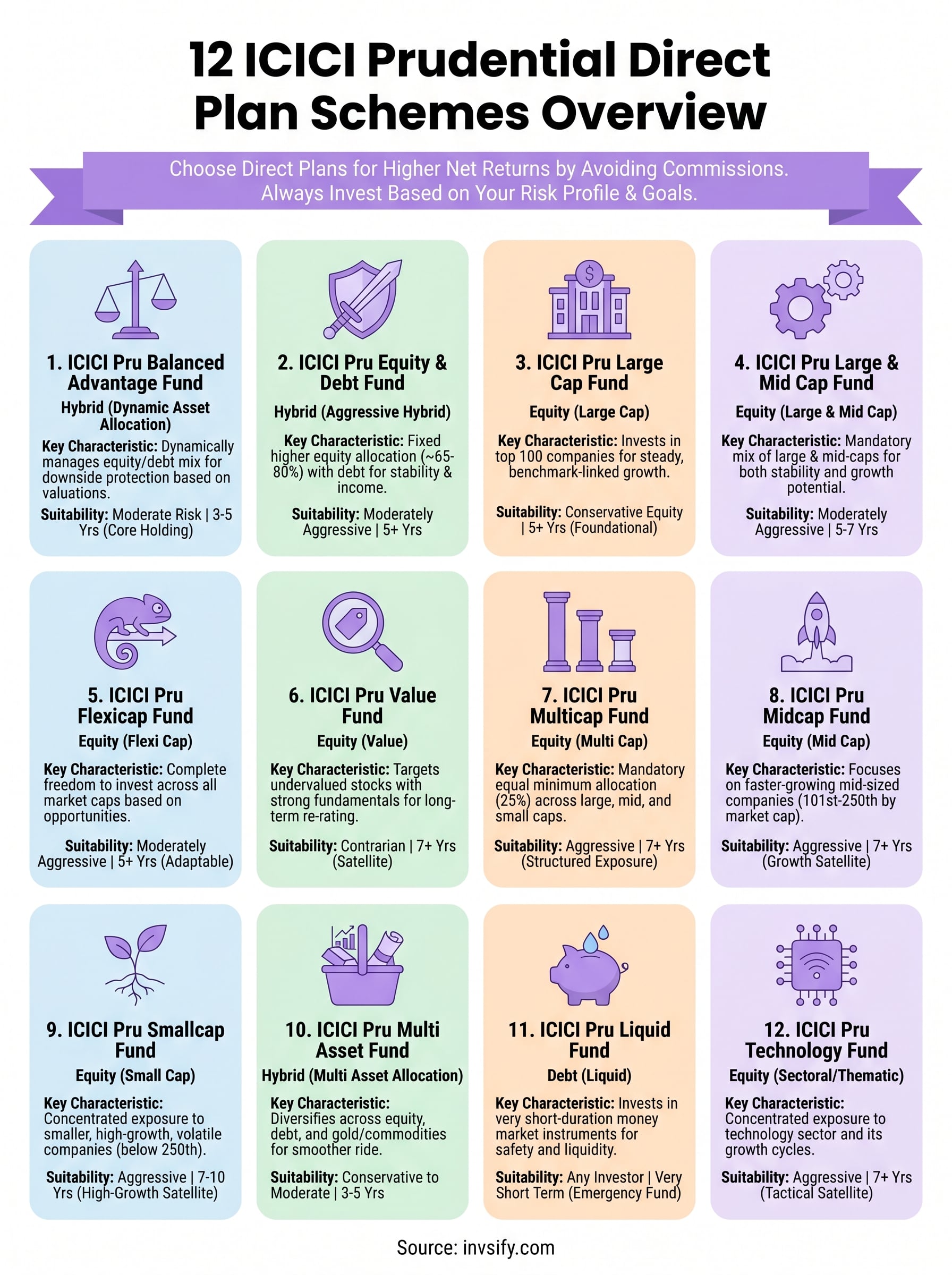
You now have a clear picture of 12 ICICI Prudential mutual fund direct plan schemes across equity, hybrid, debt, and sector categories. Each fund serves a different purpose in your portfolio, and the right combination depends on your risk tolerance, investment horizon, and financial goals, not just past returns.
Picking funds without a plan is the fastest way to end up with an unbalanced portfolio that either takes on too much risk or too little. Before you invest, it helps to know exactly how much exposure you need across asset classes and whether the funds you're considering complement each other or overlap.
Invsify gives you AI-powered, conflict-free investment advice as a SEBI Registered Investment Advisor to help you build a portfolio that actually fits your situation. You skip the guesswork and get personalized recommendations backed by data. Start building your portfolio with Invsify today.