How To Invest In Nifty 50 Index Fund: SIP Or Lump Sum
Shlok Sobti

How To Invest In Nifty 50 Index Fund: SIP Or Lump Sum
Nifty 50 index funds have become one of the most accessible ways for Indian investors to participate in the stock market. These funds track the performance of India's 50 largest companies, giving you instant diversification without the complexity of picking individual stocks. But understanding the benefits is only half the story, the real question is how do you actually invest in Nifty 50 index fund options available today?
Whether you prefer the discipline of a systematic investment plan (SIP) or have a lump sum ready to deploy, the investment process is simpler than most people assume. The key lies in choosing the right fund, completing your KYC, and selecting an investment mode that aligns with your financial goals. At Invsify, we use AI-powered insights to help investors make smarter, conflict-free investment decisions, and index funds often form a solid foundation in well-constructed portfolios.
This guide covers the complete step-by-step process to start investing in Nifty 50 index funds, compares the SIP versus lump sum approach, and highlights the top fund options worth considering.
Nifty 50 index fund basics you must know
Before you invest in Nifty 50 index fund options, you need to understand what you're buying. The Nifty 50 is an index of 50 companies selected from the National Stock Exchange (NSE) based on their market capitalization and liquidity. These companies represent approximately 13 sectors of the Indian economy, including financial services, information technology, energy, and consumer goods. The index gets rebalanced semi-annually, ensuring that only the most relevant and liquid stocks remain part of the composition.
What the index actually tracks
The Nifty 50 uses a free-float market capitalization weighted methodology to determine each company's representation. This means stocks with higher available market value carry more weight in the index. Your index fund investment mirrors this composition automatically, so when Reliance Industries holds a 10% weight in the index, roughly 10% of your fund value sits in that stock. The index calculation happens in real time during trading hours, reflecting the combined performance of all 50 constituent stocks.
The Nifty 50 accounts for about 66% of the free-float market capitalization of all stocks listed on the NSE.
How index funds replicate the Nifty 50
Index funds use a passive investment strategy to match the Nifty 50's performance. The fund manager buys all 50 stocks in the exact same proportion as the index, maintaining this ratio even as prices fluctuate. Unlike actively managed funds where managers try to beat the market, index funds aim for tracking error close to zero, meaning your returns should closely match the index itself. When companies enter or exit the Nifty 50, your fund automatically rebalances to reflect these changes.
Why investors choose these funds
You get instant diversification across India's top companies without researching individual stocks or timing the market. Index funds charge significantly lower expense ratios (typically 0.1% to 0.5%) compared to actively managed equity funds (1.5% to 2.5%), letting you keep more of your returns. Historical data shows the Nifty 50 has delivered approximately 12% to 15% annualized returns over long periods, making it a reliable wealth-building tool. These funds work particularly well for investors who prefer a hands-off approach and believe in the long-term growth of India's economy.
Choose your route: index fund vs ETF
When you decide to invest in Nifty 50 index fund options, you face an important choice: traditional index mutual funds or Exchange Traded Funds (ETFs). Both track the same index, but they differ in how you buy them, the costs involved, and the flexibility they offer. Your decision depends on your investment style, the amount you plan to invest, and whether you prefer automated investing or direct market trading.
Index funds give you simplicity
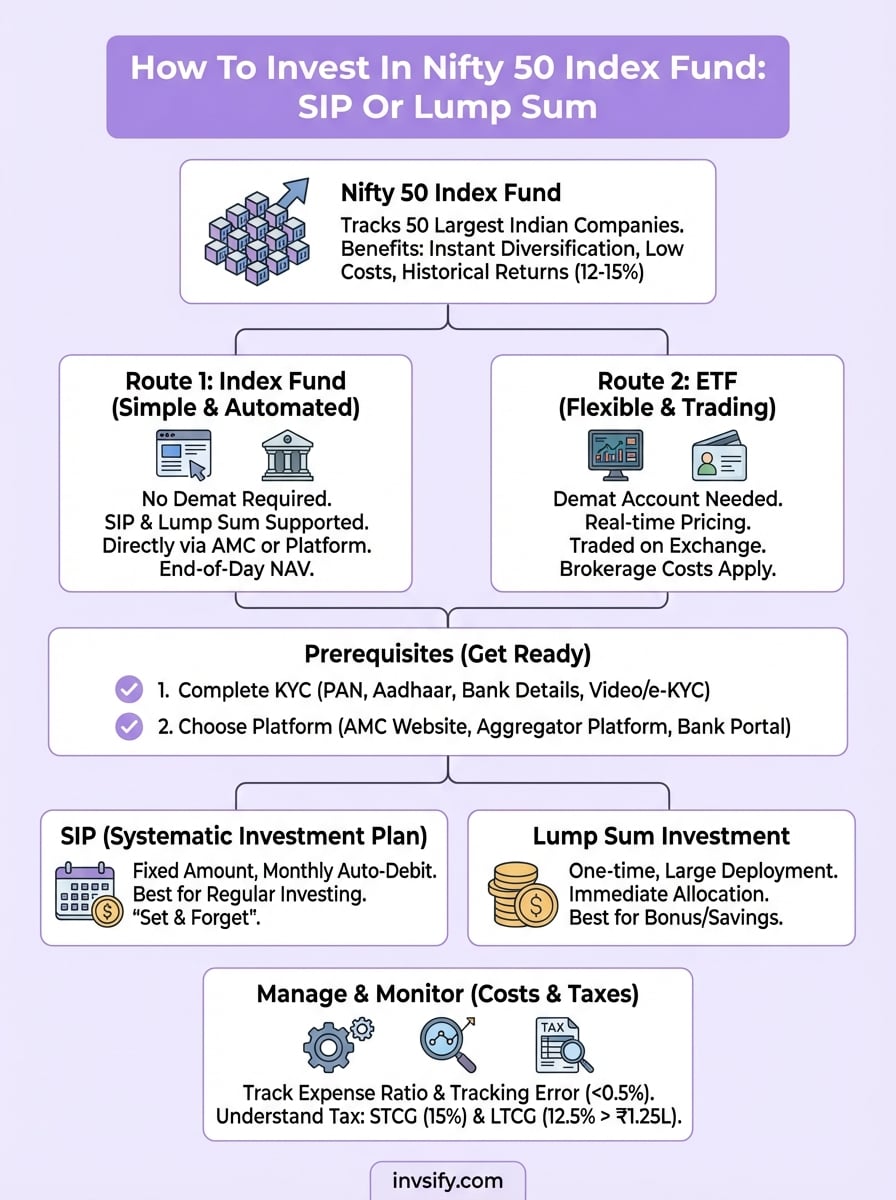
Nifty 50 index mutual funds let you invest directly through Asset Management Companies (AMCs) or platforms without needing a demat account. You buy units at the Net Asset Value (NAV) calculated once daily after market close, which means you don't worry about intraday price fluctuations. These funds support both SIP and lump sum investments, making them ideal if you want to automate monthly contributions. Your investment gets processed within one business day, and you can start with amounts as low as ₹100 or ₹500 depending on the fund house.
ETFs offer flexibility
Nifty 50 ETFs trade on stock exchanges like regular shares, giving you real-time pricing throughout the trading day. You need a demat and trading account to buy ETF units, and you pay brokerage charges on each transaction just like stock trading. ETFs typically have lower expense ratios than index funds (often 0.05% to 0.15% versus 0.1% to 0.5%), but the brokerage costs can offset this advantage for smaller investments.
ETFs work best when you're investing larger amounts infrequently, while index funds suit regular, smaller contributions.
Your choice comes down to convenience versus control: index funds automate the process, while ETFs give you trading flexibility.
Get ready to invest: KYC, accounts, and platform
Before you can invest in Nifty 50 index fund options, you need to complete three essential setup steps: KYC verification, opening the right accounts, and selecting a platform. These prerequisites typically take 2 to 7 days to complete, so start this process before you're ready to invest. The good news is you only need to do this once, and your credentials work across all mutual fund investments in India.
Complete your KYC verification first
Know Your Customer (KYC) is a mandatory one-time process regulated by SEBI that verifies your identity and address. You need your PAN card, Aadhaar card, bank account details, and a recent photograph to complete the registration. Most platforms now offer Video KYC where you complete verification through a video call in 10 to 15 minutes, or you can submit documents online for e-KYC processing.

The process works like this:
Visit any SEBI-registered platform or AMC website
Click on "Start KYC" or "Complete KYC"
Enter your PAN and verify it with your Aadhaar
Upload or capture your documents
Complete video verification or wait for e-KYC approval
Receive your KYC acknowledgment number via email
Once your KYC status shows "Verified," you can invest across any mutual fund house in India without repeating the process.
Choose your investment platform
You have three main options for investing: direct AMC websites, mutual fund platforms, or bank investment portals. Direct AMC websites like HDFC Mutual Fund or ICICI Prudential let you invest without intermediaries but require separate logins for each fund house. Platforms aggregate multiple fund houses, giving you one-stop access to compare and invest across different Nifty 50 index funds with a single login. Your bank's investment portal offers convenience since your bank account links automatically, though fund choices might be limited.
Place your investment: SIP or lump sum
Once your KYC is complete and you've chosen a platform, you're ready to invest in Nifty 50 index fund options using either the Systematic Investment Plan (SIP) or lump sum method. The choice depends on whether you want to invest a fixed amount regularly or deploy a one-time larger sum. Both approaches work through the same platform, but the steps and implications differ significantly.
Set up your SIP investment
SIP lets you invest a fixed amount monthly (or weekly/quarterly) automatically from your bank account. Most Nifty 50 index funds accept SIPs starting from ₹500 per month, making this accessible even for beginners. You select your investment date (typically between the 1st and 28th), and the platform debits your account and buys units at the prevailing NAV on that date.
Follow these steps to start your SIP:
Log into your chosen platform and search for your selected Nifty 50 index fund
Click "Invest" and select "SIP" as your investment mode
Enter your monthly amount (minimum ₹500)
Choose your SIP date and frequency (monthly recommended)
Set the duration (6 months minimum, or select "perpetual" for ongoing investment)
Complete the mandate registration for auto-debit
SIP eliminates the stress of timing the market since you buy at different price points automatically.
Make a lump sum investment
Lump sum investing means you deploy a one-time amount immediately at the current NAV. You can invest any amount above the fund's minimum (typically ₹5,000), and your units get allocated within one business day. This works best when you have received a bonus, inheritance, or accumulated savings you want to invest immediately.
Manage it well: costs, tracking, and taxes
After you invest in Nifty 50 index fund options, your work doesn't end. You need to monitor three critical aspects: the costs eating into your returns, your fund's performance relative to the index, and the tax implications when you redeem. Most investors set up their SIP and forget about it, which works for the investment part but ignores the management side that protects your wealth over decades.
Track your actual costs annually
Your index fund charges an expense ratio deducted daily from the fund's assets, which directly reduces your returns. Review your fund's expense ratio every year since AMCs sometimes increase it within SEBI limits. Calculate your actual cost by multiplying your average investment value by the expense ratio percentage. For example, ₹10 lakhs in a fund with 0.20% expense ratio costs you ₹2,000 annually. Some platforms charge additional transaction fees for lump sum investments, so check your consolidated account statement quarterly.
Monitor your tracking error
Tracking error measures how closely your fund follows the Nifty 50 index. Check your fund's NAV change against the index movement every quarter to ensure they align within 0.5%. Your fund factsheet (published monthly on the AMC website) shows this metric clearly.
A tracking error consistently above 1% signals poor fund management and justifies switching to a better index fund option.
Understand the tax treatment
Equity index funds follow equity taxation rules since they invest over 65% in stocks. You pay 15% short-term capital gains tax on profits from units sold within 12 months. Units held longer than 12 months attract 12.5% long-term capital gains tax only on gains exceeding ₹1.25 lakhs per financial year.
Next steps before you invest
You now have the complete roadmap to invest in Nifty 50 index fund options, from KYC verification to choosing between SIP and lump sum approaches. Start by completing your KYC documentation today if you haven't already, since this unlocks access to all mutual fund investments in India. Then compare the expense ratios and tracking errors of at least three different Nifty 50 index funds to identify the most cost-efficient option for your portfolio.
The decision to invest shouldn't rely on guesswork or unverified advice from online forums. At Invsify, we combine AI-powered insights with SEBI-registered advisory services to help you make conflict-free investment decisions. Our platform provides personalized recommendations based on your financial goals, risk profile, and investment horizon. Get started with Invsify to access transparent, data-backed guidance that goes beyond generic index fund advice and builds a comprehensive wealth strategy tailored to your needs.