NSDL Demat Account Online: Step-By-Step Opening Guide 2026
Shlok Sobti
NSDL Demat Account Online: Step-By-Step Opening Guide 2026
Every investment you make in stocks, mutual funds, or government securities needs a place to live, and that place is a demat account. If you're looking to open an NSDL demat account online, you're choosing India's largest depository, which holds over ₹400 lakh crore worth of assets as of 2026. That's not a small decision, and getting the process right from the start matters.
But here's what most guides won't tell you: opening the account is just step one. The real challenge begins when you need to decide what goes into it, which stocks to pick, which mutual funds to hold, and how to structure your portfolio so it actually grows. That's where unbiased, data-backed advice becomes critical, and exactly where most investors end up relying on unreliable tips from social media or commission-driven distributors who don't have your best interests in mind.
At Invsify, we're a SEBI Registered Investment Advisor that uses AI-powered insights to help you make smarter investment decisions, completely conflict-free, with zero hidden commissions. So once your demat account is ready, you'll have a clear path forward.
This guide walks you through the entire NSDL demat account opening process, from choosing a depository participant to completing e-KYC and logging into your account for the first time. Each step is broken down so you can get it done without confusion or unnecessary back-and-forth.
What an NSDL demat account is and who offers it
A demat account is a digital holding account where your securities, such as stocks, bonds, mutual fund units, and government securities, are stored electronically. Think of it as your investment locker. NSDL, which stands for National Securities Depository Limited, is the first and largest depository in India, established in 1996 and regulated by SEBI. When you open an NSDL demat account online, you're connecting your investments to a system that processes millions of transactions daily across the Indian securities market.
How NSDL works as a depository
NSDL doesn't directly open accounts for individual investors. Instead, it operates through a network of registered intermediaries called Depository Participants (DPs), which are essentially the interface between you and the depository. When you open an account with a DP, your holdings are recorded in NSDL's central database, giving you legal proof of ownership for every security you hold.
NSDL holds custody of over ₹400 lakh crore in assets and services more than 3.8 crore active demat accounts as of 2026, making it the largest depository in India by asset value.
Every time you buy or sell a security, the DP communicates the transaction to NSDL, which then updates your holdings in real time. Your 16-digit DP ID and Client ID together form your unique demat account number within the NSDL system. You'll use this number to receive shares, pledge securities, or transfer holdings between accounts.
Who the DPs are: banks, brokers, and NBFCs
NSDL has empaneled over 275 registered Depository Participants across India as of 2026. These DPs fall into three broad categories: commercial banks, full-service stockbrokers, and non-banking financial companies (NBFCs). The table below gives you a clear picture of the types and some well-known examples:
DP Type | Examples |
|---|---|
Commercial Banks | HDFC Bank, ICICI Bank, Kotak Mahindra Bank, Axis Bank, SBI |
Full-Service Brokers | IIFL Securities, Sharekhan, Motilal Oswal, Kotak Securities |
Discount Brokers | Zerodha (via CDSL primarily, also NSDL for some accounts), Upstox |
NBFCs & Others | Angel One, Bajaj Financial Securities |
Your choice of DP directly affects your account charges, service quality, and platform features. Banks tend to offer higher account maintenance fees but provide integrated banking access. Discount brokers usually offer lower fees with tech-forward platforms. Full-service brokers sit in between, often bundling research and advisory services with your demat account.
NSDL vs CDSL: what's the actual difference?
India has two depositories: NSDL and CDSL (Central Depository Services Limited). Both are SEBI-regulated, equally secure, and legally recognized for holding Indian securities. The difference lies primarily in which DP network they operate through and minor technical processes on the back end. For practical purposes, you'll find that most large banks are NSDL DPs, while many newer discount brokers work with CDSL.
From an investor standpoint, the depository itself has almost no impact on your day-to-day investing experience. What matters far more is the DP you choose, since that determines your interface, fees, and support quality. If you already bank with HDFC, ICICI, or Kotak, opening an NSDL demat account through the same institution can simplify your financial management significantly. If you want a standalone trading platform with lower costs, a broker DP might suit you better.
Before you start: pick an NSDL DP and gather docs
Two things determine how smoothly your NSDL demat account online opening goes: the DP you select and whether your documents are in order before you start. Most delays happen because applicants discover mid-process that a document is missing or in the wrong format. Taking 15 minutes to prepare now saves you significant back-and-forth later.
Documents you need ready before applying
Every NSDL DP requires a standard set of KYC documents, though some may ask for additional proof depending on your account type. The documents below cover individual resident Indian accounts, which is what most salaried investors open:
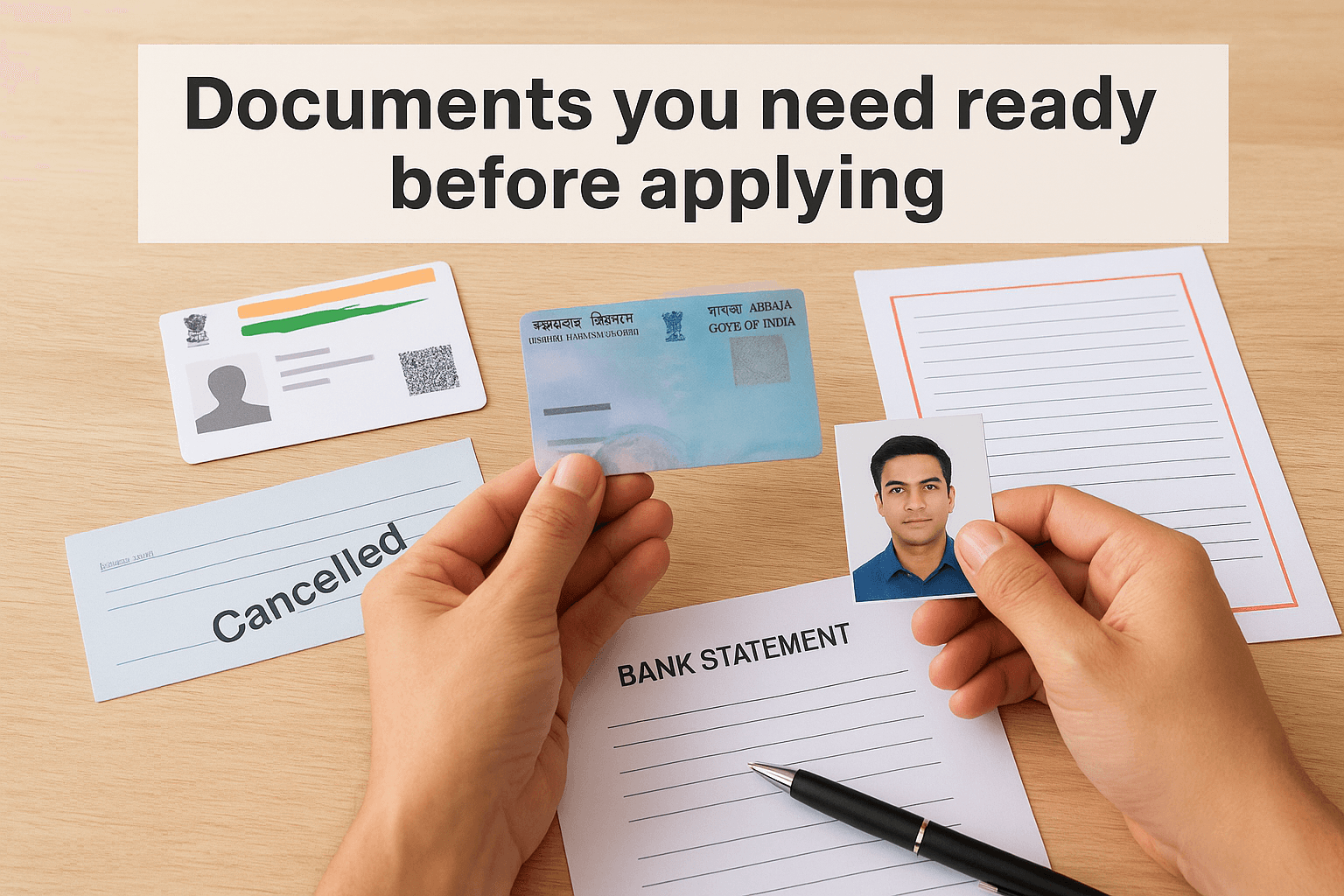
Document Category | Accepted Options |
|---|---|
Identity Proof | Aadhaar card, PAN card, Passport, Voter ID |
Address Proof | Aadhaar card, Passport, utility bill (under 3 months old), bank statement |
Income Proof | Latest 3 salary slips, ITR acknowledgment, Form 16 |
Bank Proof | Cancelled cheque or bank statement showing IFSC and account number |
Photograph | Passport-size photo (digital JPG format for online applications) |
Your PAN card is mandatory and non-negotiable across all DPs. SEBI requires it for every demat account. Your Aadhaar number linked to your active mobile number is equally essential if you want to complete e-KYC instantly, since the OTP-based verification depends on this linkage.
If your Aadhaar is not linked to your current mobile number, visit your nearest Aadhaar enrollment center to update it before starting the account opening process, because this will block you from completing online KYC.
What to check before you pick a DP
Choosing a DP before gathering documents might seem premature, but it actually saves time. Different DPs have different fee structures and platform capabilities, so knowing your DP upfront means you can upload documents directly to their portal without repeating the process elsewhere.
Run through this checklist before committing to any DP:
Account opening charges: Some DPs charge ₹0, others up to ₹999.
Annual Maintenance Charge (AMC): Ranges from ₹0 to ₹750 per year depending on the DP.
Transaction fees: Per-debit charges that apply each time you sell holdings from the account.
Platform quality: Check if the DP offers a mobile app, two-factor login, and real-time portfolio tracking.
Customer support: Verify whether they provide phone, chat, or callback support for account queries.
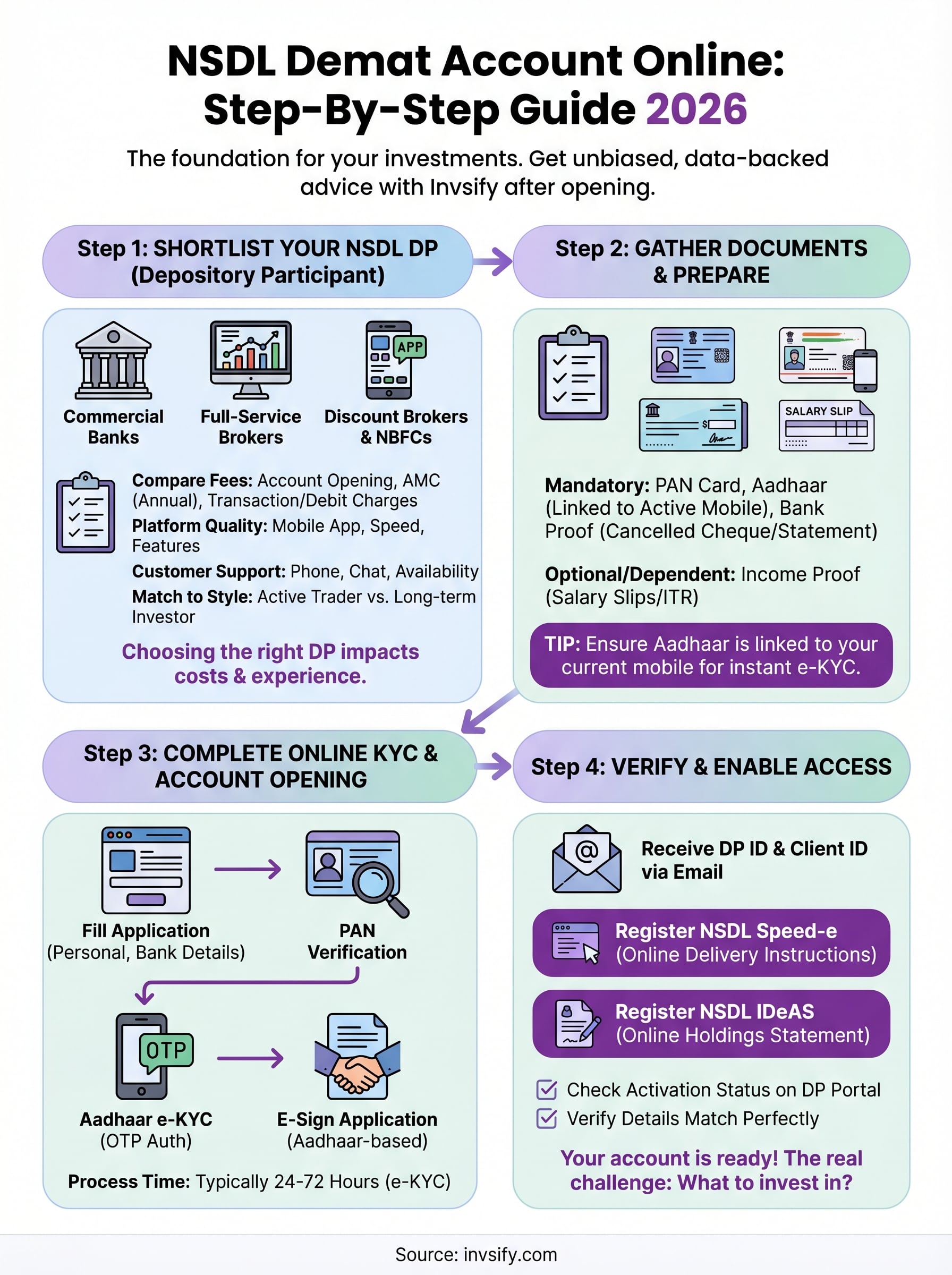
Step 1. Shortlist an NSDL depository participant
Picking the right DP is the most consequential decision you make when opening an NSDL demat account online, because you'll live with this choice every time you buy, sell, or track your investments. Most people skip this step and open an account with the first name they recognize, then spend months dealing with high AMC charges or a clunky mobile app. Take 10 minutes here instead.
Compare fees side by side
Every DP publishes a Schedule of Charges on its website. Pull up at least three options and compare them across the same parameters before deciding. The table below covers the most common fee categories you'll encounter:
DP | Account Opening Fee | AMC (Annual) | Transaction (Debit) Fee |
|---|---|---|---|
HDFC Bank | ₹0 | ₹750 | ₹13-₹25 per transaction |
ICICI Bank | ₹0 | ₹700 | ₹14 per transaction |
Kotak Securities | ₹0 | ₹600 | ₹13.5 per transaction |
IIFL Securities | ₹0 | ₹300 | ₹10 per transaction |
Motilal Oswal | ₹0 | ₹440 | ₹12 per transaction |
These figures are indicative and subject to revision, so always verify directly on the DP's official website before submitting your application. What looks like a small annual fee difference adds up meaningfully if you hold multiple securities and sell frequently.
If you plan to invest regularly in mutual funds and rarely trade individual stocks, a higher AMC with zero transaction charges often works out cheaper than a low AMC with high per-debit fees.
Match the DP to your investing style
Your trading frequency and preferred platform should drive the final shortlisting decision. If you trade actively in equities, you need a platform with fast order execution, real-time charts, and low per-transaction costs. If you're a long-term SIP investor who checks the portfolio once a month, a bank-based DP with integrated savings account access might be more convenient than a standalone broker platform.
Also verify that the DP you're considering has a functional mobile app with two-factor authentication and supports NSDL's Speed-e facility for online delivery instruction submission. These aren't optional add-ons in 2026. They're baseline requirements for managing a demat account without calling customer support every time you need to act on a transaction.
Step 2. Complete online KYC and account opening
Once you've confirmed your DP, the account opening process for your NSDL demat account online happens entirely through your browser or the DP's mobile app. Most NSDL DPs now support Aadhaar-based e-KYC, which means your identity and address verification completes in minutes using an OTP sent to your Aadhaar-linked mobile number, with no physical paperwork required.
Fill out the application form
Navigate to your chosen DP's official website and look for the "Open Demat Account" or "Open Account Online" button on the homepage. Every major DP follows a similar flow: basic personal details first, then PAN verification, then Aadhaar e-KYC, and finally bank linkage. Use the sequence below as your reference regardless of which DP you use:
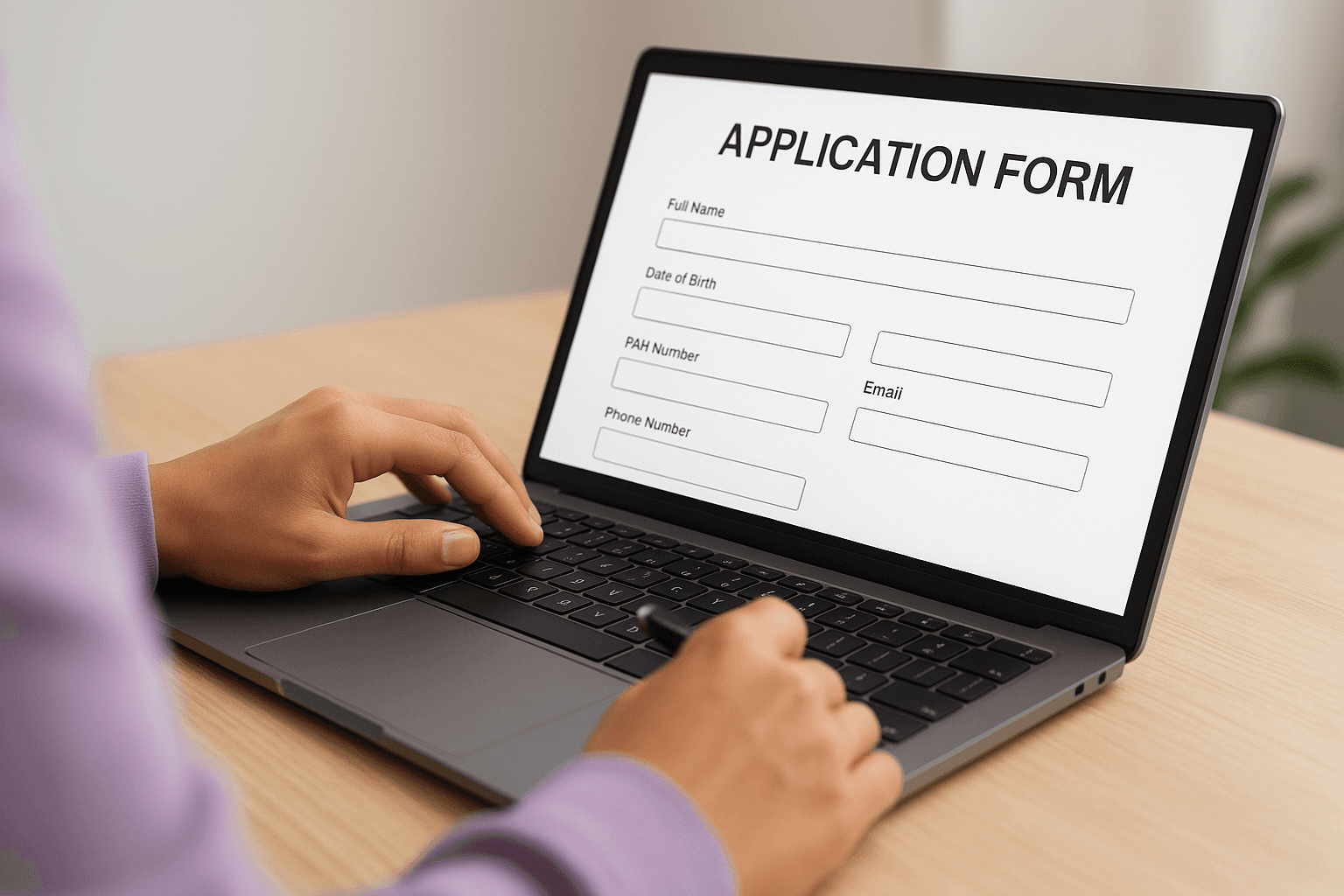
Enter your full name, date of birth, and PAN number, along with your email and phone number
Complete PAN verification, where the system cross-checks your name against the Income Tax database
Enter your Aadhaar number and submit the OTP received on your linked mobile number
Select your account type: Individual, Joint, or Minor (most salaried investors choose Individual)
Upload supporting documents: income proof and bank proof if the DP requires them beyond e-KYC
Choose your trading segments: equity, derivatives, or commodity
Review every field before submitting
If any detail on your form does not match your PAN or Aadhaar records exactly, the verification will fail and you will need to restart that step, so double-check your name spelling and date of birth before you hit submit.
Sign the application digitally
After submission, your DP will prompt you to sign the application electronically. Most DPs accept either an Aadhaar-based e-sign, where you authenticate using a second OTP, or a scanned wet signature uploaded as a JPG file. The Aadhaar e-sign option is faster and removes any need to print or courier documents. Once signed, the DP forwards your completed form to NSDL for processing.
Your application acknowledgment number arrives by email or SMS immediately after submission. Save this number because you'll use it to track your account status on the DP's portal. Processing typically takes 24 to 72 hours for e-KYC-verified accounts, though some DPs complete it faster when all documents are clean. Physical verification, if the DP requires it, can push that timeline to 5 to 7 working days.
Step 3. Verify your NSDL demat and enable access
After your DP processes the application, NSDL sends your account credentials and DP ID directly to your registered email address. This typically arrives within 24 to 72 hours for e-KYC-verified applications. Before you do anything else, confirm that the details in the welcome communication match exactly what you submitted, because any mismatch in your name or PAN information needs to be corrected through your DP before you start transacting.
Check your account activation status
Your DP's portal or mobile app will show a status tracker for your account application. Log in using your application acknowledgment number to confirm the current stage. The typical progression looks like this:
Application submitted: DP has received your form and documents
Under verification: DP is cross-checking your PAN, Aadhaar, and bank details with the respective databases
Forwarded to NSDL: DP has completed its internal checks and submitted your file to the depository
Account activated: NSDL has assigned your 16-digit DP ID and Client ID, and your account is live
If your status stays at "Under verification" for more than 3 working days, contact your DP's support team directly with your acknowledgment number. Most delays at this stage trace back to a document quality issue or a name mismatch between your PAN and Aadhaar records.
Set up NSDL Speed-e and IDeAS
Once your NSDL demat account online is active, register for two NSDL services immediately: Speed-e and IDeAS. Speed-e is NSDL's facility for submitting delivery instructions online without physical slips, which you'll need every time you transfer shares out of your account. IDeAS (Internet-based Demat Account Statement) gives you direct access to your holdings statement and transaction history through NSDL's own portal, independent of your DP's platform.
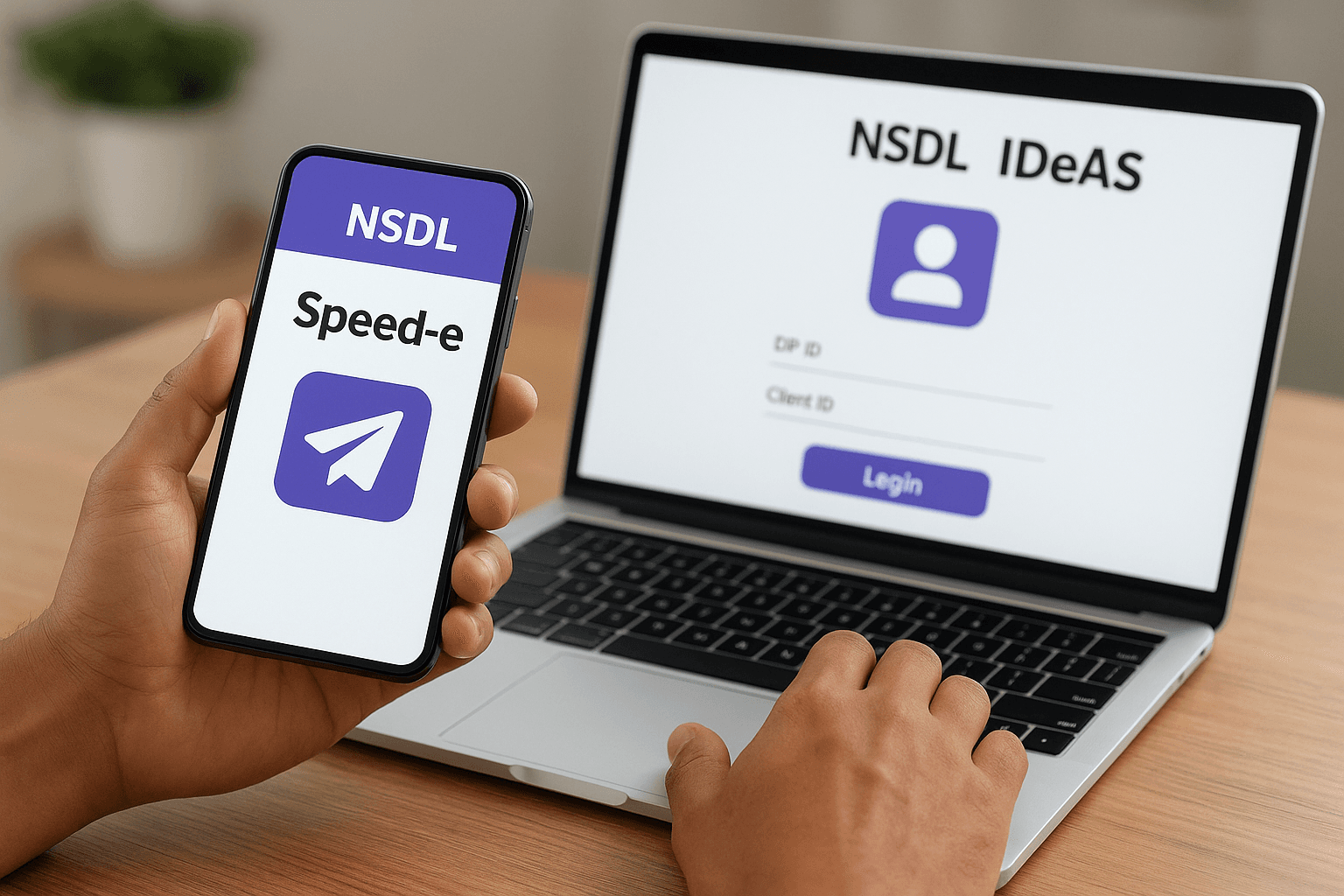
Register for both Speed-e and IDeAS through the official NSDL portal at https://nsdl.co.in, using the DP ID and Client ID from your welcome email.
To complete Speed-e registration, you'll need your DP ID, Client ID, and PAN, along with a one-time verification step through your DP. After registration, NSDL mails a PIN mailer to your registered address within 7 to 10 working days. Keep this PIN secure and change it immediately upon first login. With Speed-e active, you can authorize share transfers anytime without visiting a branch or submitting paper forms.
Troubleshooting and FAQs for 2026
Even when you follow every step correctly, small mismatches in your KYC data or document quality can stall your NSDL demat account online application. The issues below are the most common ones reported in 2026, along with direct fixes you can apply without multiple rounds of back-and-forth with support teams.
Application stuck at "Under Verification"
If your application status hasn't moved in more than 3 working days, the most likely cause is a name mismatch between your PAN and Aadhaar records. Pull up your PAN details on the Income Tax e-filing portal and compare the name spelling exactly against your Aadhaar. Even a single character difference, such as "Mohammed" vs "Mohammad," will halt the verification. Contact your DP's support team with your acknowledgment number and the specific mismatch detail so they can flag it for manual review rather than forcing an automated rejection that makes you restart.
Raising a support ticket directly with your DP resolves most name mismatch cases faster than waiting for the system to process an automatic rejection and return your application to square one.
Aadhaar OTP not arriving
Your Aadhaar-linked mobile number must be active and receiving SMS at the moment you submit. If the OTP doesn't arrive within 60 seconds, confirm that the number registered on your Aadhaar matches the SIM currently in your phone. If it doesn't match, visit your nearest Aadhaar enrollment center to update it before retrying. Attempting the OTP step multiple times in quick succession will trigger a temporary authentication lock, so wait at least 10 minutes between attempts to avoid extending the delay further.
Finding your DP ID and Client ID
Your DP ID is an 8-digit number assigned to your depository participant, and your Client ID is another 8-digit number specific to your account. Together they form your 16-digit demat account number. Both appear in the welcome email your DP sends after activation. You can also retrieve them by logging into your DP's platform and checking the "Account Details" or "Profile" section directly.
Frequently asked questions
Can you hold multiple NSDL demat accounts? Yes, you can open accounts across different DPs, but each account carries its own AMC and compliance obligations, so factor that cost in before opening more than one.
What happens if your account stays unused? Most DPs mark an account dormant after 12 to 24 months of zero transactions, depending on their policy. Reactivation requires a written request and updated KYC documents submitted to your DP.
Do you need a demat account for mutual funds? No. You can invest through an AMC or a SEBI-registered investment advisor without a demat account, since mutual fund units don't require demat holding unless you specifically opt for that format.
Your next move
You now have everything you need to open an NSDL demat account online, from picking the right depository participant to activating Speed-e and IDeAS once your account goes live. The process is straightforward when your documents are in order and your Aadhaar is linked to an active mobile number.
Opening the account is the easy part. The harder question is what to do with it once it's ready. Which stocks, mutual funds, or bonds belong in your portfolio depends on your income, risk tolerance, tax situation, and financial goals, and getting that wrong costs real money over time. Random tips from social media or advice from commission-driven distributors won't give you a clear, unbiased answer.
That's exactly what Invsify is built for. As a SEBI Registered Investment Advisor, Invsify uses AI-powered insights to help you invest with clarity and confidence, completely free of hidden commissions. Start building your portfolio the right way today.