Fast Setup Guide: Open Demat Account Online In India (2026)
Shlok Sobti

Fast Setup Guide: Open Demat Account Online In India (2026)
Gone are the days of visiting a broker's office with stacks of documents just to start investing. Today, you can open demat account online in under 15 minutes from your phone or laptop. The process has become remarkably simple, with instant verification through Aadhaar-based eKYC eliminating most of the traditional paperwork.
But with dozens of platforms offering this service, from discount brokers to full-service banks, choosing the right one matters. Fees vary wildly, and the wrong choice can cost you thousands over time in hidden charges and high brokerage.
This guide walks you through the exact steps to open your demat account online in 2026, compares the top platforms available in India, and helps you pick one that fits your investment goals. At Invsify, we help investors build wealth through AI-powered advisory services, and that journey often starts with setting up the right demat account. Let's get you started.
What you need before you start
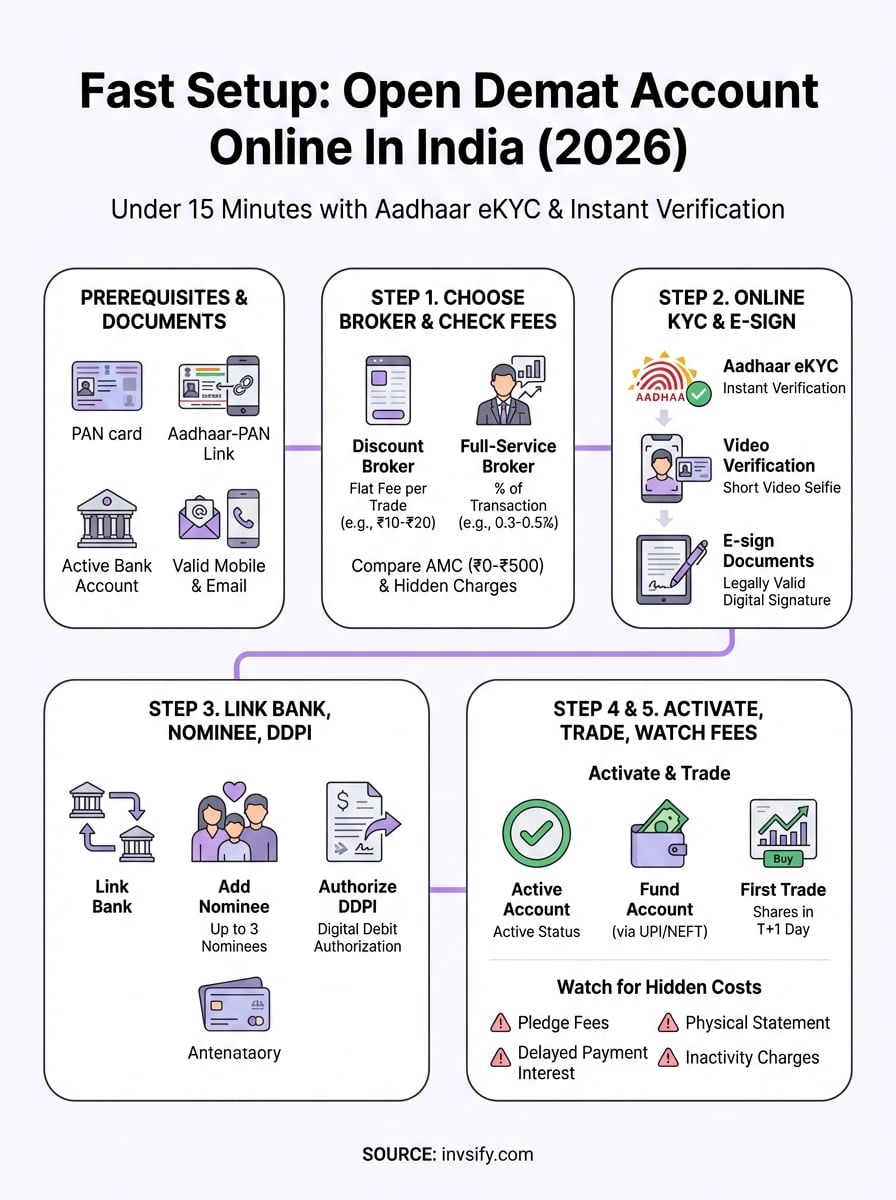
You need just four essential items to open demat account online in 2026. The process relies heavily on digital verification, so having these ready speeds up your application considerably. Most platforms complete the setup within 24 hours if you submit everything correctly the first time.
Core identity documents
Your PAN card serves as the primary identity proof for all investment accounts in India. You also need your Aadhaar card linked to your PAN, as most brokers use Aadhaar-based eKYC for instant verification. Check your linkage status on the Income Tax e-filing portal before you start the application.
Without PAN-Aadhaar linkage, you cannot complete the digital KYC process, and your application will get stuck at verification.
Bank account and proof documents
You need an active savings account in your name with a major Indian bank. The account should have online banking enabled since you will link it for fund transfers. Keep a cancelled cheque or bank statement handy as proof.
Most platforms also ask for:
Signature specimen (usually captured digitally during e-sign)
Income proof (only for derivatives trading, optional for equity)
Valid mobile number linked to your Aadhaar
Active email address for account statements and alerts
Download a recent bank statement in PDF format before starting. This saves time if the broker asks for additional verification during the process.
Step 1. Pick a broker and demat DP
Your first step to open demat account online involves choosing between two types of service providers: discount brokers and full-service brokerages. Discount brokers like Zerodha, Upstox, and Groww charge a flat fee per trade (typically ₹10 to ₹20), while traditional brokers like ICICI Direct or HDFC Securities charge a percentage of your transaction value. This choice directly impacts your long-term costs, especially if you trade frequently.
Compare discount vs full-service brokers
Discount brokers suit you if you make independent investment decisions and need low-cost execution. You get basic tools, mobile apps, and zero advisory fees. Full-service brokers offer research reports, dedicated relationship managers, and advisory support, but you pay 0.3% to 0.5% brokerage per trade. Most new investors prefer discount brokers since information is freely available online today.
Check the fee structure upfront
Look beyond the brokerage rate. Annual maintenance charges (AMC) for demat accounts range from ₹0 to ₹500. Some brokers waive AMC for the first year, then charge later. Check the call-and-trade fees (₹20 to ₹50 per order) if you ever need phone support. Account opening is usually free, but verify this before proceeding.
Hidden charges like pledge fees, physical statement costs, and SMS alerts can add up to ₹1,000 annually if you're not careful.
Step 2. Finish online KYC and e-sign
Once you select a broker, you complete the KYC process entirely online through Aadhaar-based verification. The broker redirects you to CERSAI or DigiLocker, where you enter your Aadhaar number and authenticate using an OTP sent to your registered mobile. This instant verification pulls your details like name, address, and date of birth automatically.

Complete the video verification
After Aadhaar validation, you record a short video selfie holding your PAN card. The system checks your live face against the Aadhaar photo database. This step takes under 30 seconds and replaces the old in-person verification requirement. Some brokers skip this if your Aadhaar validation is successful.
Sign digitally using e-sign
You authorize the account opening by signing documents digitally through Aadhaar e-sign. The system sends an OTP to your Aadhaar-linked mobile, and entering it applies your legally valid digital signature to the application. This eliminates physical paperwork completely when you open demat account online.
E-sign has the same legal validity as a physical signature under the IT Act 2000, so your application is binding once submitted.
Step 3. Link bank, nominee, and DDPI
After e-sign, you link your bank account for fund transfers and add a nominee for your holdings. You also authorize DDPI (Depository Participant Debit and Pledge Instruction), which lets your broker debit shares when you sell. This step completes your account setup.
Link your bank account
Enter your bank account number and IFSC code in the portal. Most brokers verify this through penny drop verification, depositing ₹1 and reversing it instantly. Upload a cancelled cheque if auto-verification fails.
Add a nominee
Add up to three nominees who receive your securities if something happens to you. Enter their name, relationship, and Aadhaar. The broker sends them an OTP for consent. Skipping this creates legal complications for heirs.
Submit DDPI authorization
Authorize your broker to debit shares when you sell through digital signature. This replaces the old POA system. You sign through Aadhaar e-sign, and the broker submits it to the depository.
Without DDPI, you cannot complete sell transactions when you open demat account online.
Step 4. Activate, fund, and buy your first stock
Your broker activates your account within 24 hours after verifying your documents and DDPI authorization. You receive a confirmation email with your client ID and trading credentials. Log in to the platform and check your account dashboard shows "Active" status. Most brokers send separate credentials for their mobile app and web platform.

Add funds to your trading account
Transfer money from your linked bank account using NEFT, RTGS, or UPI. The platform displays your available funds under "Add Funds" or "Deposit". Start with ₹5,000 to ₹10,000 for your first investment. Money appears in your trading account instantly through UPI or within 30 minutes through NEFT.
Place your first buy order
Search for a stock using its symbol or name in the order window. Enter the quantity and select "Market" order for instant execution or "Limit" order to set your price. Click "Buy" and confirm. Your order executes within seconds during market hours (9:15 AM to 3:30 PM).
Shares appear in your demat account by T+1 (next trading day) after you buy.
Step 5. Fix common issues and avoid hidden costs
Problems often surface after you open demat account online, from login errors to unexpected charges. Most issues resolve quickly if you know where to look. Brokers hide fees in their account statements under vague labels, so you need to audit charges monthly.
Watch for these hidden charges
Check your monthly statement for these common fees that brokers quietly add:
Pledge fees: ₹20 to ₹50 per stock when using holdings as margin
Physical statement costs: ₹25 per quarter if you request paper copies
Delayed payment interest: 18% to 24% annually on unpaid dues
Inactivity charges: ₹100 to ₹500 if you don't trade for six months
Call your broker immediately if you spot unexplained charges. Most waive fees on the first complaint.
Hidden charges can total ₹2,000 annually even if you trade minimally, so review statements every month.
Resolve login and trading blocks
Your account gets blocked if your Aadhaar-PAN link expires or if you miss margin payments. Log in to the broker portal and check "Account Status" for specific errors. Contact support through their app chat for instant resolution.
Where to go from here
You now know exactly how to open demat account online in India, from selecting a broker to placing your first trade. The entire process takes under 15 minutes with Aadhaar-based KYC, and your account activates within a day. Review your monthly statements carefully to spot hidden charges, and start with small investments until you understand how your chosen platform works properly.
Your next step depends on your specific investment goals. Build a diversified portfolio across multiple sectors if you're investing for long-term wealth creation. Start with blue-chip stocks or index funds if you prefer lower risk. Track your portfolio performance weekly and adjust based on market conditions.
Need help making smarter investment decisions beyond just opening an account? Start building wealth with AI-powered advisory at Invsify. We provide conflict-free recommendations and personalized insights to help you grow your money faster than self-managing through online forums or paying high distributor fees.