Retirement Planning Checklist: 16 Must-Do Steps for Indians
Shlok Sobti

Retirement Planning Checklist: 16 Must-Do Steps for Indians
You know retirement is important. You have probably saved something. But when you try to figure out if you are ready to retire, the confusion hits. How much corpus do you actually need? Should you stop SIPs or continue them? What about EPF withdrawal rules? How will medical bills get paid? You end up scrolling through Reddit threads and YouTube videos, getting more questions than answers. Most online content is either too vague or written for Americans with 401(k)s that do not apply to you.
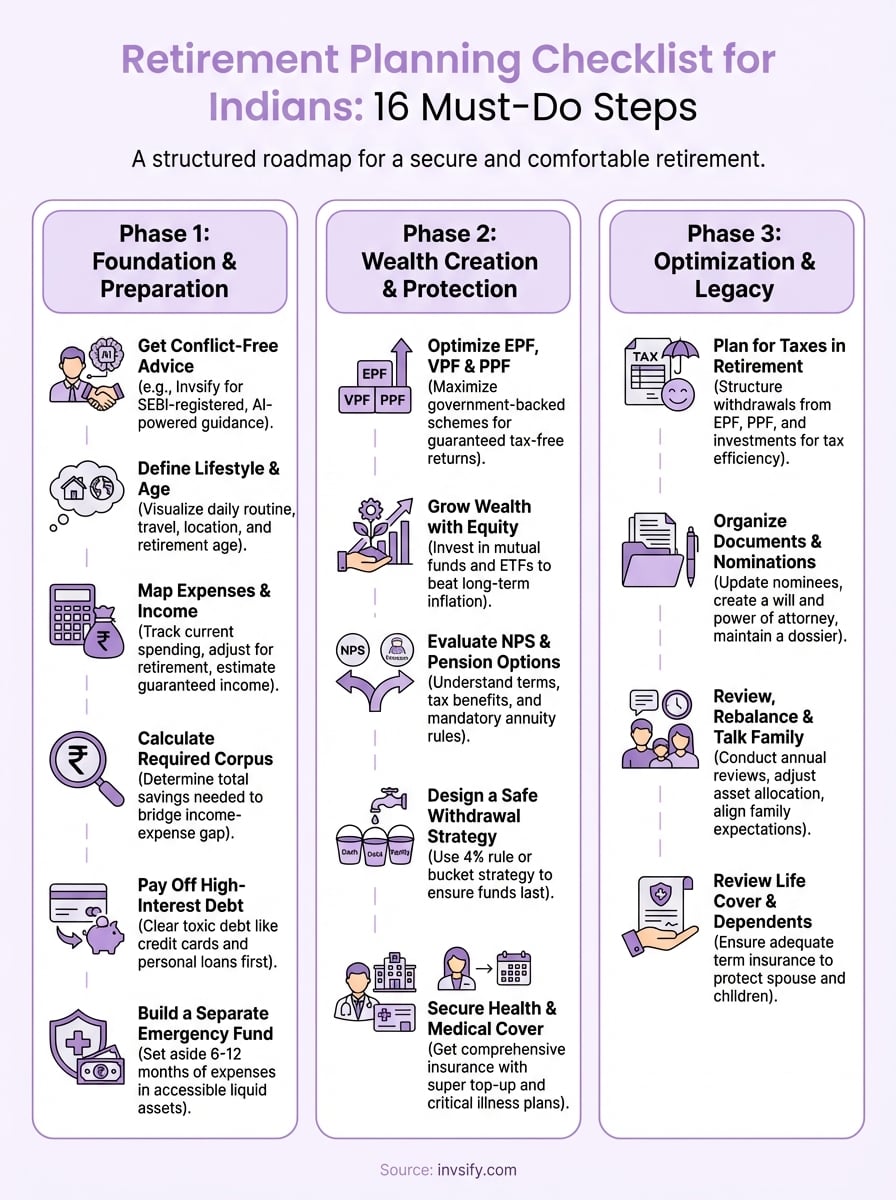
This retirement planning checklist gives you 16 concrete steps designed for Indian salaried professionals. You will learn how to calculate your retirement corpus, optimize EPF and PPF, choose between NPS and other pension options, plan withdrawals without running out of money, secure health cover for your older years, reduce taxes, and get your family on the same page. Each step explains what to do, why it matters, and how to execute it. By the end, you will have a clear roadmap instead of scattered worries.
1. Use Invsify for your retirement plan
Planning your retirement alone leaves you vulnerable to biased advice from commission-driven distributors and conflicting information from online forums. You need someone who works for your interest, not someone earning a cut from the products they recommend. This first step in your retirement planning checklist addresses that exact problem. Invsify operates as a SEBI Registered Investment Advisor, which means the platform is bound by law to put your interests first. The combination of AI-powered insights and human expertise gives you conflict-free guidance tailored to Indian salaried professionals.
Why independent advice matters
Traditional distributors earn commissions when you buy specific products. This creates an inherent conflict of interest because they get paid more for recommending expensive or unsuitable options. You end up with a portfolio designed to maximize their earnings, not your retirement security. Invsify charges a transparent advisory fee instead of hidden commissions, so recommendations focus purely on what works for your retirement goals. The Hidden Fee Calculator on the platform shows you exactly how much money you save by avoiding distributor charges over the long term.
How Invsify builds your retirement roadmap
Invsify starts by assessing your current financial situation through a seamless KYC process and risk profiling. The AI analyzes your income, expenses, existing investments, and retirement timeline to generate a personalized Wealth Wellness Score. Based on this analysis, you receive specific recommendations about how much to save, where to invest, and what adjustments to make each year. The platform tracks your progress continuously and alerts you when your plan needs course correction.

What Invsify offers Indian salaried investors
You get 24/7 access to a multilingual Conversational RM AI that answers questions about EPF, PPF, NPS, tax planning, and investment strategies specific to Indian investors. Daily audio snippets keep you updated on relevant financial news and regulatory changes. Advanced portfolio tracking consolidates all your investments in one place, while real-time AI advisory suggests rebalancing actions based on market conditions and your proximity to retirement. If you need urgent help, human support responds within 30 seconds.
Invsify combines AI precision with SEBI-registered credibility to deliver conflict-free retirement planning that prioritizes your financial security over commission payouts.
2. Define retirement age and lifestyle
Before you calculate any numbers in your retirement planning checklist, you need a clear vision of what retirement actually looks like for you. Most people skip this step and dive straight into corpus calculations, which leads to either oversaving or undersaving. Your retirement lifestyle determines how much money you need, not the other way around. Spend time visualizing your daily routine, activities, and priorities after you stop working. This mental picture becomes the foundation for every financial decision that follows.
Picture your ideal retired life
Write down what a typical week looks like in retirement. Do you see yourself traveling every quarter, or staying home with books and hobbies? Will you eat out frequently or cook most meals? Do you plan to pursue expensive hobbies like golf, or free activities like walking and gardening? Your answers directly impact your monthly expense requirements. Someone who wants to travel internationally four times a year needs a very different corpus than someone planning a quiet life in their current city. Be honest about what genuinely interests you instead of imagining a fantasy life that does not match your personality.
Choose a realistic retirement age
Indians traditionally retire at 60, but you can choose an earlier or later age based on your financial readiness and career satisfaction. Early retirement at 50 or 55 requires a larger corpus because your money needs to last longer and you lose additional years of compounding. Retiring at 65 or 70 gives your investments more time to grow and reduces the total years you need to fund. Consider your health status, job stress, and family obligations when picking your target age.
Account for family and location choices
Will you support your children financially after retirement? Do you plan to live with them or maintain a separate household? Will you stay in an expensive metro city or move to a smaller town with lower living costs? Each decision carries significant financial implications. Living independently in Mumbai requires more money than living with family in Pune. Factor in these choices now so your retirement corpus calculation reflects your actual situation, not a generic template.
3. Map current expenses and future budget
This step in your retirement planning checklist forces you to confront the real numbers instead of making vague guesses. Most people assume their expenses will drop sharply in retirement, but data shows they often stay flat or even increase for the first decade after retirement. You need a detailed expense map that accounts for your actual spending patterns and anticipated lifestyle changes. This becomes the foundation for calculating how much corpus you need.
Track your current monthly spending
Open your bank statements and credit card bills for the last six months. Categorize every expense into buckets like housing, groceries, utilities, transport, entertainment, insurance, and miscellaneous. Add up each category and divide by six to get your average monthly spend. Many Indians discover they spend 20 to 30 percent more than they thought once they track actual transactions instead of relying on memory.
Adjust costs for retirement lifestyle
Some expenses disappear after retirement. You stop paying for daily commutes, work clothes, and office lunches. But other costs increase. You have more time for hobbies, travel, and social activities that require spending. Your electricity and water bills rise when you stay home all day. Medical expenses climb with age even if you feel healthy now. Adjust each category based on your visualized retirement lifestyle from the previous section.
Factor inflation and rising medical costs
Apply a 6 to 7 percent annual inflation rate to your adjusted retirement budget. Healthcare costs typically inflate faster, around 8 to 10 percent per year, so use a higher inflation factor for medical expenses. If you retire in 15 years and your current monthly expenses are ₹50,000, you will need approximately ₹1.2 lakh per month to maintain the same lifestyle, assuming 6 percent inflation.
Your retirement corpus calculation depends entirely on getting this expense mapping right, so invest the time to build an accurate budget now instead of guessing.
4. Estimate retirement income sources
This step in your retirement planning checklist identifies every rupee you expect to receive after you stop working. Most Indians focus only on EPF or PPF and forget about other sources that can significantly reduce the corpus they need to build. You want to map out all guaranteed and probable income streams so you know how much gap your savings must fill. This exercise often reveals pleasant surprises, like a small pension you forgot about, or uncomfortable truths, like EPF running out faster than expected.
List all potential income streams
Write down every source that will pay you in retirement. Start with Employees Provident Fund (EPF) and the pension from the Employees Pension Scheme (EPS). Add your Public Provident Fund (PPF) maturity amount and any voluntary provident fund (VPF) balance. Include rental income from properties, interest from fixed deposits, dividends from stocks or mutual funds, and any annuity or pension plans you purchased. Do not forget gratuity if you worked for the same employer long enough, or any family pension if applicable.
Check vesting and eligibility rules
Each income source comes with specific vesting periods and eligibility criteria that determine when and how much you receive. EPF requires five years of service to claim the full amount with interest, while EPS needs ten years of service to qualify for monthly pension. PPF matures after 15 years but you can withdraw partially after seven years. NPS allows partial withdrawals after three years but full withdrawal only at 60. Review the terms and conditions for each investment so you do not plan around money you cannot actually access.
Identify gaps between income and needs
Subtract your estimated total monthly income from the monthly expense budget you mapped earlier. The difference tells you how much corpus you need to generate through withdrawals. If you need ₹80,000 per month and your guaranteed income covers ₹30,000, you must build enough savings to generate the remaining ₹50,000 every month for your entire retirement.
Mapping your income sources reveals the exact shortfall your retirement corpus must cover, turning vague anxiety into a specific savings target you can work toward.
5. Calculate your retirement corpus
This step in your retirement planning checklist converts your expense gap into a concrete savings target. You identified how much monthly income you need and subtracted guaranteed sources in the previous steps. Now you calculate the total corpus required to generate that income throughout your retirement years. This number might feel overwhelming at first, but breaking it into components makes the calculation manageable and actionable.

Decide monthly income you will need
Take the gap between your retirement expenses and guaranteed income that you calculated earlier. This represents the monthly amount your corpus must generate through withdrawals. If your expenses are ₹80,000 and guaranteed income covers ₹30,000, your corpus needs to produce ₹50,000 every month. Multiply this by 12 to get your annual withdrawal requirement. In this example, you need ₹6 lakh per year from your retirement savings.
Estimate how long your money must last
Indians are living longer than previous generations. A person retiring at 60 should plan for at least 25 to 30 years of retirement, taking them to age 85 or 90. Women typically need to plan for longer periods due to higher life expectancy. Review your family medical history and current health status to estimate a realistic retirement duration. Planning for 30 years gives you a comfortable buffer even if you live past 90.
Use tools to compute target corpus
Apply the 4 percent withdrawal rule as a starting point. Divide your annual withdrawal requirement by 0.04 to get your target corpus. For ₹6 lakh annual withdrawals, you need a corpus of ₹1.5 crore. Invsify's AI calculator adjusts this basic formula based on your specific risk profile, inflation expectations, and investment allocation to give you a more accurate target.
Your retirement corpus calculation transforms abstract savings anxiety into a specific financial goal that you can track and achieve through disciplined investing over time.
6. Pay off high interest debt early
This step in your retirement planning checklist protects your corpus from getting eroded by interest payments after you stop earning a salary. Carrying debt into retirement forces you to withdraw more from your savings each month, which accelerates depletion of your corpus and increases the risk of running out of money. Personal loans, credit cards, and even some home loans charge interest rates that often exceed the returns your retirement investments generate. Eliminating these obligations before retirement lets you live on a smaller corpus and reduces financial stress during your non-earning years.
Identify all loans and interest rates
List every debt you currently carry with its outstanding principal and interest rate. Include personal loans, credit card balances, car loans, education loans, and home loans. Calculate the total monthly EMI you pay across all these obligations. Note which loans charge interest rates above 10 percent, as these qualify as toxic debt that destroys wealth faster than most investments can build it.
Prioritize clearing toxic borrowings
Pay off credit card debt first since it typically charges 36 to 42 percent annual interest. Next target personal loans that often carry 12 to 18 percent rates. Use bonuses, increments, or windfalls to make lump sum prepayments on these high interest debts instead of investing that money. The guaranteed saving from eliminating expensive debt often beats uncertain investment returns.
Plan your home loan prepayment strategy
Home loans carry lower interest rates, usually 8 to 9 percent, which makes them less urgent than other debt. However, entering retirement with a mortgage payment hanging over you creates unnecessary stress. Calculate how much extra you need to pay monthly to clear your home loan three to five years before retirement instead of letting it run until the end of its tenure.
Eliminating high interest debt before retirement gives you immediate guaranteed returns that match or exceed what most conservative retirement investments deliver.
7. Build a separate emergency fund
This step in your retirement planning checklist creates a financial buffer that protects your retirement corpus from unexpected withdrawals. Many Indians make the mistake of treating their retirement savings as an emergency fund, which forces premature corpus depletion and ruins long-term planning. You need a dedicated pool of money sitting outside your retirement investments that handles medical emergencies, home repairs, or family crises without touching the funds meant to generate your retirement income. This separation prevents you from selling investments at the wrong time or breaking fixed deposits that penalize early withdrawal.
Decide the right emergency fund size
Calculate six to twelve months of your current household expenses as your emergency fund target. If you spend ₹60,000 monthly, you need ₹3.6 to ₹7.2 lakh set aside. Choose the higher end if you have health conditions, aging parents, or dependents with special needs. Self-employed professionals should maintain twelve months of expenses since their income fluctuates more than salaried employees. This fund covers sudden job loss, major medical bills, or urgent family obligations without derailing your retirement savings.
Choose safe places to park the money
Park emergency funds in liquid and accessible instruments that you can withdraw within 24 to 48 hours without penalties. Keep three months of expenses in your savings bank account for immediate access. Put the remaining amount in liquid mutual funds or short-term fixed deposits that offer better returns than savings accounts while maintaining quick withdrawal options. Avoid locking emergency money in equity investments or PPF that restrict access.
Rules for using and refilling the fund
Tap your emergency fund only for genuine financial emergencies, not for planned expenses like vacations or gadget purchases. After using the fund, prioritize rebuilding it through your monthly savings before increasing retirement contributions. This discipline ensures you always maintain a protective buffer between unexpected life events and your retirement corpus.
Separating your emergency fund from retirement savings prevents forced withdrawals that permanently damage your long-term financial security during your non-earning years.
8. Optimize EPF, VPF and PPF
This step in your retirement planning checklist maximizes the government-backed savings schemes that form the foundation of most Indian retirement portfolios. EPF, VPF, and PPF offer guaranteed returns with tax benefits at entry, growth, and withdrawal, making them essential components despite their conservative nature. Most salaried professionals treat these schemes passively, accepting default contributions without exploring optimization strategies that can significantly boost their retirement corpus. Understanding the nuances of each scheme helps you extract maximum value while maintaining the safety net these instruments provide.
Understand EPF and EPS benefits
Your EPF account receives 12 percent of your basic salary from your employer plus an equal contribution from you. This corpus earns interest currently around 8.15 percent, which compounds tax-free until withdrawal. The Employees Pension Scheme (EPS) diverts 8.33 percent of your employer's contribution into a pension fund that pays monthly pension after 58 years of age if you complete ten years of service. You can access your EPF balance when you switch jobs or at retirement, but early withdrawal before five years attracts tax on the accumulated interest.
Use VPF to boost fixed income savings
Voluntary Provident Fund lets you contribute more than the mandatory 12 percent to your EPF account, earning the same interest rate with identical tax benefits. You can contribute any amount beyond the basic requirement, though interest above ₹2.5 lakh annual contribution becomes taxable. VPF works well when you want guaranteed returns without market risk, especially as you approach retirement and need to reduce equity exposure.
Plan PPF contributions and withdrawals
Public Provident Fund accepts annual contributions up to ₹1.5 lakh and currently pays 7.1 percent interest. The account matures after 15 years but you can extend it in five-year blocks. Partial withdrawals become available after seven years, and you can take loans against your balance from the third year. Maximize PPF contributions when you have spare savings beyond EPF and want long-term tax-free compounding for your retirement corpus.
Optimizing these three government schemes creates a solid fixed-income foundation that protects a significant portion of your retirement savings from market volatility.
9. Grow wealth with equity investing
This step in your retirement planning checklist addresses the inflation problem that destroys purchasing power over decades. Fixed income instruments like EPF and PPF protect capital but rarely deliver returns that significantly exceed inflation after taxes. You need equity exposure through stocks or mutual funds to generate real wealth growth that keeps your retirement corpus ahead of rising costs. Indians often avoid equities due to volatility fear, but the longer timeline to retirement actually makes market fluctuations less risky since you have years to recover from temporary downturns.
Role of equity in beating inflation
Equity investments historically deliver 12 to 15 percent annual returns over long periods, compared to 7 to 8 percent from debt instruments. This difference compounds dramatically across decades. A ₹10 lakh investment at 8 percent grows to ₹46.6 lakh in 20 years, while the same amount at 13 percent becomes ₹1.15 crore. Equity exposure helps you build a larger corpus with the same monthly savings by capturing growth from Indian businesses expanding their revenues and profits over time.

Picking suitable mutual funds and ETFs
Choose diversified equity mutual funds that spread risk across multiple companies and sectors instead of picking individual stocks. Index funds and ETFs that track Nifty 50 or Nifty 500 offer low cost exposure to broad market growth. Actively managed large cap or flexi cap funds work if you want professional stock selection. Avoid sector funds or thematic funds that concentrate risk in specific industries.
Setting your equity allocation by age
Start with 70 to 80 percent equity allocation in your 30s and early 40s when you have decades before retirement. Reduce equity by 2 to 3 percent each year as you approach 60, moving money into debt and hybrid funds for stability. Maintain at least 30 to 40 percent in equities even after retirement to combat inflation during your non-earning years.
Equity investing transforms your retirement planning checklist from a savings exercise into wealth creation by harnessing compound growth that fixed income alone cannot deliver.
10. Evaluate NPS and pension options
This step in your retirement planning checklist examines the National Pension System (NPS) and other pension products that promise regular income after retirement. NPS offers tax benefits and market-linked returns, but it comes with strict withdrawal restrictions and mandatory annuity purchases that many investors overlook until retirement approaches. You need to understand how NPS compares to voluntary provident fund (VPF), PPF, and mutual funds before committing substantial money to a product that locks your wealth for decades. The right pension strategy depends on your risk appetite, tax situation, and flexibility needs.
When NPS fits into your retirement plan
NPS works well when you want an additional Section 80CCD(1B) deduction of ₹50,000 beyond the ₹1.5 lakh limit under Section 80C. This extra tax break makes NPS attractive for high income earners in the 30 percent tax bracket. The scheme lets you choose between equity and debt exposure based on your age, with automatic rebalancing as you approach 60. However, NPS forces you to buy an annuity with at least 40 percent of your corpus at retirement, which generates taxable monthly income at relatively low rates compared to systematic withdrawals from mutual funds.
Comparing NPS with other pension products
Traditional pension plans from insurance companies offer guaranteed monthly payouts but tie up large premiums for decades with poor liquidity. NPS provides higher potential returns through market exposure while keeping costs lower than most insurance plans. VPF delivers guaranteed returns similar to EPF without locking money until 60, giving you more withdrawal flexibility than NPS.
Choosing annuity and payout structures
You must convert 40 percent of your NPS corpus into an annuity that pays monthly pension for life. Compare annuity rates across different providers since even a 0.5 percent difference significantly impacts your lifetime income. Joint life annuities protect your spouse but pay lower monthly amounts than single life options.
NPS offers valuable tax benefits but the mandatory annuity purchase and withdrawal restrictions make it less flexible than building your retirement corpus through mutual funds and EPF.
11. Design a safe withdrawal strategy
This step in your retirement planning checklist determines how you convert your accumulated corpus into reliable monthly income without running out of money. Most Indians withdraw retirement funds haphazardly, taking large amounts whenever needed, which depletes the corpus faster than planned. You need a structured approach that balances your immediate cash needs with long-term sustainability. The withdrawal strategy you choose directly impacts whether your money lasts 20 years or 35 years, making it one of the most consequential decisions in retirement planning.
Understand sequence of returns risk
Withdrawing money during market downturns permanently reduces your corpus in ways that subsequent market recoveries cannot fix. If you retire with ₹2 crore and the market drops 30 percent in your first year while you withdraw ₹8 lakh for expenses, your corpus falls to ₹1.32 crore. Even if markets recover fully the next year, you start with a smaller base that generates less future growth. This sequence of returns risk hits hardest in the first five years after retirement when your corpus is largest and withdrawals have maximum impact.
Choose a sustainable withdrawal rate
The 4 percent rule suggests withdrawing 4 percent of your initial corpus annually, adjusted for inflation each year. For a ₹2 crore corpus, you withdraw ₹8 lakh the first year, then increase that amount by inflation in subsequent years. Indian retirees should consider a 3 to 3.5 percent rate to account for longer life expectancy and volatile markets. Lower withdrawal rates increase the probability your money lasts through your entire retirement.
Use bucket strategies for stability
Divide your corpus into three buckets: cash and liquid funds for the next two years of expenses, debt funds for years three to seven, and equity for years eight onwards. This strategy lets you avoid selling equity during market crashes since you have seven years of expenses safely parked in non-equity assets. Refill the cash bucket annually by selling from whichever asset class performed best.
Designing a safe withdrawal strategy protects your retirement corpus from depletion by matching your spending needs with appropriate investment risks across different time horizons.
12. Secure health and medical cover
This step in your retirement planning checklist protects your corpus from the single biggest financial threat in your non-earning years: medical expenses. Indians often underestimate healthcare costs after 60, assuming their current health insurance will suffice. Medical inflation runs at 8 to 10 percent annually, far exceeding general inflation, and hospitalization costs triple or quadruple as you age. A week-long hospital stay that costs ₹2 lakh today will demand ₹5 lakh in 15 years. Without adequate cover, a single medical emergency can wipe out years of retirement savings, forcing you to depend on your children or compromise on treatment quality.

Review your existing health insurance
Pull out your current health insurance policy and check the sum insured, coverage terms, and exclusions. Most employer-provided policies end when you retire, leaving you uninsured exactly when medical needs increase. Individual policies become expensive to buy after 55, with insurers imposing higher premiums and pre-existing disease waiting periods. If you rely on employer insurance, purchase an individual policy at least five years before retirement to complete waiting periods while you still have income. Verify your policy covers room rent without sub-limits, includes daycare procedures, and offers lifetime renewability.
Add super top up and critical illness cover
Base health insurance covers hospitalization but large medical bills quickly exhaust standard ₹5 to ₹10 lakh policies. Super top-up plans provide additional coverage at lower premiums by activating after your base policy limit exhausts. A ₹20 lakh super top-up costs far less than increasing your base policy to ₹30 lakh. Critical illness policies pay a lump sum upon diagnosis of conditions like cancer, heart attack, or stroke, covering non-hospitalization expenses like rehabilitation, home care, and income loss during treatment.
Plan for elder care and long term support
Medical insurance covers acute hospitalization but not chronic care or assisted living that many Indians need after 75. Long-term care insurance remains rare in India, so plan how you will fund nursing care, physiotherapy, or live-in help if mobility declines. Discuss elder care preferences with your family now, deciding whether you prefer aging at home with support or moving to a senior living community.
Comprehensive health coverage prevents medical emergencies from converting into financial disasters that destroy the retirement corpus you spent decades building.
13. Review life cover and dependents
This step in your retirement planning checklist ensures your family stays financially secure if you die during retirement or shortly before reaching it. Many Indians buy term insurance in their 30s but never reassess coverage as their financial situation evolves. Your insurance needs change dramatically as you approach retirement since you no longer need to replace decades of future salary. However, you still must protect dependents from losing essential income streams and ensure your spouse maintains their standard of living. Reviewing and adjusting life cover now prevents your family from facing financial hardship exactly when they need stability.
Check term insurance adequacy
Calculate how much income your family needs if you die tomorrow. Subtract existing assets like EPF, PPF, and investments that your spouse can access immediately. The remaining gap determines your required term insurance coverage. Most retirees need less coverage than working professionals since their children become financially independent and home loans get paid off. Consider reducing your sum assured to lower premiums while maintaining protection for essential expenses.
Provide income security for a spouse
Your spouse loses your pension income and faces reduced household cash flow after your death. Term insurance should replace at least 10 to 15 years of the income you provided, allowing your spouse to maintain their lifestyle and cover medical expenses. Structure the payout so your spouse receives funds through a combination of lump sum and monthly income options that prevent mismanagement.
Protect children and other dependents
Evaluate whether your children still need financial support after your death. Adult children with established careers typically need less protection than those pursuing higher education or starting businesses. Calculate support requirements for aging parents or dependent siblings who rely on your contributions. Allocate term insurance proceeds specifically for these obligations through proper nomination and will documentation.
Life insurance in retirement shifts from replacing lost salary to protecting your spouse's financial independence and covering dependent obligations that outlast your earning years.
14. Plan for taxes in retirement
This step in your retirement planning checklist prevents unnecessary tax outgo from eating into your fixed income during non-earning years. Many Indians assume retirement automatically brings lower tax liability, but poor planning can push you into higher tax brackets than necessary. Your EPF withdrawals, pension income, and investment returns each face different tax treatments that require strategic coordination. Understanding how various retirement incomes get taxed lets you structure withdrawals to minimize tax burden while maximizing spendable cash flow.
How common retirement incomes are taxed
EPF withdrawals become fully tax-exempt if you complete five years of continuous service, but premature withdrawals before five years attract tax on the interest component. EPS pension and annuity income from NPS face taxation at your applicable slab rate since they count as regular income. Interest from fixed deposits and savings accounts adds to your taxable income, while PPF withdrawals and maturity amounts remain completely tax-free. Long-term capital gains from equity mutual funds above ₹1.25 lakh attract 12.5 percent tax, while debt fund gains get taxed at your slab rate.
Use tax efficient investment options
Maximize contributions to PPF and VPF since they offer tax-free growth and withdrawals under the EEE (exempt-exempt-exempt) category. Equity mutual funds held over one year qualify for lower long-term capital gains rates compared to short-term holdings. Health insurance premiums up to ₹50,000 for senior citizens reduce taxable income under Section 80D, providing immediate tax savings on essential protection.
Time withdrawals to reduce tax outgo
Spread large withdrawals across multiple financial years instead of taking lump sums in a single year to stay within lower tax brackets. Withdraw from equity investments after completing one year to access favorable long-term capital gains treatment. Consider delaying taxable income sources like annuities or pension if you have sufficient tax-free withdrawals from EPF or PPF in early retirement years.
Strategic tax planning in retirement keeps more money in your pocket by coordinating withdrawals across different investment types to exploit favorable tax treatments.
15. Organize documents and nominations
This step in your retirement planning checklist prevents your family from facing administrative chaos when you die or become incapacitated. Most Indians scatter their financial information across different accounts, lockers, and email folders without telling anyone where to find critical documents. Your family needs immediate access to account details, passwords, and legal documents to settle your estate or manage your affairs during medical emergencies. Organizing everything now saves them months of frustration and prevents permanent loss of assets nobody knew existed.
Proper documentation and nomination organization transforms a potential nightmare of searching through papers and accounts into a straightforward administrative process your family can complete in days.
Update nominees across all accounts
Review nominee designations on every financial account you own. Your EPF, PPF, NPS, mutual funds, insurance policies, and bank accounts each require separate nominee forms that may still list outdated information from years ago. Add or update nominees to reflect your current family situation, especially after marriage, divorce, or the birth of children. Outdated nominations cause legal disputes among heirs and delay fund transfers by years.
Create will and power of attorney
Draft a legal will that specifies how you want your property, investments, and personal belongings distributed after death. A registered will prevents family disputes and ensures your wishes get executed without court battles. Create a power of attorney document that authorizes a trusted person to handle your financial and medical decisions if illness or injury leaves you unable to make choices independently.
Maintain a family information dossier
Compile a master document listing every financial account, insurance policy, and investment you hold with account numbers and contact information. Include locker keys, digital wallet passwords, and email credentials your family needs to access important information. Store physical copies in your home safe and share digital versions with your spouse or adult children. Update this dossier annually as you open new accounts or close old ones.
16. Review, rebalance and talk family
This final step in your retirement planning checklist creates an ongoing process instead of a one-time exercise. Your financial situation, health status, and family needs change constantly as you age, which means your retirement plan must adapt accordingly. Markets shift, tax laws change, and inflation rates fluctuate in ways that demand regular adjustments to keep your strategy aligned with reality. You also need your family to understand and support your retirement decisions since their expectations directly impact your financial security and emotional well-being.
Schedule annual retirement plan reviews
Set a specific date each year to review your entire retirement portfolio and compare actual progress against your original targets. Check whether your corpus is growing at the expected rate, whether your asset allocation still matches your age and risk profile, and whether new investment options have emerged that offer better returns or lower costs. Review any changes in tax laws or government schemes that affect EPF, PPF, or NPS contributions. Update your expense projections based on actual spending patterns instead of old estimates.
Rebalance your portfolio as you age
Your equity allocation should decrease gradually as you approach retirement to reduce volatility risk. If you planned for 70 percent equity at 40 and 50 percent at 50, check whether market movements have pushed your actual allocation away from target. Rebalance by selling overweight asset classes and buying underweight ones to restore your planned allocation. This disciplined approach forces you to sell high and buy low instead of chasing performance.
Align expectations with your family
Discuss your retirement plans openly with your spouse and adult children to prevent misunderstandings about financial support. Clarify whether you plan to fund weddings, help with home purchases, or support grandchildren's education from your retirement corpus. Your family needs to understand that your fixed income limits how much you can contribute to their goals without compromising your own security.
Regular reviews and family alignment keep your retirement plan responsive to changing circumstances instead of letting outdated assumptions drive critical financial decisions.
Final thoughts
This retirement planning checklist gives you a structured path from vague anxiety to concrete action. You now understand how to calculate your required corpus, optimize EPF and PPF contributions, balance equity and debt, secure health coverage, minimize taxes, and organize documents for your family. Each step builds on the previous one, creating a comprehensive system that addresses financial, medical, and administrative aspects of retirement.
Your next move is implementation. Pick the step where you feel most uncertain and start there. If you need help calculating your retirement corpus or want conflict-free advice on asset allocation, sign up with Invsify to get AI-powered insights backed by SEBI-registered expertise. The platform consolidates your accounts, tracks progress, and adjusts recommendations as you move closer to retirement. The difference between a comfortable retirement and financial stress in your 70s depends on the actions you take today, not wishful thinking about tomorrow.