SEBI AIF Regulations PDF: Latest Amendments FAQs & Circulars
Shlok Sobti

SEBI AIF Regulations PDF: Latest Amendments FAQs & Circulars
If you're searching for the SEBI AIF Regulations PDF, you're likely either setting up an Alternative Investment Fund, ensuring compliance with the latest norms, or conducting legal research. Either way, you need the right documents, not outdated versions buried across multiple government portals. SEBI has amended the AIF Regulations, 2012 several times since their inception, and keeping track of every circular, gazette notification, and FAQ update is no small task.
This article compiles the latest amended versions of the SEBI (Alternative Investment Funds) Regulations, 2012, along with master circulars, operating guidelines, and official FAQs, all in one place. We've organized everything so you can find exactly what you need without jumping between dozens of tabs.
At Invsify, we're a SEBI Registered Investment Advisor that uses AI-backed insights to help Indian investors make informed, conflict-free decisions. While AIFs cater to a specific investor category, understanding the regulatory framework around them matters, whether you're evaluating an AIF opportunity or simply building your financial knowledge. Let's get into the details.
Why SEBI AIF regulations matter
SEBI introduced the Alternative Investment Funds Regulations in 2012 to bring structure and oversight to a segment that was growing fast with very little formal governance. Before that framework existed, pooled investment vehicles like hedge funds, private equity funds, and venture capital funds operated with minimal disclosure requirements. The regulations changed that fundamentally, and every amendment since has tightened the rules further.
What an AIF actually covers
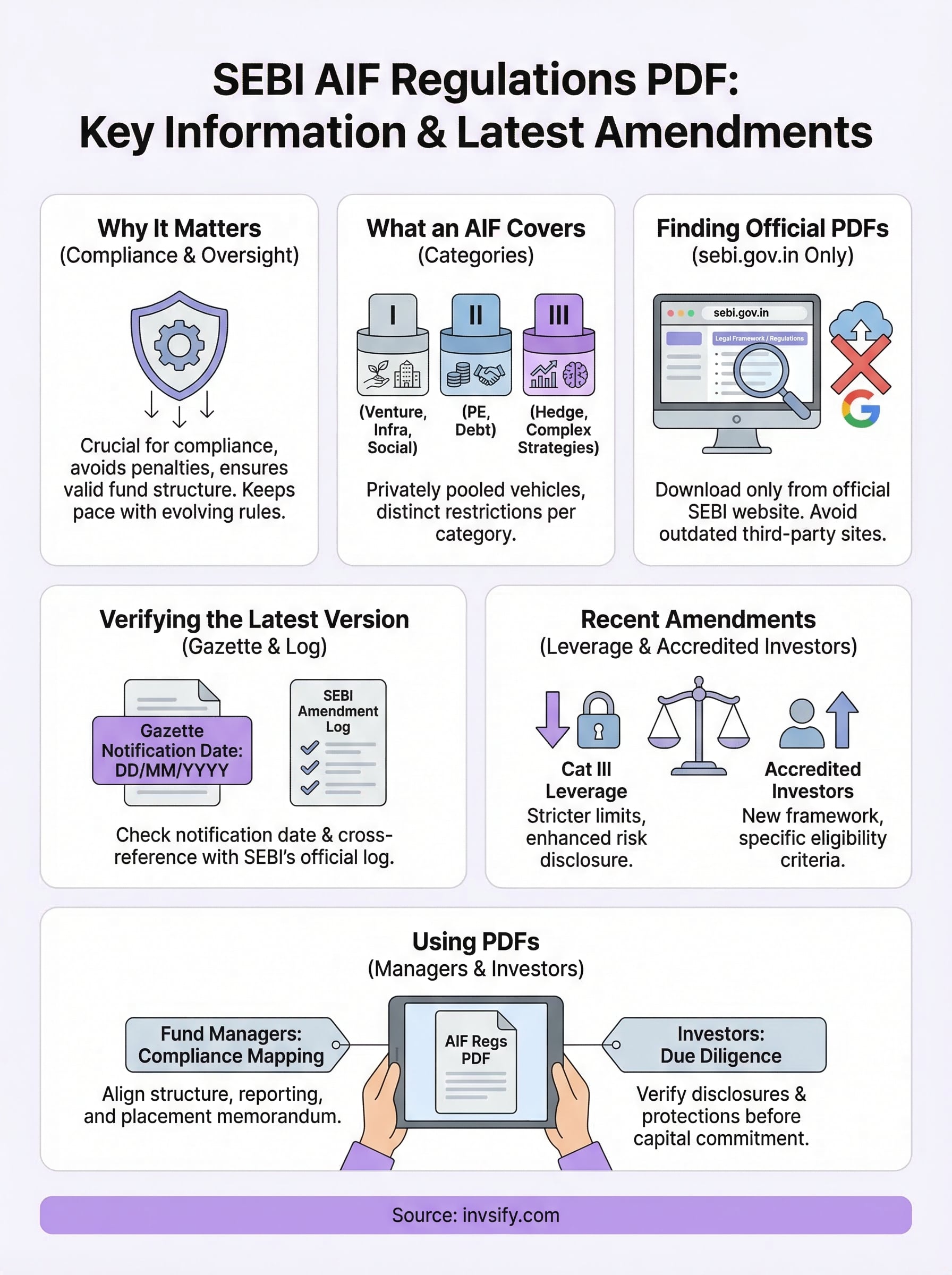
An AIF is any privately pooled investment vehicle that collects funds from sophisticated investors, whether Indian or foreign, and invests according to a defined policy. SEBI classifies AIFs into three categories: Category I (infrastructure, venture capital, social venture funds), Category II (private equity, debt funds), and Category III (hedge funds using complex trading strategies). If you're investing in or managing any fund that pools capital outside of mutual funds and other regulated products, the SEBI AIF Regulations almost certainly apply to you.
Understanding which category your fund falls under is the first step, since each category carries different restrictions on leverage, investment strategies, and eligible investors.
Why staying current with amendments matters
SEBI has issued multiple amendments, master circulars, and FAQs to the original 2012 framework, and the sebi aif regulations pdf you use for compliance must reflect the most recent consolidated version. Relying on an outdated document can expose fund managers to regulatory penalties, affect your registration status, or invalidate specific fund structures you've put in place. For investors evaluating an AIF before committing capital, the regulatory framework tells you what protections exist, what disclosures you're entitled to, and how the fund manager is accountable under Indian law.
Where to find official SEBI AIF PDFs
SEBI publishes all regulatory documents on its own website, making it the only authoritative source you should use for the sebi aif regulations pdf and related materials. Third-party sites frequently host outdated or incomplete versions, so going directly to the source removes any risk of working with stale regulations.

SEBI's official website
The primary location for all AIF-related documents is sebi.gov.in. Navigate to the "Legal Framework" section and filter by "Regulations" to locate the SEBI (Alternative Investment Funds) Regulations, 2012 along with every subsequent amendment notification in PDF format.
Always download directly from sebi.gov.in to ensure you have the authentic, unmodified version of any regulatory document.
Master circulars and FAQs
SEBI periodically consolidates its guidance into master circulars that replace earlier individual circulars. You can find these under the "Circulars" section on the same website, filtered by "Alternative Investment Funds." FAQ documents covering eligible investors, reporting requirements, and fund operations are also hosted there, typically under the "Guidance Notes" or dedicated AIF resource tabs.
How to confirm you have the latest version
Downloading a sebi aif regulations pdf is only useful if it reflects the current regulatory position. SEBI amends its regulations through gazette notifications, and the consolidated document on its website is updated accordingly. Before you use any PDF for compliance or legal work, take two minutes to verify you're working with the most current version.
Check the gazette notification date
Every amendment to the AIF Regulations carries a specific gazette notification number and date published by the Ministry of Law and Justice. Open the PDF you downloaded and scroll to the last amendment entry listed. Then cross-check that date against SEBI's official website to confirm no newer amendment has been issued after that point.
If your PDF does not reference a gazette notification number, treat it as unverified and download a fresh copy directly from sebi.gov.in.
Cross-reference with SEBI's amendment log
SEBI maintains a chronological list of all amendments for each regulation on its legal framework page. Match the amendment numbers listed there against what appears in your downloaded file. If any numbers are missing, your version is incomplete. You should also check the "Recent Updates" section on the SEBI homepage, since fresh circulars or amendments sometimes appear there before the consolidated regulation document gets updated.
What the latest amendments changed
SEBI has made several significant changes to the AIF Regulations since 2012, with recent amendments focusing primarily on investor protection and fund governance. Reviewing the latest sebi aif regulations pdf helps you understand exactly where the rules shifted and how those shifts affect your obligations as a fund manager or investor.

Category III funds and leverage rules
SEBI tightened leverage limits for Category III funds, capping gross exposure to reduce systemic risk across the market. Fund managers now face stricter requirements around margining and risk management disclosures, ensuring sophisticated investors receive a clearer picture of downside exposure before committing capital.
Accredited investor framework
One of the more notable recent additions is the accredited investor framework, which allows certain high net-worth individuals to participate in AIFs under relaxed conditions. SEBI defined specific eligibility criteria based on net worth and income thresholds, giving fund managers more flexibility when structuring deals for this investor segment.
Review these accredited investor thresholds carefully, since your fund's eligibility criteria and minimum investment requirements may need updating to align with the revised definitions.
How to use the PDFs for compliance and research
Once you have the correct sebi aif regulations pdf downloaded, the next step is knowing how to apply it practically. Fund managers, legal teams, and investors each use these documents differently, but the core principle stays the same: reference the primary source rather than summaries or third-party interpretations when making compliance or investment decisions.
For fund managers and legal teams
Your compliance work should be built directly on the official regulation text, not secondary sources. Use the PDF to map your fund's structure against the relevant category requirements, cross-check your placement memorandum disclosures against what SEBI mandates, and build your annual reporting schedule around the timelines specified in the regulations and master circulars.
Keep a dated copy of every version you download so you can demonstrate which regulatory text governed your decisions at any specific point in time.
For investors doing due diligence
When evaluating an AIF, the regulation PDF tells you exactly what disclosures the fund manager must provide and what investor rights apply to your category. Use it to verify that the fund's offer documents meet the required standards, and flag any gaps before you commit capital to a particular fund structure.
Wrap up and what to do next
The sebi aif regulations pdf is not a one-time download. Every time SEBI issues a new amendment or master circular, your compliance baseline shifts, and working from the right version is non-negotiable whether you're managing a fund or evaluating one as an investor. Always pull documents directly from sebi.gov.in, verify the gazette notification date, and cross-reference the amendment log before relying on any version for legal or compliance decisions.
Beyond the regulatory framework, your broader investment decisions deserve the same level of care and precision. Knowing the rules governing AIFs is useful, but building a personal wealth strategy that actually works for your financial goals requires personalized, conflict-free guidance. Invsify combines AI-driven insights with SEBI-registered advisory expertise to help you invest smarter without hidden fees eating into your returns. Start your wealth journey with Invsify and get advice built around your goals, not a distributor's commission.