Wealth Management Explained: Services, Fees And How It Works
Shlok Sobti

Wealth Management Explained: Services, Fees And How It Works
You earn well, you save consistently, and maybe you've even started investing. But at some point, managing your money stops being just about picking the right mutual fund or timing the market. It becomes about coordinating everything, investments, taxes, insurance, retirement planning, estate decisions, into one coherent strategy. That's where wealth management explained as a concept starts to actually matter.
Wealth management is often thrown around loosely, sometimes confused with portfolio management or financial planning. They're not the same thing. Wealth management sits above all of it, it's a structured, holistic approach to handling your entire financial life, not just one piece of it. And while it was traditionally reserved for ultra-rich families with crores parked offshore, the access has shifted dramatically, especially in India, thanks to SEBI-registered advisors and AI-driven platforms.
At Invsify, we built our platform around this exact shift, giving salaried professionals and serious investors access to conflict-free, AI-powered wealth management without the opacity of traditional distributors. Whether you're evaluating if wealth management is right for you or trying to understand what it actually includes, this article breaks it all down. We'll cover what services fall under the umbrella, how the process typically works, what fees look like, and how to decide if it's time to move beyond DIY investing.
What wealth management includes
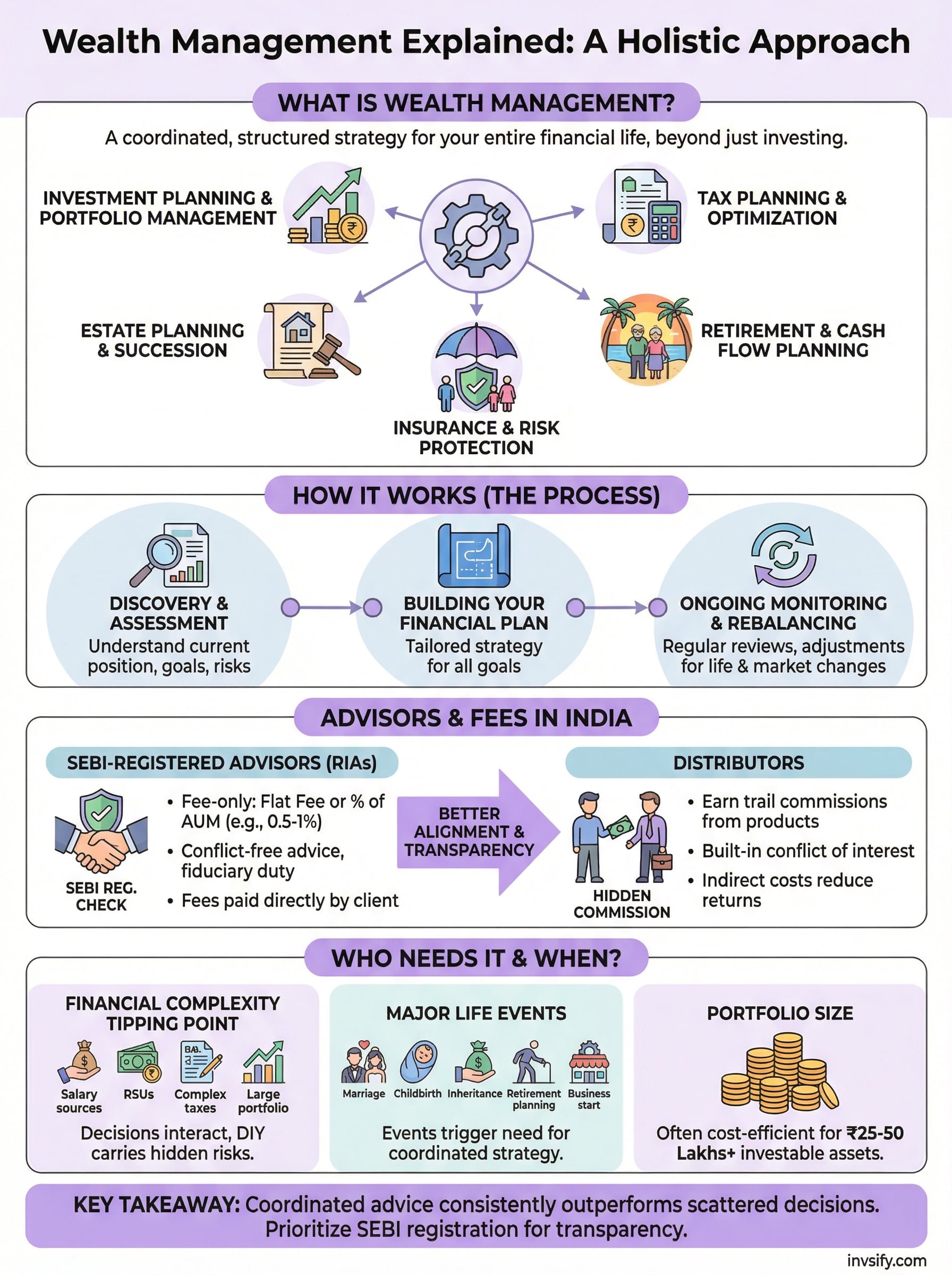
Wealth management isn't a single service. It's a combination of disciplines working together under one advisory relationship. When wealth management explained properly, it covers at least five distinct areas, and a good wealth manager ensures all of them connect. Think of it like a financial operating system: investment management might be the most visible layer, but the engine running underneath includes tax strategy, risk coverage, estate planning, and retirement projections.

Investment planning and portfolio management
This is what most people picture first, and it is genuinely central. Your asset allocation across equity, debt, gold, real estate, and alternative assets gets structured around your goals, your risk tolerance, and your investment horizon. A wealth manager doesn't just pick mutual funds. They build a goal-mapped portfolio, adjusting it as your income grows, your goals evolve, and market conditions shift.
Rebalancing, tax-loss harvesting, and performance benchmarking are all part of this ongoing process. Your portfolio isn't a static document you revisit once a year. It responds continuously to both life changes and market conditions.
Getting your portfolio right isn't a one-time decision. It's a continuous process that responds to both life changes and market realities.
Tax planning and optimization
Taxes in India can quietly erode a significant portion of your wealth if you're not proactively managing them. A qualified wealth manager looks at your full income picture, including salary, capital gains, dividends, and rental income, and identifies legal ways to reduce your tax liability. This includes structuring investments to maximize Section 80C, 80D, and 54EC benefits, using tax harvesting strategies on equity gains, and timing exits from assets to minimize short-term capital gains exposure.
Tax planning runs year-round as part of your overall strategy. The advisors who treat it as a March-only activity are the ones who leave money on the table for you every financial year.
Insurance and risk protection
Your wealth-building efforts mean little if a single health emergency or liability event can wipe them out. Wealth management includes a thorough review of your existing insurance coverage across term life, health, critical illness, and liability policies. The goal isn't to push the most expensive product. The goal is to identify gaps between what you hold and what your actual risk exposure demands.
Most salaried Indians are under-insured in ways they don't realize until they file a claim. Your wealth manager quantifies those gaps and recommends coverage adjustments that protect your financial plan from catastrophic setbacks.
Retirement and cash flow planning
Retirement planning sits at the core of why most people seek wealth management in the first place. Your wealth manager maps out your expected retirement corpus based on your current savings rate, projected returns, and lifestyle assumptions. From there, they build a drawdown strategy that ensures your money lasts as long as you need it to.
Cash flow planning extends beyond retirement as well. It covers near-term goals like buying a home, funding education, or building an emergency reserve. Each goal gets a dedicated timeline and funding plan, so your money is always directed at the right priority at the right time.
Estate planning and succession
This is the area most Indian investors overlook until it's too late. Estate planning means deciding, clearly and legally, how your accumulated wealth transfers to your family or chosen beneficiaries. A wealth manager works with you to structure your will, set up nominations across all accounts and policies, and in some cases explore trust structures for larger estates.
Without this in place, your family can face months of legal delays, court proceedings, and disputes that fracture relationships. Succession planning isn't a morbid exercise. It's one of the most practical, responsible decisions you can make as someone who has worked hard to build wealth.
Why wealth management matters for Indians
India's financial landscape has changed faster in the last decade than in the four before it. Equity participation through mutual funds has surged, tax rules have grown more layered, and salaried professionals are now managing income from multiple sources, including stocks, bonds, real estate, side businesses, and foreign assets. With that complexity comes a real need for structured guidance, not scattered tips from online forums or advice shaped by hidden commission incentives.
The growing complexity of Indian income
Your tax situation alone illustrates why wealth management explained in the Indian context looks different from the Western version. New Tax Regime vs. Old Tax Regime, LTCG on equity above one lakh rupees, TDS on dividends, and Section 54EC bonds for capital gain deferral are all decisions that interact with each other in ways most people don't track actively. Getting one wrong can cost you more than a year of returns.
Indian salaried professionals are also dealing with increasing EPF, NPS, and PPF decisions, alongside private market options like REITs, Sovereign Gold Bonds, and direct equity. Managing all of these without a coordinated plan means you're optimizing each piece in isolation while the whole picture quietly underperforms year after year.
The single most expensive financial mistake Indians make is treating each investment as a standalone decision rather than part of a coordinated plan.
The distributor conflict problem
Most Indians access financial products through distributors, not independent advisors. This distinction matters more than people realize. A distributor earns a trail commission from the fund house, which creates a built-in incentive to recommend products that pay them more, rather than products that genuinely suit your goals and timeline.
SEBI-registered investment advisors (RIAs), by contrast, are legally required to act in your interest and charge fees directly from you rather than from product companies. The fee structure itself removes the conflict. When your advisor profits only when your outcomes improve, the quality and honesty of the advice shifts completely. You stop seeing recommendations for high-commission ULIPs and start seeing goal-aligned, cost-efficient strategies instead.
The shift toward RIA-based advice is still early in India, but the investors who have made that move consistently report clearer financial strategies and meaningfully lower total costs over time. Understanding this distinction is one of the most important steps you can take before selecting any wealth management service.
How wealth management works step by step
Wealth management explained as a concept sounds comprehensive, but the actual process has a clear, repeatable structure. It doesn't start with product recommendations. It starts with understanding your current position completely before making a single investment decision. The sequence matters because each step builds on the previous one, and skipping ahead is exactly what produces misaligned portfolios and wasted money.

Discovery and financial assessment
Your wealth manager begins by building a complete picture of where you stand financially. This includes your income, existing assets, liabilities, insurance coverage, tax history, and current investment mix. It also includes a structured conversation about your goals, your risk tolerance, and the timelines attached to each priority you have.
This phase surfaces gaps you may not have noticed, things like under-insurance, tax inefficiencies, or portfolio concentration risks that look harmless in isolation but compound into real problems over years. Nothing gets recommended until this foundation is fully mapped.
The quality of every financial recommendation that follows depends entirely on the accuracy and depth of this initial assessment.
Building your financial plan
With a clear picture in place, your wealth manager builds a structured financial plan that ties your goals to specific strategies. Each goal, whether it's retirement at 55, funding a child's education, or buying property, gets assigned a target corpus, a funding timeline, and a recommended asset allocation.
This isn't a generic plan pulled from a template. It reflects your actual income trajectory, tax situation, and risk capacity. The investment strategy, insurance adjustments, and tax planning all connect here into a single coordinated document. You review it, ask questions, and align on the approach before anything moves.
Ongoing monitoring and rebalancing
A wealth management relationship doesn't end when the plan is signed off. Your portfolio and financial plan get reviewed regularly, typically quarterly, to check performance against benchmarks, assess whether your asset allocation has drifted, and flag any changes in your life circumstances that require adjustments.
Tax reviews happen ahead of each financial year-end. Insurance coverage gets reassessed when income or liabilities change significantly. Goal timelines get updated as priorities shift. The ongoing monitoring phase is what separates a genuine wealth management relationship from a one-time advisory call. Markets move, life changes, and your strategy needs to reflect both continuously to stay effective.
How wealth managers charge fees in India
Understanding how fees work is one of the most practical parts of wealth management explained clearly. Fee structures directly affect your net returns over time, and the difference between a commission-based model and a fee-only model compounds into a significant gap over a decade. India's wealth management industry operates across several fee models, and knowing which one your advisor uses tells you a lot about whose interests they're actually serving.

Fee-only and AUM-based models
SEBI-registered investment advisors (RIAs) in India typically charge in one of two ways: a flat annual fee or a percentage of assets under advice. Flat fees can range from ₹10,000 to several lakhs per year depending on the complexity of your financial situation and the scope of services covered. AUM-based fees generally fall between 0.5% and 1% of your portfolio value annually, giving the advisor a direct stake in growing your wealth rather than simply selling you products.
Both models carry trade-offs. Flat fees give you cost certainty regardless of how your portfolio performs. AUM-based fees scale with your wealth, which aligns the advisor's income with your growth but can become expensive as your portfolio size increases significantly over the years.
The fee model your advisor uses is not a minor administrative detail. It shapes every recommendation they make.
SEBI caps and regulatory limits
SEBI sets clear limits on what registered investment advisors can charge. Under current SEBI regulations, individual RIAs can charge up to ₹1.25 lakh per year per family or up to 2.5% of assets under advice, whichever is lower. This cap exists specifically to protect investors from advisory fee arrangements that grow unreasonably expensive relative to the value delivered.
These regulatory guardrails matter because they signal that your advisor operates within a transparent, audited structure. When you work with a SEBI-registered advisor, you can verify their registration, review their track record, and understand exactly what you're paying before you commit to anything.
What distributor commissions actually cost you
Distributors don't send you a fee invoice, but that doesn't mean their advice is free. Trail commissions paid by fund houses come directly out of your returns. A regular plan mutual fund can cost you 0.5% to 1% more per year than a direct plan, and over 20 years at scale, that difference is substantial enough to meaningfully change your retirement corpus.
Invsify's hidden fee calculator shows you precisely how much you've been losing to distributor commissions annually, so you can see the real cost before making any decision about switching.
Who needs wealth management and when
Not everyone needs a wealth manager right now, but most serious investors reach a point where the cost of not having one starts to outweigh the discomfort of paying for one. Understanding who genuinely benefits from wealth management explained at the level of a full advisory relationship helps you decide whether you're already at that threshold or approaching it fast.
When your financial complexity crosses a tipping point
The clearest signal that you need wealth management is when your financial decisions start interacting with each other in ways you can't easily track. You're earning from salary, RSUs, rental income, or freelance work. Your tax situation spans multiple heads of income. Your portfolio has grown to a point where an unplanned exit or a missed rebalancing event costs you real money, not just opportunity cost.
At this stage, DIY investing starts carrying hidden risks. You're no longer just picking stocks or selecting a mutual fund. You're making decisions that carry tax implications, insurance consequences, and estate planning dimensions simultaneously, and most people don't realize they've crossed this threshold until a poor decision makes the gap between what they were doing and what they should have been doing very clear.
The right time to seek wealth management is before a costly mistake forces the decision, not after.
Life events that make wealth management essential
Certain life events reliably shift someone from needing basic financial planning to needing full-spectrum wealth management. A significant salary increase, a job change involving ESOPs or deferred compensation, inheriting assets, starting a business, or planning for retirement within a ten-year window all introduce complexity that isolated, product-level advice can't cover adequately.
Marriage, having children, or a serious health diagnosis in the family also trigger the need. Your insurance coverage, your nominee structures, your estate documents, and your investment strategy all need to respond to these events in a coordinated way. A wealth manager ensures one life change doesn't leave another part of your financial plan exposed or outdated.
The portfolio size question
There's no universal rule about what portfolio size demands a wealth manager, but most RIA-based services in India become genuinely cost-efficient when your investable assets cross ₹25 to 50 lakhs. Below that level, the advisory fee as a percentage of your wealth can feel disproportionate relative to the benefit. Above it, the returns from coordinated tax planning, insurance optimization, and goal-aligned rebalancing routinely outpace the advisory cost by a margin that compounds meaningfully over time.
How to choose a wealth manager safely
Choosing a wealth manager is one of the most consequential financial decisions you'll make, and the selection process deserves as much rigor as any large investment. With wealth management explained as a coordinated, long-term relationship, the quality of your advisor directly determines the quality of your outcomes. The market in India includes a mix of SEBI-registered advisors, bank-based relationship managers, and commission-driven distributors, and distinguishing between them requires a specific checklist, not a gut feeling.
Verify SEBI registration first
Before anything else, confirm that your prospective wealth manager holds a valid SEBI RIA registration. You can verify this directly on the SEBI website by checking the official list of registered investment advisors. A valid registration tells you the advisor operates under a regulated framework with defined obligations toward your interests, mandatory disclosure requirements, and a complaints process if something goes wrong.
This single step filters out a large portion of people calling themselves wealth managers who are actually product distributors with no fiduciary obligation to you. An unregistered advisor can recommend whatever pays them the most without any legal accountability. SEBI registration changes that structure completely, shifting the advisor's legal obligation from the product company to you.
The most reliable filter when selecting a wealth manager is not their marketing material. It's their SEBI registration status.
Ask the right questions before you commit
Your first conversation with a potential wealth manager should feel more like an interview than a pitch. Ask directly how they earn their income, whether through fees you pay or commissions from product manufacturers. Ask them to walk you through how they would handle a client with your income profile, tax situation, and goals. Their answer reveals whether they actually have a structured process or whether they're improvising around product availability.
Beyond income, ask how often they review client portfolios, what their client-to-advisor ratio is, and what happens to your account if your advisor leaves the firm. These aren't uncomfortable questions. They're basic due diligence that any credible advisor will welcome and answer with specifics, not vague reassurances.
Watch for red flags
Certain behaviors should stop any further conversation immediately. If an advisor promises guaranteed returns on equity or recommends concentrating a large portion of your savings into a single product, treat both as disqualifiers. Credible advisors never guarantee market outcomes because no honest professional can deliver on that promise, and any advisor who makes it is either misinformed or working an angle.
Be equally cautious if an advisor pressures you to decide quickly or consistently avoids discussing alternatives to what they're recommending. A wealth manager working in your interest wants you to understand your options fully before committing to anything.
Wealth manager vs financial planner vs advisor
These three titles get used interchangeably in India, but they describe meaningfully different scopes of work. Treating them as synonyms leads to mismatched expectations and paying for a service that doesn't actually address your situation. With wealth management explained properly, the distinctions become clear and directly useful when you're deciding who to hire.
What a financial planner does
A financial planner focuses on building a structured plan around specific goals, retirement savings, education funding, or buying a home. Their work is largely document-driven, producing a roadmap that answers the question of how much you need to save and in what instruments. Many financial planners in India operate on a one-time or project basis, delivering a plan without taking on ongoing advisory responsibility for execution.
Financial planners typically don't manage your portfolio actively or provide tax advisory on a continuing basis. You get the blueprint, but implementing it and adjusting it over time falls back on you unless you've explicitly engaged them for ongoing support.
What a financial advisor does
Financial advisors cover a broader range of activities, but the title in India carries no specific regulatory definition on its own. Someone calling themselves a financial advisor could be a SEBI-registered investment advisor, a mutual fund distributor, a bank relationship manager, or an insurance agent. The title alone tells you very little about their actual scope, fee model, or legal obligation toward your interests.
Your real question when you encounter anyone using this title is whether they hold a SEBI RIA registration, because that registration is what establishes fiduciary duty and fee transparency. Without it, the advice is shaped by commissions, not your goals.
The title "financial advisor" in India means almost nothing without the regulatory context behind it.
What a wealth manager does differently
A wealth manager combines everything a financial planner does with active, ongoing portfolio management, tax optimization, insurance review, and estate planning, all under one coordinated relationship. Where a financial planner delivers a plan and steps back, a wealth manager stays engaged continuously, monitoring your portfolio, flagging tax opportunities before each year-end, and adjusting your strategy as your income and goals evolve.
Wealth managers typically work with clients whose financial lives have grown complex enough that isolated advice creates gaps. If your income comes from multiple sources, you hold assets across several instruments, or you're approaching major life transitions, a wealth manager's integrated approach covers dimensions that a financial planner or standalone advisor simply isn't structured to handle.
Final takeaways
Wealth management explained as a concept comes down to one core idea: your financial decisions work better when they work together. Investment management, tax planning, insurance, retirement planning, and estate structuring aren't separate tasks to handle one at a time. They're interconnected, and treating them as isolated decisions is what quietly costs you money year after year.
The biggest practical takeaways from this article are straightforward. SEBI registration is non-negotiable when selecting an advisor, fee transparency matters more than low fees, and the right time to get structured advice is before your complexity outpaces your capacity to manage it alone. Whether you're a salaried professional managing a growing portfolio or someone approaching a major life transition, coordinated advice consistently outperforms scattered decisions.
If you're ready to move from DIY investing to a structured, conflict-free wealth strategy, start your wealth management journey with Invsify today.