Top 8 Wealth Management Tips for Indian Salaried Investors
Shlok Sobti

Top 8 Wealth Management Tips for Indian Salaried Investors
You earn a decent salary each month but somehow wealth building feels like a puzzle with missing pieces. Reddit threads give you one answer. Your colleague swears by another. Traditional advisors push products with hidden fees. You wonder if you should invest more in equity or play it safe. Should you prepay that home loan or build a larger emergency fund? These questions pile up while your money sits idle or gets scattered across random investments.
This guide walks you through eight practical wealth management tips designed specifically for Indian salaried investors like you. You'll learn how to set clear financial goals that match your life stage. We'll show you how to automate your investments so compounding does the heavy lifting. You'll discover smart ways to save taxes while building wealth. We'll cover budgeting without the boring spreadsheets. Insurance that actually protects your family. Portfolio diversification that makes sense for India. And how to review your finances without spending every weekend buried in statements. Each tip comes with real actions you can take starting today.
1. Use AI powered wealth advice from Invsify
You need a trusted partner who understands Indian markets and your specific salary structure. Invsify brings AI powered insights directly to your phone without the conflicts of interest that plague traditional distributors. As a SEBI Registered Investment Advisor, Invsify combines advanced technology with regulatory credibility to deliver personalized wealth management tips that actually work for salaried investors.
Why AI driven advice beats guesswork
Traditional advisors often push products that earn them commissions. Your office WhatsApp group shares tips based on hearsay. AI driven advice from Invsify analyzes your actual financial situation against thousands of data points to recommend investments that match your goals and risk profile. The platform calculates your Wealth Wellness Score in real time, showing exactly where you stand and what actions will improve your financial health. You get unbiased recommendations backed by data rather than someone's sales target.
Smart investors choose conflict-free advice over commission-driven product pushing.
Key Invsify features for salaried investors
Conversational RM AI answers your investment questions 24/7 in multiple languages, perfect for those late night doubts about mutual funds or tax saving options. You receive daily audio snippets covering market updates and financial planning concepts during your commute. Advanced portfolio tracking shows all your investments in one dashboard. The hidden fee calculator reveals how much you save by avoiding traditional distributors. Your personalized weekly insights arrive every Monday with specific actions tailored to your portfolio.

How to onboard and use Invsify day to day
Sign up takes five minutes with a seamless KYC process and quick risk profiling. Connect your existing investments through secure APIs. Check your Wealth Wellness Score each morning like you check the weather. Ask the AI chatbot specific questions about rebalancing or tax planning whenever you need clarity. Review your weekly personalized report and implement one recommended action each week. When you face urgent decisions, use the 30 second callback feature to speak with human advisors who understand your complete financial picture.
2. Set clear financial goals that fit your life
Most wealth management tips start with goal setting but stop at vague advice like "save for retirement." You need specific targets that match your actual life circumstances as a salaried Indian. Your goals should reflect both your current income level and your future aspirations, whether that means buying a home in five years, funding your child's engineering degree in 2035, or retiring early at 50. Clear goals transform random investing into a structured wealth building strategy.
Decide short, medium and long term goals
Short term goals span the next three years and might include building an emergency fund, taking a family vacation, or buying a car. Medium term goals stretch from three to ten years like purchasing property, starting a business, or creating an education corpus. Long term goals cover retirement planning and legacy building beyond ten years. Write down three goals in each category that genuinely matter to you rather than copying what everyone else wants.
Turn goals into numbers and timelines
Convert each goal into a specific rupee amount based on current prices adjusted for inflation. Your daughter's engineering education might cost ₹30 lakhs in 2035 when she turns 18. A comfortable retirement needs roughly 25 times your annual expenses, so if you spend ₹10 lakhs yearly today, target ₹2.5 crores accounting for inflation. Set exact dates for achieving each goal. Vague timelines like "someday" never translate into concrete investment plans.
Goals without numbers are just wishes that never materialize into wealth.
Prioritize between conflicting goals
You cannot fund every goal equally with a limited salary. Rank your goals by urgency and importance using a simple scoring system. Emergency fund creation always tops the list because it prevents you from derailing other plans during crises. Retirement planning deserves higher priority than luxury purchases since you cannot borrow for your golden years but can finance a car. When two important goals compete for the same money, delay the one with a longer timeline or find ways to increase your income.
3. Build a budget and emergency fund
A solid budget forms the foundation of all effective wealth management tips because you cannot invest money you do not save. Your salary provides predictable income that makes budgeting simpler than it is for business owners or freelancers. Creating an emergency fund protects your investments from premature withdrawals during unexpected crises like medical emergencies or job loss. These two financial tools work together to create stability before you chase higher returns.

Track income and expenses without stress
Download your bank statements for the past three months and categorize every expense into groups like groceries, rent, utilities, entertainment, and subscriptions. Most banking apps now show spending patterns automatically. Calculate what percentage goes to needs versus wants to identify where your money actually flows. You will discover that small recurring expenses like unused gym memberships or multiple OTT subscriptions drain significant amounts yearly.
Cut waste and boost your monthly surplus
Cancel subscriptions you rarely use and negotiate better rates on insurance or broadband by comparing alternatives. Pack lunch twice a week instead of eating out daily to save ₹4,000 monthly without feeling deprived. Redirect these savings immediately into investments before lifestyle inflation absorbs them. Every ₹1,000 saved monthly becomes ₹10 lakhs in 20 years at 12% returns.
The gap between earning and spending determines wealth faster than salary increases alone.
Create and park a solid emergency fund
Build six months of essential expenses in a liquid fund or high interest savings account that you can access within 24 hours. This typically ranges from ₹3 to ₹6 lakhs for most salaried households. Keep this money separate from your regular savings account to avoid dipping into it for vacations or gadgets.
Manage loans and credit cards wisely
Pay credit card bills in full every month to avoid interest rates exceeding 36% annually. Prepay high interest personal loans before investing in market linked products. Home loans carry lower rates and offer tax benefits, so avoid aggressive prepayment unless you have surplus funds beyond your investment goals.
4. Start early and automate your investing
Time amplifies money better than any other factor in wealth management tips. Starting your investments at 25 instead of 35 can triple your retirement corpus even with identical monthly contributions. Automation removes the mental friction that causes most salaried investors to skip investments during busy months or market volatility. Setting up automatic transfers ensures your money works while you focus on your career and family.
How compounding works for salaried investors
Your investments generate returns that themselves generate returns, creating exponential growth over decades. A monthly SIP of ₹10,000 started at age 30 grows to approximately ₹3 crores by age 60 at 12% annual returns. Delay that same investment by just five years and your corpus shrinks to ₹1.8 crores despite contributing only ₹6 lakhs less. Every year you wait costs you lakhs in potential wealth.
Use SIPs in mutual funds NPS and EPF
Systematic Investment Plans in equity mutual funds let you invest as little as ₹500 monthly while rupee cost averaging smooths market volatility. Your Employee Provident Fund already automates retirement savings through salary deductions, providing tax free returns. The National Pension System offers additional tax benefits under Section 80CCD(1B) with automated monthly contributions. Link these SIPs to your salary credit date so money moves to investments before you spend it.
Automation transforms investing from a monthly decision into a wealth building habit.
Choose the right monthly investment amount
Calculate 20% of your take home salary as your baseline investment target after accounting for essential expenses and EMIs. Begin with 10% if 20% feels overwhelming, then increase by 2% annually as you receive salary hikes. Your investment amount should rise with your income to prevent lifestyle inflation from consuming every rupee of your raises.
5. Diversify across assets suited to India
Putting all your salary into one investment type exposes you to unnecessary risk in volatile markets. Diversification spreads your money across different asset classes that react differently to economic changes, protecting your wealth when one sector underperforms. Indian salaried investors need a diversification strategy that accounts for rupee denominated assets, tax implications, and liquidity requirements specific to our financial ecosystem rather than blindly copying Western portfolio models.
Core asset classes for Indian investors
Equity through mutual funds and stocks offers inflation beating returns over long periods, making it essential for goals beyond ten years like retirement. Debt instruments including fixed deposits, bonds, and debt mutual funds provide stability and regular income with lower volatility. Gold serves as a hedge against currency depreciation and economic uncertainty while maintaining cultural significance. Real estate can build wealth but requires large capital and lacks liquidity for most salaried investors. Public Provident Fund and National Pension System combine tax benefits with forced long term savings discipline.

Allocate wisely between equity debt and gold
Your age determines your base equity allocation using the simple formula of 100 minus your age as the equity percentage. A 30 year old should target roughly 70% in equity and 30% in debt. Adjust this baseline based on your risk tolerance and goal timelines, increasing debt allocation as you approach major goals like home purchase or retirement. Limit gold exposure to 10-15% of your portfolio through Sovereign Gold Bonds or gold ETFs rather than physical jewelry. Rebalance annually to maintain these ratios.
Portfolio allocation matters more than picking individual stocks for long term wealth creation.
Avoid common diversification mistakes
Owning ten large cap mutual funds creates false diversification since they all hold similar stocks like Reliance and HDFC Bank. Choose one fund per category instead. Avoid concentrating more than 20% in your employer's stock despite ESOP benefits. International equity exposure helps but keep it under 20% due to tax inefficiency and currency risks for rupee earners. Real estate already dominates most Indian portfolios through primary residence, so additional property investments often create over concentration rather than diversification.
6. Plan taxes smartly while you build wealth
Taxes erode your investment returns silently if you ignore planning while executing other wealth management tips. Every rupee saved in taxes compounds into thousands over decades when invested properly. Indian tax laws offer numerous deductions and exemptions specifically designed for salaried investors, but most people only discover them during frantic March filing when opportunities have already passed. Strategic tax planning throughout the year maximizes your take home returns without crossing into risky tax evasion.
Make full use of key Indian tax sections
Section 80C provides ₹1.5 lakh deduction through EPF contributions, life insurance premiums, home loan principal repayment, and ELSS mutual funds. Section 80D covers health insurance premiums up to ₹25,000 for yourself and ₹50,000 for parents above 60 years. The additional ₹50,000 deduction under Section 80CCD(1B) for NPS contributions sits outside the 80C limit, creating space for ₹2 lakh total deductions. HRA exemption reduces taxable salary for renters while home loan interest deduction under Section 24(b) allows ₹2 lakh deduction annually. Track these deductions monthly rather than scrambling in March when you have already missed contribution deadlines.
Pick tax efficient investment products
ELSS mutual funds deliver equity returns with three year lock in and tax free long term capital gains up to ₹1 lakh annually. Public Provident Fund offers completely tax free returns on contributions, interest, and maturity under EEE status. Equity mutual funds held beyond one year attract only 10% tax on gains exceeding ₹1 lakh while debt funds now face taxation at slab rates after April 2023 changes. Index funds minimize turnover and generate fewer taxable events compared to actively managed funds.
Tax efficiency adds 1-2% extra returns annually without taking additional investment risk.
Plan capital gains and exit strategies
Harvest long term gains under ₹1 lakh every March by selling and repurchasing equity investments to reset your cost basis without paying taxes. Space out redemptions across financial years when selling large positions to stay within lower tax brackets. Offset capital gains with capital losses from underperforming investments before the year ends. Consider delaying equity sales by a few days if crossing the one year mark saves you from 15% short term capital gains tax.
7. Protect your family with the right insurance
Insurance protects the wealth you build from getting wiped out by unexpected events. Medical emergencies drain savings faster than any market crash while premature death of the primary earner destroys financial security for dependents. Adequate insurance coverage completes your wealth management tips by ensuring your family maintains their lifestyle and achieves their goals even when life takes tragic turns. Most salaried investors either skip insurance entirely or buy inadequate policies pushed by agents earning fat commissions.

Why insurance is a key part of wealth
Your salary stops if you cannot work due to illness or death. Term life insurance replaces your future income stream so your family can continue paying school fees, EMIs, and daily expenses without liquidating investments prematurely. Health insurance prevents a single hospitalization from consuming years of disciplined savings. Insurance transfers catastrophic financial risk to companies for a small annual premium, freeing your investments to grow undisturbed toward long term goals.
Insurance protects wealth you already built while allowing future wealth to compound uninterrupted.
Choose adequate term life and health cover
Buy term life cover worth at least 15 times your annual income to replace 20-25 years of earnings for dependents. A ₹10 lakh salary needs roughly ₹1.5 crore coverage costing only ₹12,000-15,000 yearly for a healthy 30 year old. Health insurance should cover ₹10 lakhs minimum for metros and ₹5 lakhs for smaller cities, supplemented with a ₹50 lakh super top up policy for major illnesses.
Review nominations and key documents
Update insurance nominations after marriage, childbirth, or divorce to ensure payouts reach intended beneficiaries. Keep policy documents, premium receipts, and claim forms accessible to family members who might need them during emergencies when you cannot help.
8. Review rebalance and stay on track
Building wealth requires consistent monitoring rather than set and forget approaches. Your financial situation evolves with salary hikes, family changes, and market movements that shift your portfolio away from original allocations. Regular reviews catch problems early before small deviations become major risks that derail your wealth management tips. Disciplined rebalancing maintains the risk reward balance you designed while systematic reviews keep you accountable to the goals you set months or years ago.
How often to review your finances
Check your portfolio summary quarterly through platforms like Invsify that consolidate all investments in one dashboard. Schedule these reviews on fixed dates like the first Sunday of January, April, July, and October so they become automatic habits. Review individual fund performance and asset allocation annually before filing taxes when you already have financial documents handy. Major life events like marriage, childbirth, job changes, or property purchase demand immediate reviews regardless of your regular schedule.
Simple rules to rebalance your portfolio
Rebalance when any asset class deviates more than 5% from target allocation, such as equity growing from 70% to 76% after a bull run. Sell the overweight asset and buy the underweight one to restore original ratios. Use new investments to rebalance instead of selling when possible to avoid triggering capital gains taxes unnecessarily.
Systematic rebalancing forces you to sell high and buy low without emotional decisions.
Handle market volatility without panic
Market corrections of 10-20% happen every few years and present buying opportunities rather than reasons to exit. Continue your SIPs during downturns since you accumulate more units at lower prices. Avoid checking portfolio values daily because short term fluctuations create anxiety that leads to poor decisions. Focus on your goal timelines instead of market noise since 10 year goals easily ride out 2 year bear markets.
Your next steps
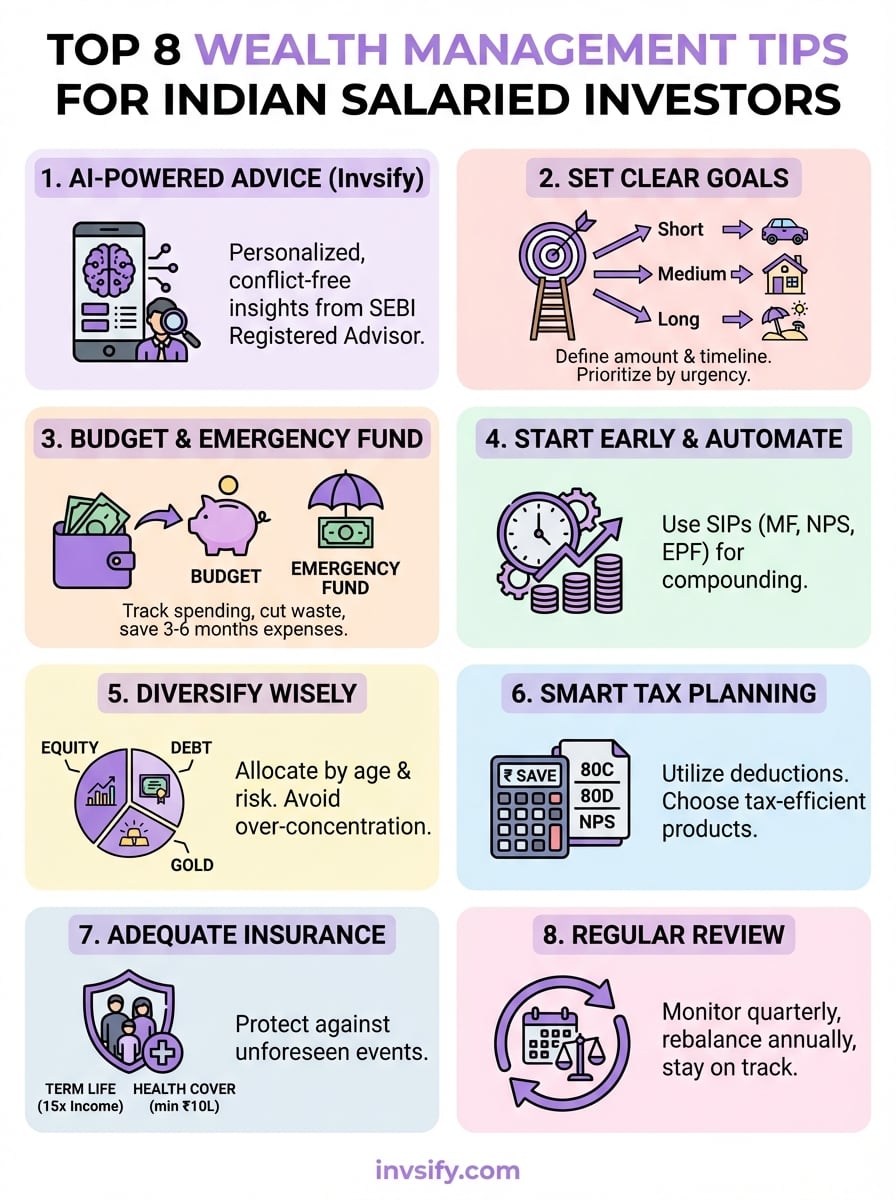
Implementing these eight wealth management tips transforms your salary from monthly income into lasting wealth that supports your family across generations. You now understand how AI powered platforms eliminate conflicts of interest. Clear goals give direction to every rupee you invest. Your budget and emergency fund create stability while automation harnesses compounding without monthly decisions. Diversification protects you from market shocks specific to Indian asset classes. Smart tax planning adds percentage points to returns. Insurance shields everything you build from unexpected catastrophes. Regular reviews keep you aligned with changing life circumstances.
Start with one action today rather than attempting everything simultaneously. Sign up with Invsify to get your personalized Wealth Wellness Score and AI driven recommendations tailored to your salary and goals. Connect your existing investments. Ask the AI chatbot your pressing questions. Review your first weekly insight report. Each small step compounds into financial confidence and real wealth over time. Your future self will thank you for beginning this journey now instead of waiting for the perfect moment that never arrives.