What Is A Portfolio Tracker? Features, Benefits In India
Shlok Sobti

What Is A Portfolio Tracker? Features, Benefits In India
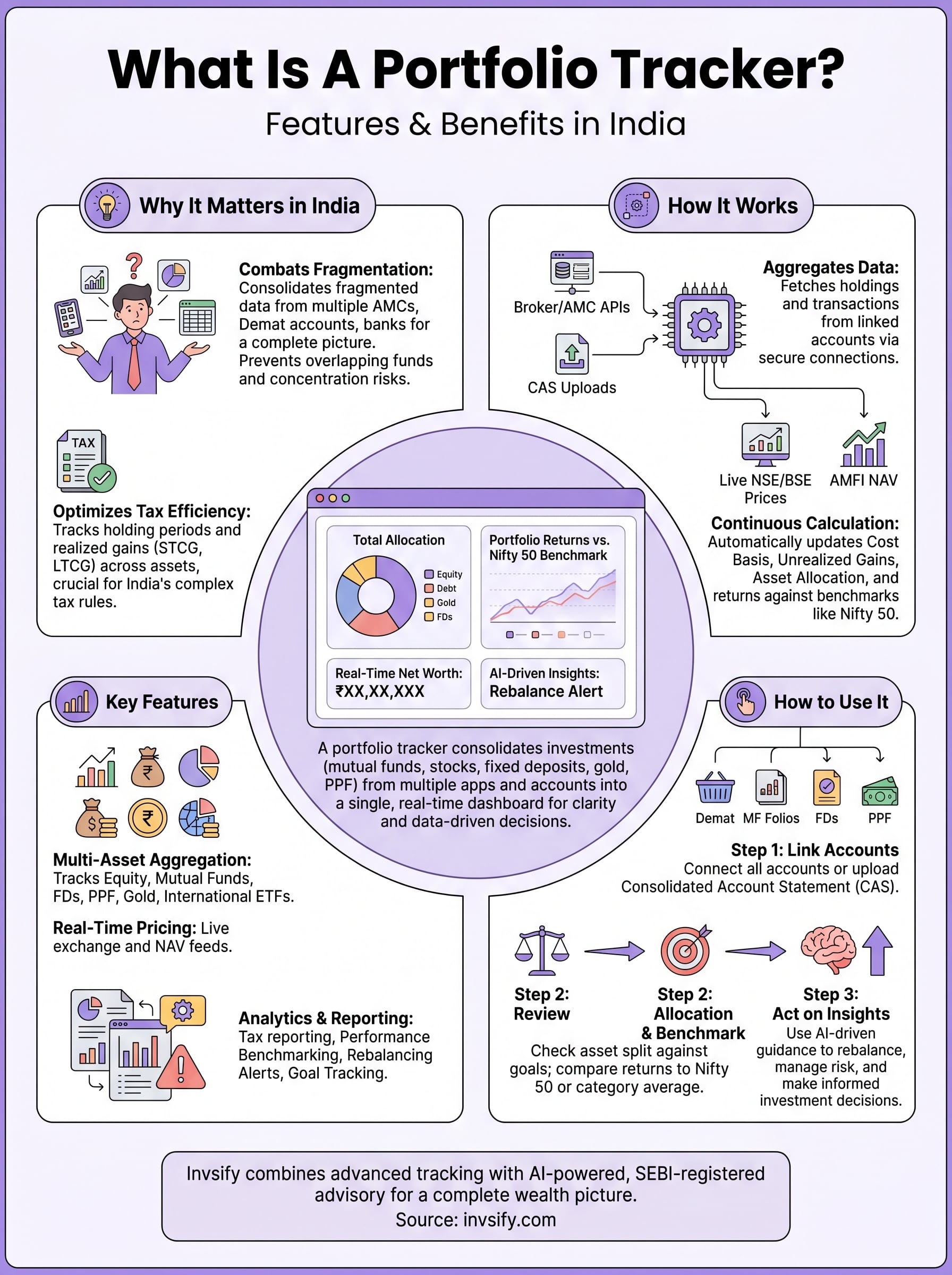
You own mutual funds, stocks, maybe some fixed deposits and gold. But do you actually know how your overall wealth is performing right now? Most Indian investors juggle multiple apps, demat accounts, and spreadsheets to get a fragmented picture. A portfolio tracker solves this by pulling all your investments into a single, real-time dashboard, giving you clarity instead of chaos.
At its core, a portfolio tracker monitors the value, returns, and allocation of every asset you hold. It replaces guesswork with hard numbers. And when paired with AI-driven insights, like what we build at Invsify through our advanced portfolio tracking and real-time advisory, it becomes more than a passive tool. It becomes a decision-making engine.
This article breaks down exactly what a portfolio tracker is, the features that matter, and why it's become essential for Indian investors managing their own wealth.
Why portfolio tracking matters in India
Indian investors today hold wealth across more asset classes than ever before. You might have mutual funds through multiple AMCs, a demat account for equities, PPF or EPF contributions, fixed deposits spread across banks, and perhaps some physical gold on top of that. Without a system to consolidate these, you're making decisions based on incomplete and fragmented information, which costs you real money over time.
When you can't see your full financial picture, you default to gut feel instead of strategy.
The Indian investing landscape is uniquely complex
India's financial market has expanded rapidly. The number of demat accounts in India crossed 180 million in 2024, and retail participation in mutual funds has grown steadily through SIPs. But growth in participation has not always been matched by growth in awareness. Many investors hold overlapping funds, duplicate stock positions, or excessive concentration in a single sector without realizing it, simply because they never see everything in one place.
A portfolio tracker gives you that consolidated view. It lets you spot sector concentration risks, check if your asset allocation still matches your goals, and measure actual returns against benchmarks like the Nifty 50 or a relevant fund category average.
Tax efficiency depends on what you track
In India, tax rules vary significantly by asset class and holding period. Equity gains held under 12 months attract short-term capital gains tax at 20%, while debt fund gains are taxed at your applicable income slab rate. If you're not actively tracking buy dates, cost basis, and realized gains across every holding, you're leaving tax-saving opportunities unused and possibly underestimating your liability come filing season.
How portfolio trackers work
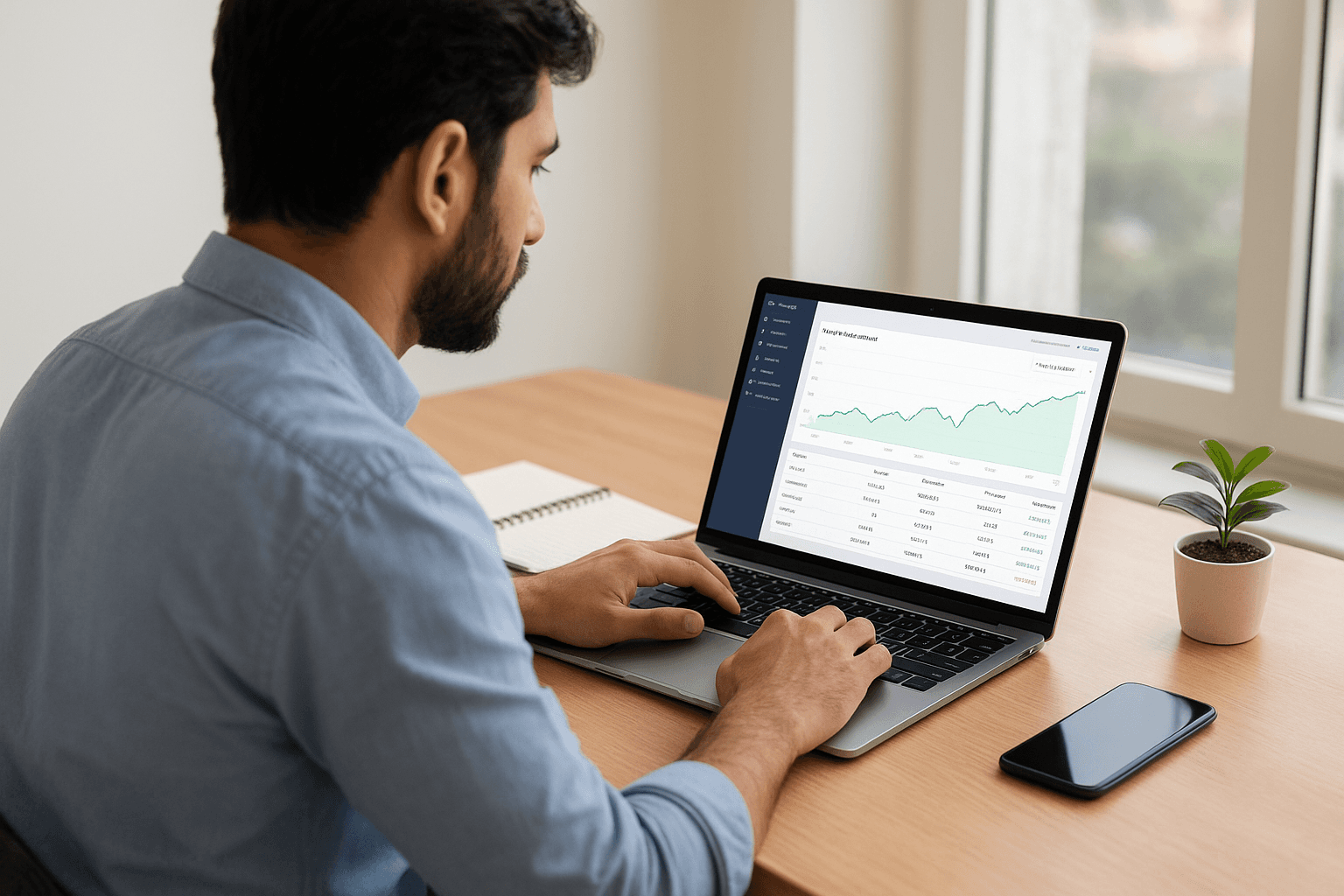
A portfolio tracker works by aggregating data from multiple financial accounts into one view. Most modern trackers connect to your broker, AMC, or depository through secure API integrations or statement uploads, pulling live prices and transaction history automatically. You no longer need to log into five different apps to understand where your money stands.
The moment all your accounts sync, you see your complete financial picture without any manual calculations.
What happens behind the scenes
When you link an account, the tracker fetches your holdings and historical transactions, then maps each asset to its current market price. For mutual funds, it reads NAV data from AMFI. For equities, it pulls live exchange prices from the NSE or BSE. Here is what it calculates continuously:
Cost basis and unrealized gains across every holding
Asset allocation percentages against your target mix
Returns compared against relevant benchmarks like the Nifty 50
How AI takes this further
Basic trackers display data. AI-powered trackers interpret it, flagging issues you might miss entirely on your own. A tracker with an AI advisory layer, like what Invsify provides, goes beyond showing raw numbers.
Your tracker can identify concentration risks and rebalancing opportunities based on your goals and risk profile, turning financial data into clear, actionable guidance you can act on right away.
How to use a portfolio tracker step by step
Getting started with a portfolio tracker is straightforward once you follow the right sequence. You begin by linking your financial accounts and then let the tool handle the aggregation. Most platforms complete the setup through a simple onboarding flow that takes under 15 minutes to finish.
Link your accounts and import your holdings
Your first step is to connect every account you hold, including your demat account, mutual fund folios, and any fixed deposits or PPF contributions you maintain. Many trackers accept a consolidated account statement (CAS) from NSDL or CDSL, which delivers your complete transaction history in a single upload. Once imported, your portfolio data populates automatically, removing the need for any manual entry.
Getting all your accounts linked in one session prevents data gaps from distorting your overall picture.
Review your allocation and set a benchmark
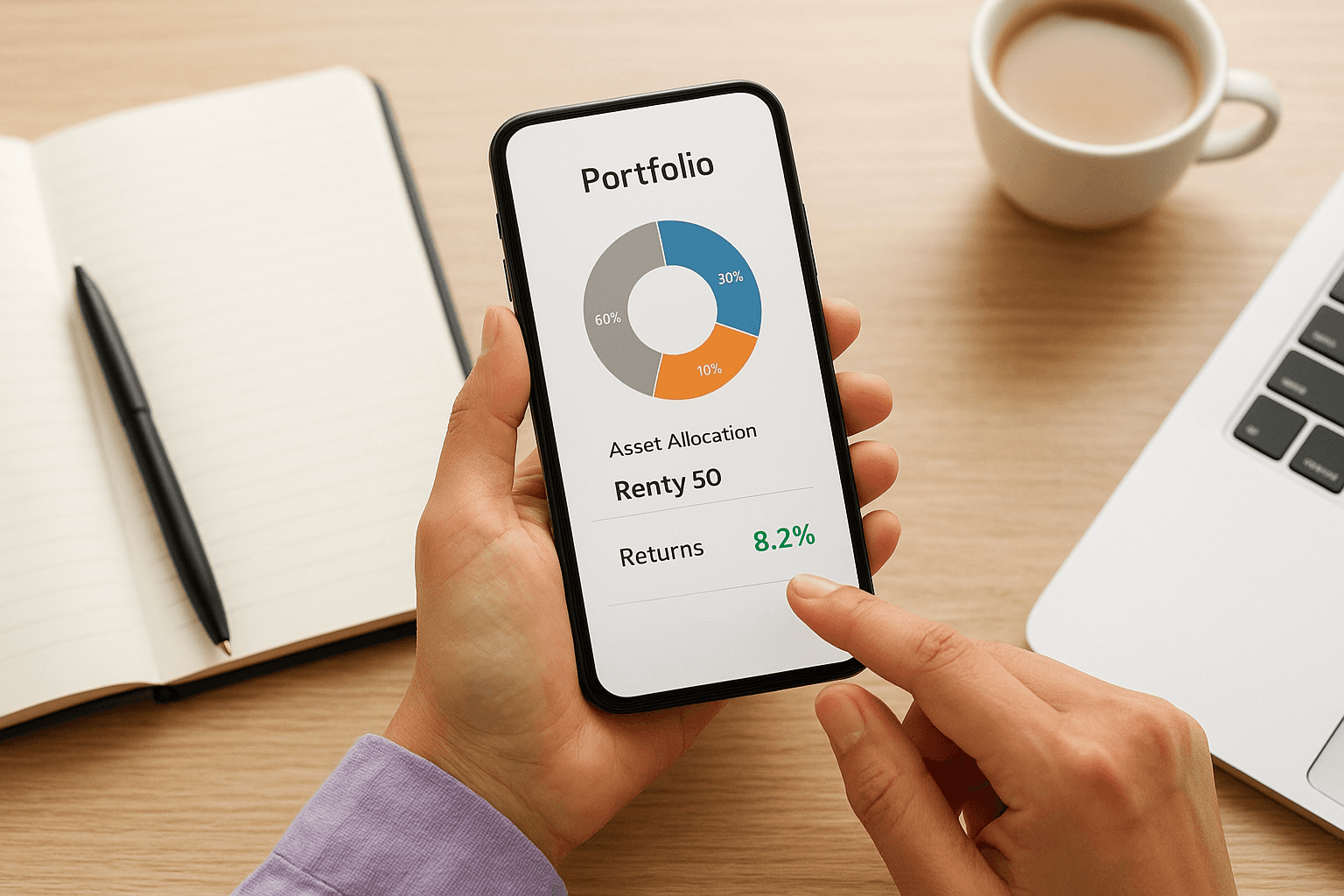
After your holdings load, review your current asset allocation across equity, debt, and other asset classes. Setting a benchmark, like the Nifty 50 for your equity portion, tells you clearly whether your returns are meeting your goals or falling short.
Check if your equity vs. debt split matches your target allocation
Compare returns against the Nifty 50 or a relevant category benchmark
Identify any segment where you hold more concentration risk than intended
Key features to look for in a portfolio tracker
Not every portfolio tracker delivers the same value. When you assess what is a portfolio tracker built for serious investors, the features that matter most come down to data breadth and analytical depth. The right tool handles your complete asset universe, not just equities.
A tracker that only shows your stocks leaves most of your wealth invisible.
Multi-asset aggregation and real-time pricing
Your tracker must consolidate every asset class you hold, including mutual funds, equities, fixed deposits, PPF, and gold. Look for real-time pricing from NSE, BSE, and AMFI NAV feeds so your net worth stays accurate throughout the trading day without requiring any manual updates.
Mutual fund NAV updated daily from AMFI
Live equity prices from NSE and BSE
Fixed income and PPF balances tracked separately
Tax reporting, benchmarking, and rebalancing alerts
Calculating short-term and long-term capital gains separately, with India-specific rules applied automatically, is non-negotiable. This lets you make tax-efficient exit decisions before you sell rather than discovering the liability afterward.
Strong trackers also measure your portfolio performance against relevant benchmarks like the Nifty 50. They send rebalancing alerts when your allocation drifts beyond your set thresholds, keeping your investment plan on track without constant manual monitoring.
How to choose the right portfolio tracker
When evaluating what is a portfolio tracker worth using day-to-day, the decision starts with mapping your current asset mix and checking whether each platform fully supports it. A tracker that handles only equities misses mutual funds, PPF, and fixed deposits entirely, leaving you with a partial and misleading view of your net worth.
The best tracker for you is the one that reflects your full financial picture, not just part of it.
Match the tracker to your asset mix
Before committing to any platform, list every asset class you currently hold and verify the tracker covers all of them. Check whether international ETFs or sovereign gold bonds are included in the base plan or locked behind a premium tier upgrade.
Mutual funds, equities, PPF, and FDs should all be supported
Real-time NAV and live exchange price feeds should come standard
Prioritize security and regulatory compliance
Your financial data is highly sensitive, so the platform must follow strong security standards and operate within India's regulatory framework. Choosing a platform tied to a SEBI-registered advisor gives you an additional layer of accountability that generic tools do not offer.
Look for encrypted data handling and secure API connections
Confirm the platform's regulatory registration before linking any accounts
A Simple Way to Get Started
Understanding what is a portfolio tracker is only useful when you actually start using one. The fastest way to move forward is to pick a platform that covers your full asset mix and get your accounts linked in a single session. Once your holdings are consolidated, you stop guessing and start making decisions grounded in real data.
Invsify combines advanced portfolio tracking with AI-powered, conflict-free advisory from a SEBI-registered advisor. Your wealth gets a complete picture, including your allocation, returns, and tax exposure, and the AI flags what needs your attention without you having to dig for it. You also get personalized weekly insights and a Wealth Wellness Score that tells you exactly where you stand.
If you're ready to see your full financial picture in one place, start tracking your portfolio with Invsify and make every investment decision with clarity.