What Is Total Expense Ratio in Mutual Funds: Costs & Impact
Shlok Sobti
What Is Total Expense Ratio in Mutual Funds: Costs & Impact
Total Expense Ratio tells you how much you pay each year to keep your money invested in a mutual fund. Think of it as the price tag for professional fund management. Every mutual fund charges this fee to cover costs like paying the fund manager, handling paperwork, and running daily operations. The TER gets deducted automatically from your investment returns, so you never see a separate bill. A fund with 1% TER and 12% gross returns gives you 11% after expenses.
This guide breaks down everything you need to know about TER in Indian mutual funds. You'll learn why this number matters more than most investors realize, how to spot it in fund documents, what costs it covers and what it misses, and how to use TER when comparing funds. We'll show you typical TER ranges across different fund categories and answer the most common questions investors ask. By the end, you'll know exactly how expense ratios affect your wealth and how to make smarter choices.
Why total expense ratio matters in mutual funds
TER cuts into your returns every single year you stay invested. The fund house deducts this cost before calculating your NAV, which means you never see the full gross returns the fund generates. When you check your portfolio and see a 10% gain, that number already reflects the TER deduction. Understanding what is total expense ratio in mutual funds helps you grasp why two funds tracking the same index can deliver different returns to investors.
TER directly reduces your actual returns
Your wealth grows slower when you pay higher expense ratios. A fund charging 2% TER takes that amount off your returns annually, which compounds against you over decades. Suppose you invest ₹10 lakh in a fund that earns 12% gross returns. With a 1% TER, you get 11% and end up with ₹67.3 lakh after 20 years. With a 2% TER reducing returns to 10%, you get only ₹60.6 lakh from the same initial investment and market performance. That ₹6.7 lakh difference came purely from the higher expense ratio.
The impact multiplies over longer periods because you lose returns on the money that went to fees. Every rupee paid as TER is a rupee that cannot compound and grow for you. Most investors focus on choosing the right fund category or timing the market, but they ignore the guaranteed cost sitting right in the fund documents.
High expense ratios act as a permanent drag on your portfolio, compounding against you year after year.
Small differences create large wealth gaps
You might think 0.5% difference in TER sounds trivial. Half a percentage point hardly seems worth your attention when markets swing by several percentage points daily. Yet over your investing lifetime, this small gap creates surprisingly large wealth differences. Consider two index funds tracking the Nifty 50. One charges 0.3% TER and the other charges 0.8%. Both track the same index, hold identical stocks, and deliver identical gross returns before fees.

Starting with ₹5 lakh and adding ₹20,000 monthly for 25 years at 12% gross returns, the 0.3% TER fund gives you ₹3.88 crore while the 0.8% TER fund delivers ₹3.54 crore. You lose ₹34 lakh to that 0.5% difference despite investing in functionally identical products. This wealth gap exists purely because of the expense ratio, making it one of the few investing factors you can actually control and predict.
How to read and use TER in mutual funds
You can find the expense ratio printed clearly in every mutual fund's fact sheet and scheme information document. Fund houses publish these documents monthly, and SEBI requires them to display the TER prominently. The number appears as a percentage, typically ranging from 0.10% to 2.25% depending on the fund type and size. When you look at a fund's details on platforms like AMFI or the asset management company's website, you'll spot the TER listed right alongside key metrics like AUM and NAV.
Understanding what is total expense ratio in mutual funds helps you use this number effectively when selecting investments. The TER alone never tells the complete story about a fund's value, but it serves as a critical filter in your decision process. You need to combine expense ratio analysis with performance history, fund manager track record, and your own investment goals.
Find TER in official fund documents
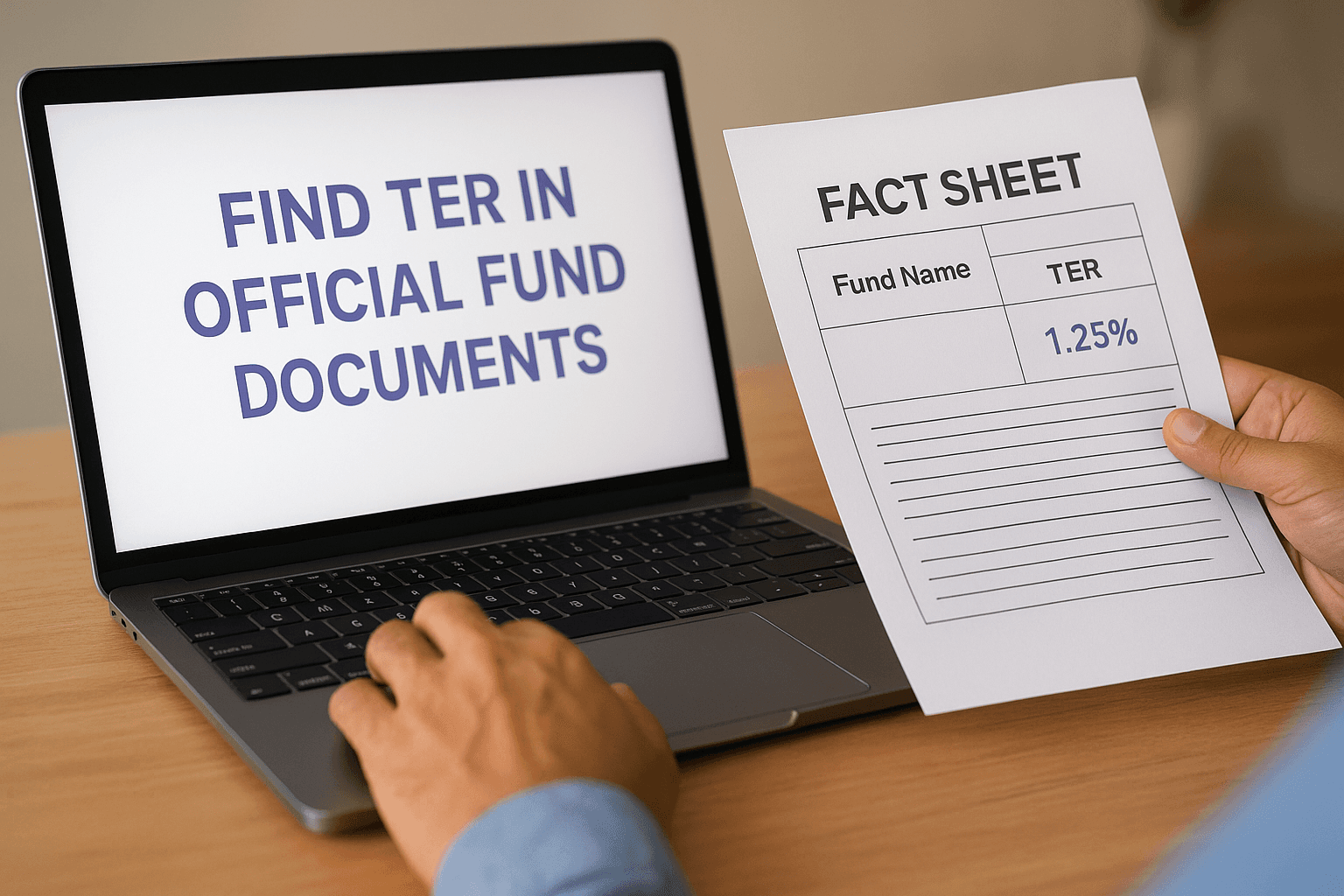
Every mutual fund publishes a monthly fact sheet that lists the current TER near the top or in the fund details section. You can download this PDF from the AMC's website or check it on the AMFI portal. The scheme information document, which you receive before investing, also displays the maximum TER the fund can charge. Fund aggregator platforms show TER alongside each scheme when you browse mutual funds, making comparison easy.
Check both the regular plan TER and direct plan TER if you're comparing options. Direct plans skip distributor commissions and typically charge 0.5% to 1% lower expense ratios than regular plans of the same fund. This difference alone can justify choosing direct plans for most investors.
Compare TER only within the same category
Comparing a debt fund's 0.4% TER against an equity fund's 1.2% TER makes no sense. Different fund categories carry different operational costs because of how they function. Passive funds tracking indices charge much lower TERs (often below 0.5%) than actively managed funds that require research teams and frequent trading. International funds typically charge higher TERs than domestic funds due to added complexity.
Focus your TER comparison on funds within the same category. When you evaluate large cap equity funds, compare their expense ratios against other large cap funds. When you look at gilt funds, stack them against competing gilt funds. This apples to apples comparison reveals which funds deliver better value within their category.
Comparing expense ratios across different fund categories leads to misleading conclusions about value.
Balance TER against actual performance
A fund charging 1.5% TER but consistently delivering 2% above category average gives you better outcomes than a fund charging 0.8% TER while trailing its peers. You pay for fund management because you expect the manager to add value through security selection and market timing. Calculate the net returns after expenses, not just the gross returns or TER in isolation.
Look at three to five year rolling returns after accounting for the expense ratio. Some funds justify higher costs through superior performance. Others charge premium rates while delivering below average results. Your goal is finding funds that maximize net returns in your pocket, which means weighing both costs and performance together.
How TER is calculated and deducted in India
Fund houses calculate and deduct TER every single day, not once per year. This daily deduction happens automatically before they publish the Net Asset Value (NAV) you see on investment platforms. When you check what is total expense ratio in mutual funds and see a number like 1.2%, that represents the annual percentage, but the fund applies it proportionally each day. You never receive a bill or see a separate transaction for this fee because it gets baked into your daily NAV calculation.
The daily deduction formula
The fund house divides the annual TER by 365 to get the daily expense rate. They then multiply this daily rate by the fund's Assets Under Management (AUM) to arrive at the rupee amount deducted that day. The formula looks like this: Daily TER = (Annual TER / 365) × AUM. For example, a fund with ₹1,000 crore AUM and 2% annual TER deducts approximately ₹5.48 lakh each day (2% of ₹1,000 crore divided by 365 days).
Your investment gets impacted because this daily deduction reduces the total pool of assets. When the fund's holdings generate returns, those returns first get reduced by the daily TER before the NAV calculation happens. This means you automatically receive net returns with expenses already subtracted.
Automatic deduction from NAV
You can never separate the expense ratio from your returns because the fund applies it before calculating each day's NAV. Suppose a fund's holdings grow by 0.08% on a particular day. If the daily TER equals 0.0055% (roughly 2% annually), the NAV only increases by 0.0745% that day. The TER gets subtracted from gross returns continuously, which means you see only the net performance in your portfolio statements and app dashboards.
This automatic process protects fund houses from collection difficulties while ensuring consistent fee recovery. You cannot opt out or negotiate this deduction because it forms part of the fund's legal structure approved by SEBI.
The NAV you see already reflects all expense ratio deductions, giving you the true net value of your investment.
SEBI limits on TER
Indian regulations cap how much funds can charge based on their category and AUM size. Equity funds can charge up to 2.25% for the first ₹500 crore of assets, dropping to 1.05% for assets above ₹50,000 crore. Debt funds face slightly lower limits, starting at 2% and dropping to 0.8% for large funds. These slabs create a declining scale where bigger funds charge lower percentage fees because they spread fixed costs across more assets.
The regulations also permit an additional 0.3% charge if the fund attracts at least 30% of new inflows from investors in smaller cities (beyond the top 30 urban centers). Index funds and ETFs face stricter caps, typically limited to 1% maximum TER regardless of fund size.
Funds disclose their actual TER daily on their websites and through AMFI. Most funds charge less than the regulatory maximum, particularly in competitive categories where lower costs attract more investors.
What TER includes and what it leaves out
TER captures most of the recurring operational costs a fund incurs, but several significant expenses fall outside this ratio. Understanding what is total expense ratio in mutual funds requires knowing both what gets included and what remains hidden from this single number. The expense ratio covers everyday fund operations but excludes transaction-specific costs that you still pay indirectly. This distinction matters because looking only at TER gives you an incomplete picture of your total investing costs.
Costs covered by TER
The fund manager's salary and research team expenses form the largest component of TER, typically consuming 0.5% to 1.5% of the ratio. Asset management companies need skilled professionals to analyze securities, build portfolios, and execute the fund's strategy. Administrative costs including record keeping, regulatory compliance, legal fees, and audit charges also get bundled into TER. These operational necessities keep the fund running smoothly and meeting SEBI requirements.
Distribution expenses appear in regular plan TERs but not in direct plans. When you invest through a distributor or broker, the fund pays them commission for bringing your business, and this cost gets added to your expense ratio. Registrar and transfer agent fees for maintaining investor records, processing transactions, and sending statements contribute smaller amounts. Marketing and communication costs that funds spend on investor education and scheme promotion round out the TER components.
TER covers the predictable, recurring costs of running a fund but misses the variable expenses tied to actual trading.
Costs excluded from TER
Brokerage charges and transaction costs remain outside the TER calculation despite directly impacting your returns. Every time the fund manager buys or sells securities, the fund pays brokerage fees, exchange charges, and bid-ask spreads. These costs get deducted from the fund's assets but never appear in the published expense ratio. Actively managed funds that trade frequently can rack up significant transaction costs that substantially reduce net returns beyond what TER suggests.
Exit loads hit you directly when you redeem units before a specified holding period. Many equity funds charge 1% if you exit within one year, and this fee goes entirely outside TER. Securities transaction tax applies when funds buy or sell equity shares, adding another layer of cost. Tax implications on your gains, including capital gains tax, remain completely separate from fund expenses. Transaction charges that platforms or brokers may levy for processing your mutual fund orders create additional costs that fall outside the expense ratio umbrella.
Typical TER ranges and benchmarks in India
Understanding what is total expense ratio in mutual funds becomes practical when you know what different fund categories typically charge. Indian mutual funds show wide expense variations based on fund type, management style, and asset size. You can use these benchmarks as reference points when evaluating whether a specific fund charges reasonable fees for its category. Market leaders in each segment often price their TERs competitively to attract investors, creating informal standards that others follow.
Index funds and ETFs maintain lowest TERs
Passive funds tracking indices charge the lowest expense ratios in India, typically ranging from 0.05% to 0.50%. Large Nifty 50 and Sensex index funds from major fund houses often price themselves between 0.10% and 0.30%, with direct plans at the lower end. ETFs tracking the same indices sometimes go even lower, with some charging just 0.05%. These minimal costs reflect the simple strategy of replicating an index rather than picking individual stocks.
International index funds cost slightly more, usually 0.30% to 0.80%, because they involve foreign exchange management and regulatory complexities. Gold ETFs and other commodity ETFs typically charge between 0.50% and 1% annually.
Actively managed equity funds charge more
Equity mutual funds where managers actively select stocks charge substantially higher TERs, ranging from 0.80% to 2.25% depending on fund size. Large cap funds with substantial AUM often charge 1.00% to 1.50%, while mid cap and small cap funds demanding more research effort push toward 1.50% to 2.00%. Sectoral and thematic funds frequently hit the upper limits because they require specialized expertise.

Active equity funds justify higher TERs through their potential to outperform passive benchmarks, though not all succeed.
Direct plans consistently price 0.50% to 1% below regular plans since they skip distributor commissions.
Debt funds fall in the middle range
Debt mutual funds charge lower TERs than equity funds, typically spanning 0.30% to 1.50% across categories. Liquid funds and ultra short duration funds often charge 0.30% to 0.60% because they hold simple, high quality debt. Corporate bond funds and credit risk funds that need deeper credit analysis charge 0.75% to 1.25%. Gilt funds investing only in government securities usually stay within 0.50% to 1.00% range.
Dynamic bond funds requiring active duration management sometimes push higher, reaching 1.00% to 1.50%. Fund size plays a major role in debt fund TERs, with larger funds spreading fixed costs across bigger asset bases and charging proportionally less.
Common questions about TER in mutual funds
Investors frequently ask about expense ratios when comparing funds because these costs directly affect their wealth accumulation. You need clear answers to make informed decisions about what is total expense ratio in mutual funds and how it impacts your specific situation. The questions below address the most common confusion points that come up during fund selection and portfolio review.
Does higher TER guarantee better fund management?
Higher expense ratios create no automatic link to superior performance. Some funds charge premium rates while delivering mediocre returns, whereas others maintain low costs and consistently outperform their benchmarks. The TER primarily reflects the fund house's cost structure and management style rather than the quality of investment decisions. You should evaluate actual net returns over multiple market cycles instead of assuming expensive funds offer better expertise.
Actively managed funds naturally charge more than passive funds, but this difference only makes sense when the active manager generates enough extra returns to overcome the higher costs. Research teams, sophisticated analysis tools, and frequent portfolio adjustments all cost money, yet not every active fund successfully converts these resources into better investor outcomes.
Can fund houses change TER after you invest?
Fund houses possess the ability to modify TER within SEBI limits without seeking your explicit approval for each change. They must disclose any modifications through updated fact sheets and scheme documents, but you won't receive individual notifications about small adjustments. Most TER changes happen gradually as the fund's AUM grows or shrinks, triggering different regulatory slab rates.
Your expense ratio typically decreases as the fund attracts more assets, spreading fixed costs across a larger base.
Fund houses occasionally reduce TERs voluntarily to stay competitive when rival funds lower their charges. Sharp increases are rare because they require justification and tend to drive investors away. You can monitor TER changes by checking monthly fact sheets or setting up alerts through investment platforms.
Should you automatically choose funds with lowest TER?
Cost matters enormously, but the cheapest fund in a category sometimes delivers worse outcomes than moderately priced alternatives. You need to weigh expense ratios against historical performance, fund manager tenure, portfolio quality, and investment strategy consistency. A fund charging 0.40% TER but trailing its benchmark by 1% annually gives you worse results than a fund charging 0.80% while beating the benchmark by 1.5%.
Index funds represent the main exception where lowest TER almost always wins because all funds in the category hold identical securities and target identical returns. The fund with minimal costs delivers maximum net returns to investors. Active funds require more nuanced evaluation since management skill can justify higher expenses when it produces superior risk-adjusted returns.
Key takeaways on TER
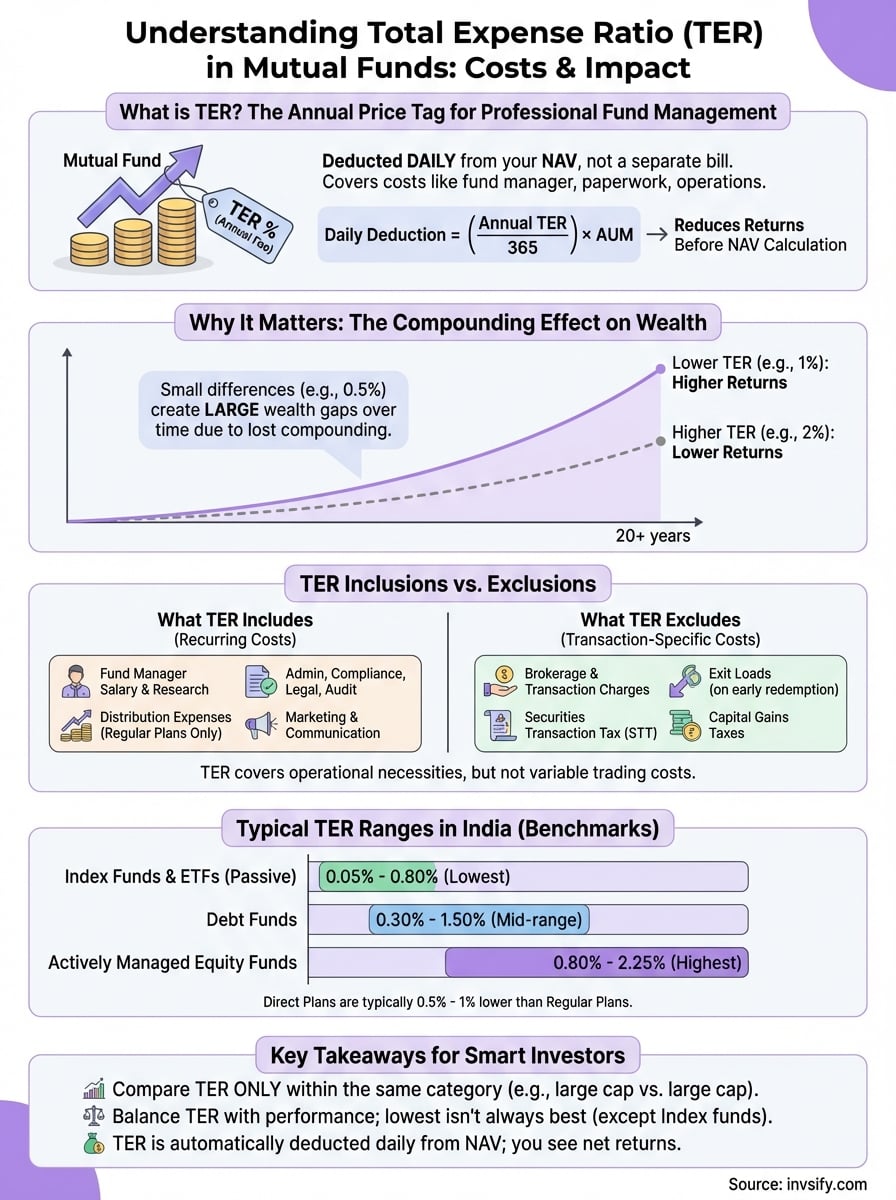
Understanding what is total expense ratio in mutual funds empowers you to keep more of your investment returns over time. TER gets deducted daily from your fund's NAV, reducing your wealth automatically before you see any performance numbers. You should compare expense ratios strictly within the same fund category, balance costs against actual net performance, and remember that passive funds charge far less than actively managed alternatives. Direct plans save you 0.5% to 1% annually compared to regular plans from the same fund house, with zero difference in portfolio or strategy.
Smart investors track TER alongside historical returns when building diversified portfolios. Start building wealth with AI-powered investment guidance that helps you select cost-efficient funds aligned with your financial goals.