How To Start Online Investing In India: A Step-By-Step Guide
Shlok Sobti
How To Start Online Investing In India: A Step-By-Step Guide
If you've been sitting on savings that barely beat inflation in a bank account, you've probably already wondered how to start online investing. The good news: it's never been more accessible. With a smartphone, a PAN card, and a few hundred rupees, you can open an account and buy your first investment within a day. No branch visits, no paperwork piles, no middlemen taking a cut you didn't agree to.
But accessible doesn't mean simple. Between Demat accounts, trading platforms, KYC verification, and choosing the right assets, the process can feel overwhelming, especially when every app claims to be the best place to start. Making uninformed decisions early on can cost you real money through hidden fees, poor fund choices, or unnecessary risk.
That's exactly why we built Invsify, a SEBI Registered Investment Advisor that combines AI-powered guidance with transparent, conflict-free advice to help you invest smarter from day one. This guide walks you through every step of starting your online investing journey in India, from picking the right platform to placing your first order, so you can move forward with clarity instead of confusion.
Before you start: accounts, risks, and basics
Before you figure out how to start online investing, you need to understand the infrastructure behind it. Investing in India through an online platform requires specific accounts that work together as a system, and skipping this setup correctly will cost you time and cause failed transactions later. Getting the foundation right typically takes one to three business days, but it saves you from regulatory headaches and account errors that slow down most beginners.
The three accounts every Indian investor needs
Every online investor in India operates through three linked accounts. Each plays a distinct role, and you cannot trade stocks, ETFs, or bonds on a stock exchange without all three in place and connected.
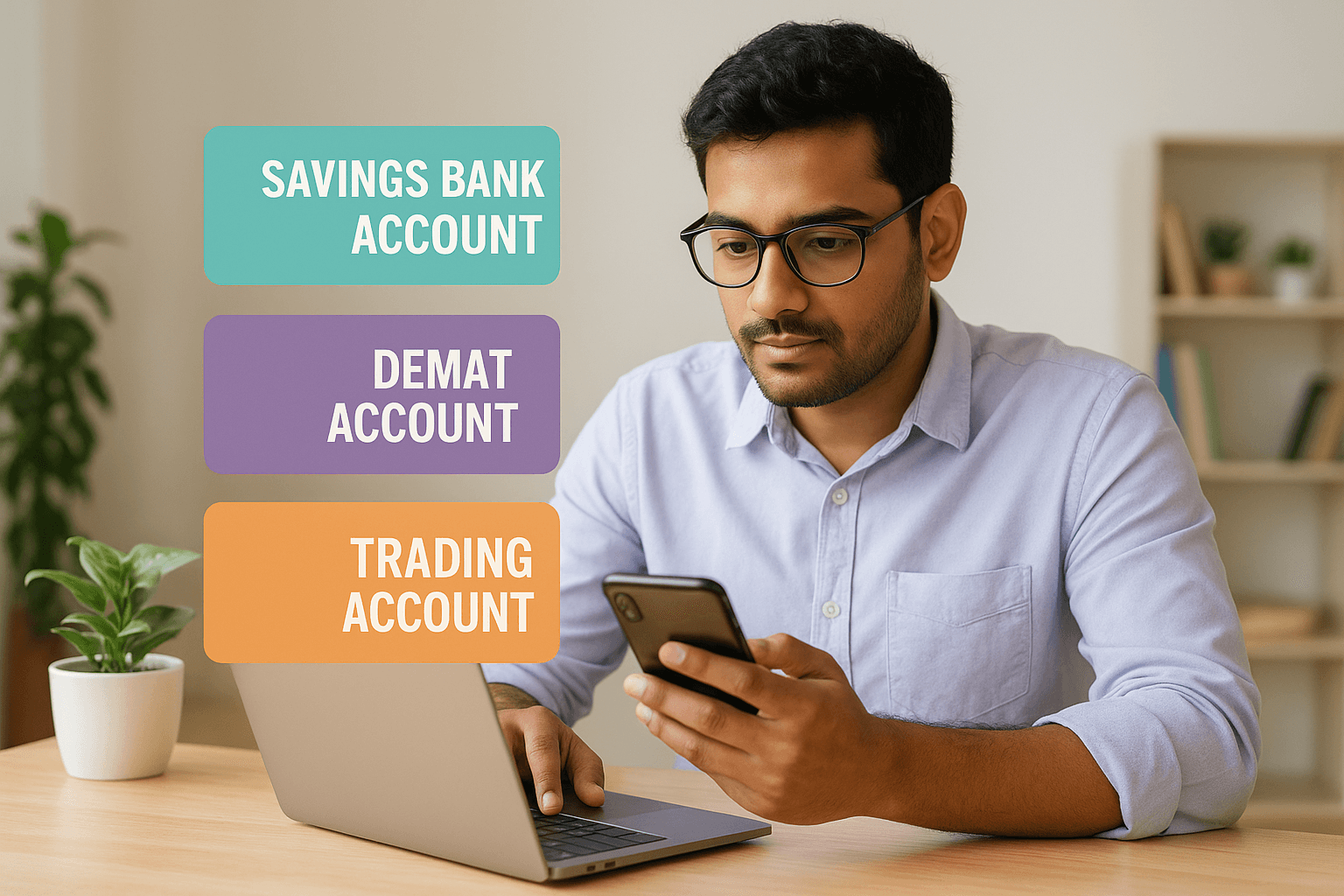
Account | What it does | Who provides it |
|---|---|---|
Savings bank account | Funds your investments and receives returns | Your bank |
Demat account | Holds your securities in electronic form | SEBI-registered depository participant |
Trading account | Executes buy and sell orders on the exchange | Your broker |
Your savings account links to your trading account through a bank mandate setup, which authorizes automatic fund transfers when you place an order. Your Demat account and trading account are usually opened together through the same broker, but they remain technically separate entities. One important exception: if you plan to invest only in direct mutual funds, you can skip the trading account entirely and use a mutual fund platform or a SEBI-registered investment advisor directly, which simplifies the process considerably.
Most beginners confuse the Demat account with the trading account. Your trading account is where orders are placed; your Demat account is where your holdings are stored.
Understanding risk before your first trade
Risk in investing goes well beyond the possibility of losing money. It includes liquidity risk (not being able to access cash when you need it), concentration risk (holding too much in a single stock or sector), and platform risk (using unregulated apps that offer no investor protection). Recognizing these risks before your first transaction puts you in a far stronger position than someone who learns them after a loss.
Regulatory protection is your first line of defense. SEBI (Securities and Exchange Board of India) regulates brokers, depositories, and investment advisors, which means using registered platforms gives you legal recourse if a dispute arises. You can verify any broker or advisor on the SEBI official website. Starting with a small capital amount, such as Rs. 500 to Rs. 5,000, while you learn how the mechanics work is a practical strategy: it limits your downside during the learning curve without keeping you on the sidelines indefinitely.
Step 1. Set goals and pick your risk level
Most people approach how to start online investing by jumping straight to picking funds or stocks without knowing what they're actually investing for. That is a mistake. Your goals determine your time horizon, and your time horizon directly shapes which asset classes make sense for you. A 24-year-old building retirement wealth over 30 years can absorb far more short-term volatility than a 42-year-old saving for a child's college fees due in three years.
Define your financial goals
Your goals need to be specific and time-bound to translate into a workable investment plan. Vague intentions like "grow my wealth" don't help you decide between equity mutual funds and liquid funds. Breaking your goals into three time buckets gives you an immediate, usable framework.
Time Horizon | Duration | Suitable Asset Types |
|---|---|---|
Short-term | 0-3 years | Liquid funds, short-duration debt funds |
Medium-term | 3-7 years | Hybrid mutual funds, index funds |
Long-term | 7+ years | Equity mutual funds, direct stocks, NPS |
Assess your risk tolerance
Risk tolerance describes how much portfolio loss you can handle without making panic-driven decisions. Two factors shape it: your financial capacity to absorb a loss without affecting your lifestyle, and your psychological comfort with watching your balance drop during a market correction. Both factors carry equal weight.
Honest self-assessment here prevents the most common early investing mistake: choosing high-return assets because the numbers look attractive, then selling during a dip and locking in a real loss.
Try this exercise: imagine your Rs. 1,00,000 portfolio drops to Rs. 70,000 within six months. Would you hold, add more, or sell? If your instinct is to sell, you belong in a lower-risk allocation, regardless of what your target returns look like. Build your portfolio around how you will actually behave under pressure, not how you hope you would.
Step 2. Choose a SEBI-registered platform
Choosing where to invest matters as much as deciding what to invest in. Unregistered platforms carry real legal risk, and some charge fees that quietly eliminate your returns before you notice them. When you are working through how to start online investing, the registration status of your platform is non-negotiable: verify it on the SEBI website before you hand over any personal or financial data.
What to check before registering
Before you create an account, run through a short verification checklist. You can search for any broker or advisor on the SEBI official portal using their name or registration number.
SEBI registration number: Should be displayed on the platform's website, typically in the footer
Type of registration: Check whether they are registered as a stockbroker, depository participant, or Registered Investment Advisor (RIA)
Fee structure: Look for a clear, published fee schedule with no commissions on product sales
Investor charter: SEBI requires registered intermediaries to publish this document for transparency
If a platform cannot show you its SEBI registration certificate on demand, treat that as a firm reason to walk away.
Key platform types available in India
Not every platform suits every investor. Your goal and time horizon from Step 1 should drive this choice directly.
Platform Type | Best For | Key Feature |
|---|---|---|
Full-service broker | Active traders needing research | Research reports, advisory calls |
Discount broker | Cost-conscious self-directed investors | Low flat fees, basic charting |
Mutual fund platform | Beginners focused on SIPs | Direct plan access, goal tracking |
SEBI-registered RIA | Investors wanting conflict-free advice | Personalized plans, no product commissions |
Discount brokers charge lower transaction fees, but they rarely provide personalized guidance. A SEBI-registered investment advisor, by contrast, earns from advisory fees rather than product commissions, which removes the conflict of interest that often pushes traditional advisors toward recommending unsuitable products to you.
Step 3. Open your Demat and trading accounts
Once you have chosen a SEBI-registered platform, opening your Demat and trading accounts is the most process-heavy step in how to start online investing. Most brokers now offer a fully paperless KYC process that you complete online through Aadhaar-based verification, and the entire setup takes between 15 and 30 minutes if your documents are ready beforehand.
Documents you need before you start
Gathering your documents before you begin prevents the process from stalling partway through. Incomplete submissions are the single most common reason account approvals get delayed by one to three business days.
Keep these ready in digital format (clear photos or scanned PDFs):
PAN card: mandatory for all investment accounts in India
Aadhaar card: required for Aadhaar-based e-KYC verification
Cancelled cheque or bank passbook front page: links your bank account to the trading account
Passport-size photograph: needed by most brokers during the application
Signature on white paper: scanned or photographed clearly
Your PAN and Aadhaar must be linked before you apply; unlinked accounts will fail e-KYC verification and delay your approval by several days.
The account opening process, step by step
The actual registration follows a predictable sequence across most SEBI-registered brokers and platforms. Follow these steps in order:

Visit your chosen platform's website and click "Open Account" or its equivalent
Enter your mobile number and verify via OTP
Enter your PAN number and complete basic personal details
Complete Aadhaar-based e-KYC: your Aadhaar is verified via OTP sent to your Aadhaar-linked mobile
Upload your documents (cancelled cheque, photograph, signature)
Complete the In-Person Verification (IPV): a short live video call or selfie video, as required by SEBI
Sign the account opening form digitally using an OTP or Aadhaar e-sign
Wait for broker approval, which typically takes one to two business days
Once approved, you receive your Demat account number (BO ID) and trading credentials by email or SMS.
Step 4. Make your first online investment
Your accounts are active and your funds are transferred. This is where how to start online investing moves from setup into real action. Your first investment does not need to be large or complex. A single SIP of Rs. 500 in an index fund is a legitimate, functional first investment that puts the mechanics in motion and builds the habit of regular investing without unnecessary risk.
Choose your first asset
For most beginners, index mutual funds or large-cap equity funds offer the lowest complexity with the broadest market exposure. They do not require you to pick individual stocks, and their expense ratios are significantly lower in direct plans compared to regular plans. Starting here gives you market participation without concentrated single-stock risk.
Investor Profile | Suggested First Asset | Why It Works |
|---|---|---|
Conservative | Liquid fund or short-duration debt fund | Stable returns, low volatility |
Moderate | Large-cap or Nifty 50 index fund | Diversified, low-cost equity exposure |
Aggressive | Multi-cap or flexi-cap equity fund | Higher growth potential over 7+ years |
Place your first order
Once you have selected your fund or asset, the order process on most platforms takes under three minutes if you follow the steps in sequence.
Log in to your trading or investment platform
Search for the fund name or ticker symbol
Select "Direct Plan" for mutual funds to avoid distributor commissions
Choose "SIP" for monthly contributions or "Lumpsum" for a one-time investment
Enter the amount and confirm payment through your linked bank account or UPI
Save the transaction confirmation number from your email or the platform dashboard
Starting with a SIP rather than a lumpsum protects you from buying a large position right before a short-term market correction.
After your first order processes, check your Demat account holdings within two business days to confirm the units are credited correctly.
Next steps
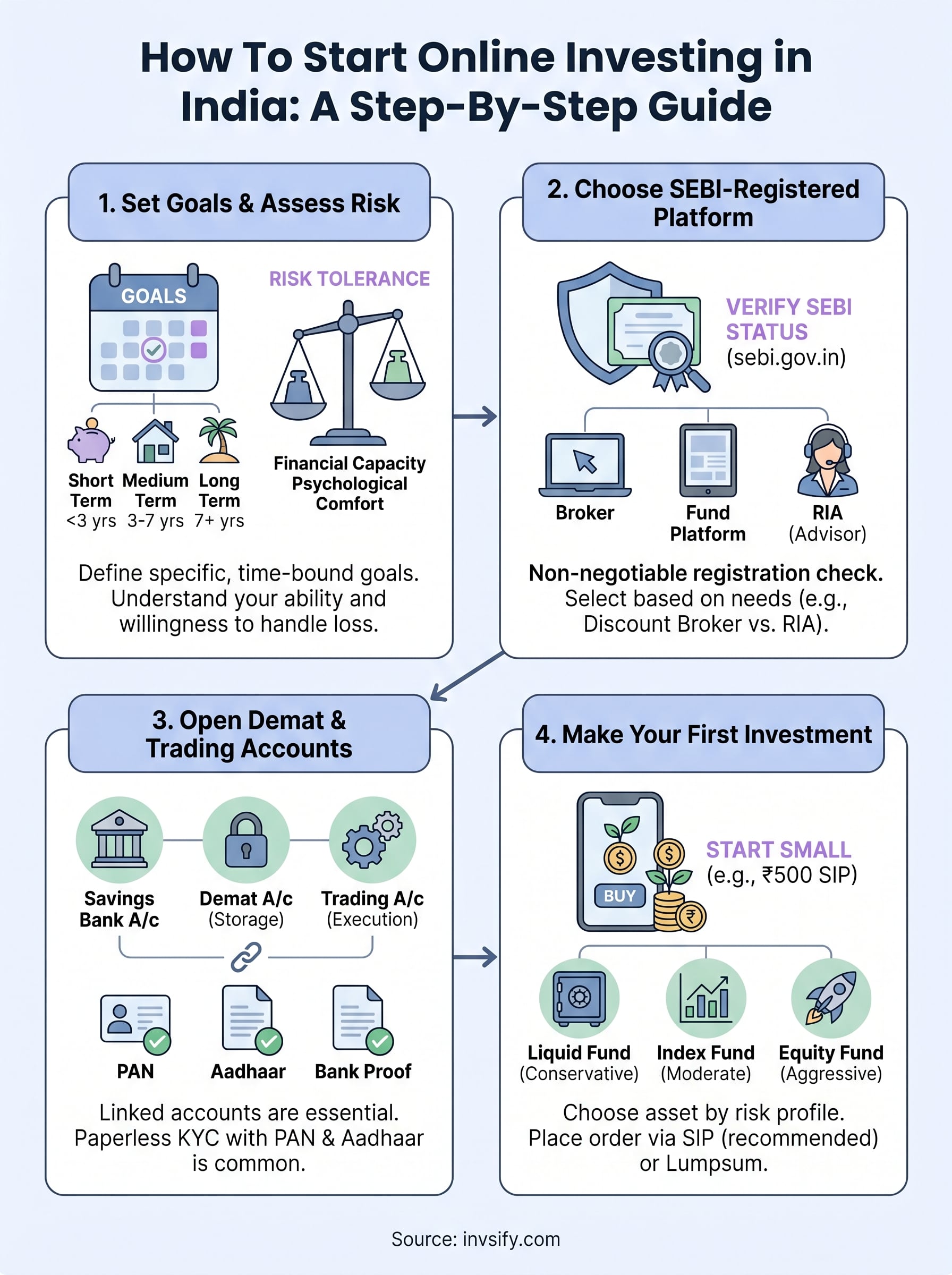
You now have a complete picture of how to start online investing in India, from setting up your accounts to placing your first order. The process is straightforward when you follow the steps in sequence: define your goals, assess your risk tolerance, choose a SEBI-registered platform, open your Demat and trading accounts, and make your first investment. Each step builds directly on the previous one, so skipping ahead creates gaps that cost you time and money later.
Starting is the hardest part, and keeping your investment strategy on track after that requires ongoing, conflict-free guidance rather than guesswork from online forums. Invsify combines AI-powered insights with the credibility of a SEBI Registered Investment Advisor to give you personalized recommendations without hidden commissions. You get a Wealth Wellness Score, real-time portfolio tracking, and 24/7 multilingual support, all in one place. Start building your portfolio with Invsify today.